


On October 7, Dor Almog lost his best friend, Amit Magnezi, who was murdered at the Nova music festival. He then insisted on reporting for reserve duty and fought in Gaza until he was critically wounded in the January 2024 building collapse in al-Mawasi.
Of the 22 soldiers who entered the building, Almog was the only one to survive. Despite the pain and the severity of his injuries, he found a way not only to rehabilitate himself, but also to fulfill a dream. "That was the first time I said no to something like that," Almog recalled of Magnezi’s invitation on October 6 to join him at the Nova festival.
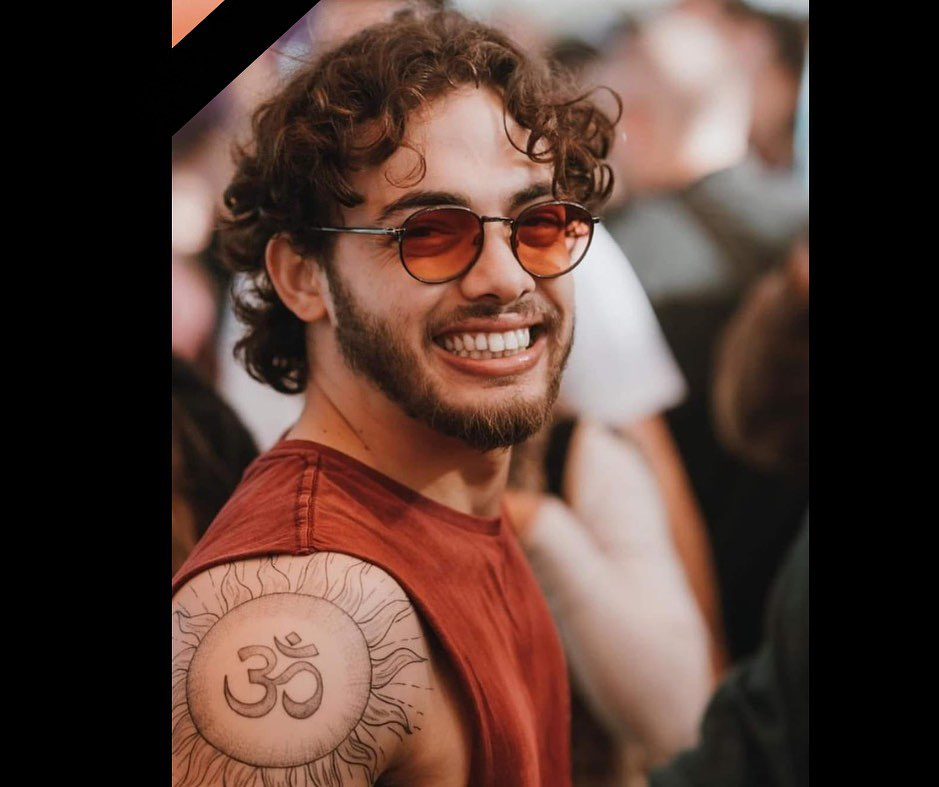
Almog had recently completed his service as a fighter in the Givati Brigade and had begun a course in the From Combat to High-Tech program. He turned down the invitation because he had an important exam. When he woke on Saturday morning, he learned of the massacre.
"I saw on TV that there had been a party. They did not know how many people had been killed or what could be said. I went to Amit’s mother trying to figure out what was happening," he recalled. Only later that week did they receive the worst possible news: Amit had been murdered.
That same Saturday, Almog decided he would insist on joining the reserves and taking part in the fighting. "Staying home was not an option for me. I had to be doing something," he said.
He joined a newly formed team of reservists and fought alongside them in Gaza. "I looked at them with admiration. They had put their entire lives on hold to fight for other people and defend places far from home. Seeing that kind of commitment was extraordinary," he said.
The force fought in Gaza until January 22, 2024, when it took part in an operation in al-Mawasi. Twenty-two soldiers entered a booby-trapped building that exploded and collapsed. Twenty-one were killed. Almog was the sole survivor.
"There was a massive explosion, and everything went white," he recalled. "I felt Amit Magnezi, my friend who was murdered at Nova, with me. I went in because of him, and I made it back because of him." He said thoughts of Magnezi helped him find the strength to crawl out.
That terrifying moment also connected him to the mixed martial arts training he had practiced before the war. "I knew I wasn’t freezing or fleeing. I was fighting," he said. "My MMA background had taught me how to function in extreme situations and respond under intense pressure."
"After the explosion, I could have closed my eyes, wished for it all to end and escaped the hell around me. But the moment I drew my first breath, with soot choking me, I realized I was still alive. I saw the opening left by the RPG and thought: Either I burn to death or I suffocate. So I used my legs, my arms and whatever else still worked, and crawled out."
Almog was evacuated to Soroka Medical Center, where he was sedated and placed on a ventilator for five days. "When I woke up, I asked, 'Where are my friends?' Nobody knew how to tell me," he said.
A week after the disaster, Almog’s commander and fellow soldiers gathered around his hospital bed. "He read the names to me one by one. Fourteen were friends from the platoon, five of them were from the reconnaissance unit and two were from the Armored Corps," Almog said. "That was when the rehabilitation process really began. I realized that I had been given my life as a gift, and that if I collapsed too, then instead of 21 fallen soldiers, there would have been 22."
‘Returning to myself’
In the corridors of Sheba Medical Center’s Returning to Life rehabilitation department, Almog met Sagi Dovev, who had left his role as a combat instructor with the IDF’s elite Sayeret Matkal unit about a year and a half earlier. When the war began, he came to the hospital to meet wounded members of the unit.
"I began doing what I do best, which is training people and building resilience through combat," Dovev said.
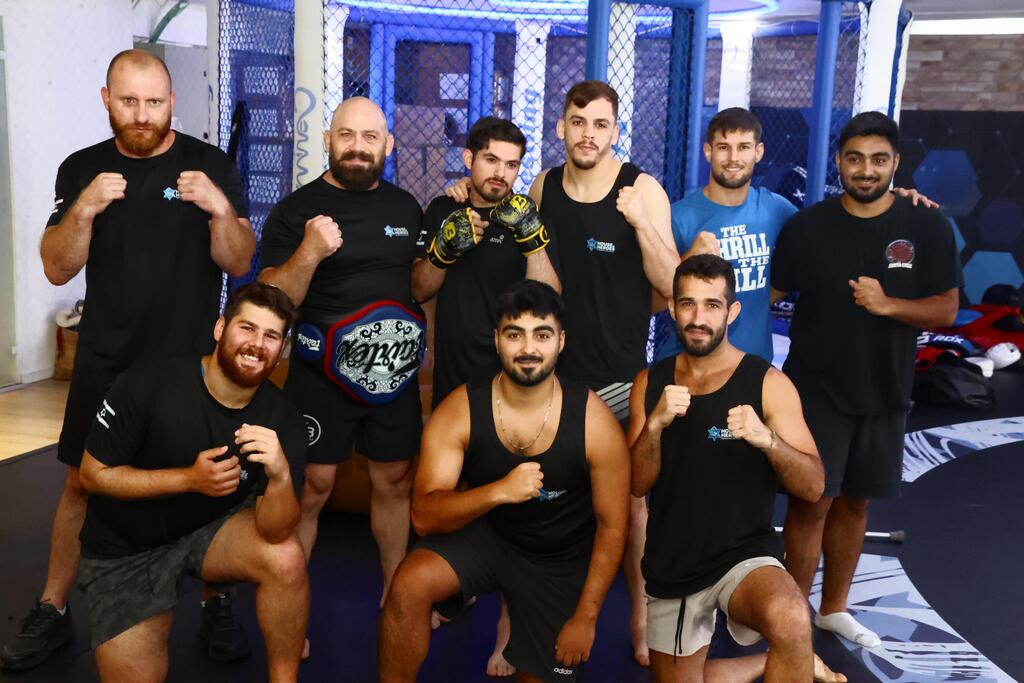
‘Building resilience through combat.’ Sagi Dovev (second from left, second row) and Dor Almog (center, front row) with other fighters set to compete at Menora Arena
(Photo: Moti Kimchi)
Fighters from other units later joined the training sessions, along with female soldiers and former hostages abducted on October 7.
From the time they met, Almog and Dovev steadily built a rigorous training routine. "The feeling is that I am simply returning to myself, to my motor skills, my movement and my angles. I really missed it," Almog said. "He brought back my fighting spirit," recalling their first training session, when he was still bandaged and using a wheelchair.
Today, Almog and many other wounded male and female soldiers train at Beit HaGibor, a rehabilitation and training center founded and managed by Dovev in Or Yehuda.
Their current training is focused on a major milestone in their shared journey: Gordon Fight Nights, scheduled to take place on July 27 at Menora Mivtachim Arena in Tel Aviv. The event, which will feature international fighters, is led by Israeli MMA superstar Ahavat Gordon and his brothers Ruach and Kibedy.
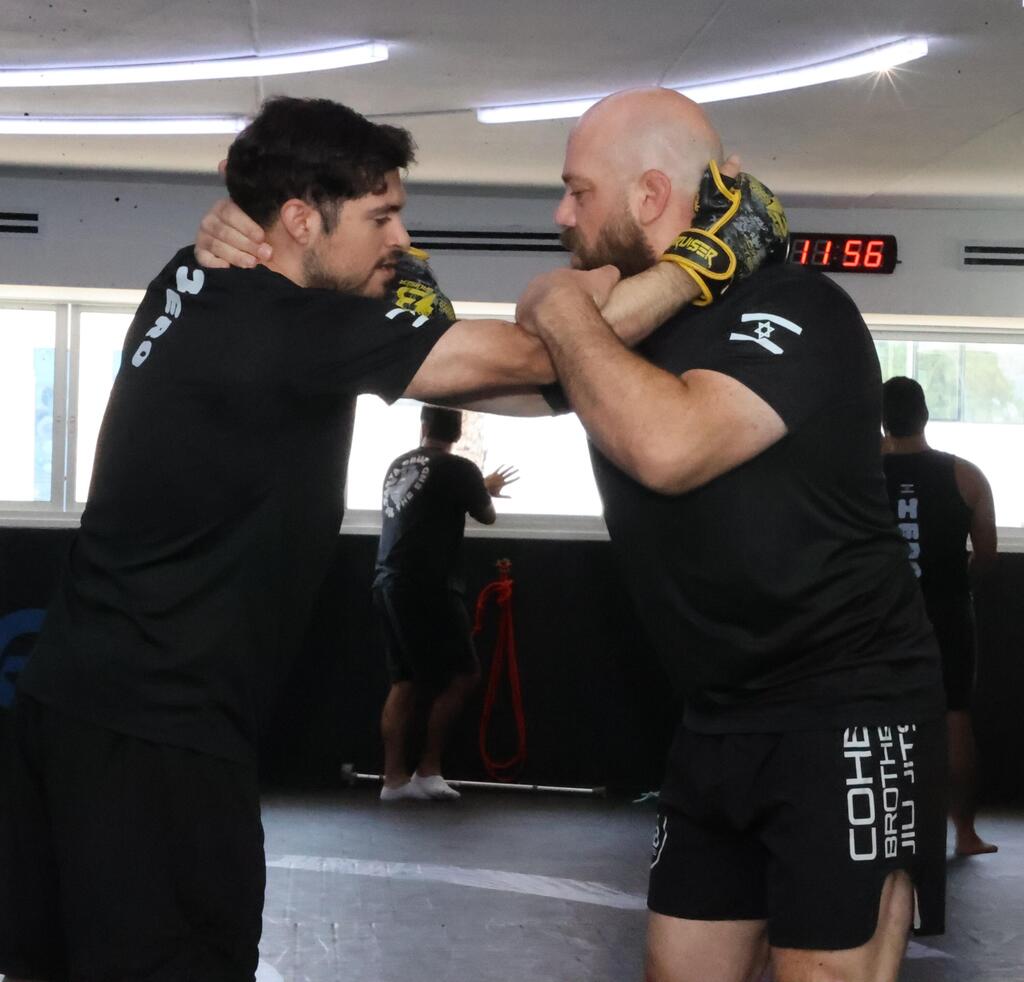
Dor and Sagi. ‘Sagi brought back my fighting spirit’
(Photo: Moti Kimchi)
"I told him, 'Listen, I am going to put you in the ring and you will fight in front of thousands of spectators,' Dovev recalled telling Almog at the beginning of their work together. "We are putting on three fights featuring our heroes just before the main event. One of the fights I am most looking forward to is Dor’s. For me, the very act of stepping into the ring is the victory."
Dor, does stepping into the ring feel like a victory for you as well?
"Absolutely. It is a huge victory. I want every wounded person to see us, soldiers who were seriously injured, fighting in that ring. And not only the wounded. Anyone going through a difficult time, for whatever reason, should come watch us, gain some perspective and tell themselves: 'If they can do it, anyone can.'"