

He lived on the edge, and that’s how he died. Earlier this month, Sergey Shipitsin, a 35-year-old Ashdod native and one of the most prominent figures in Israel’s parkour and extreme sports scene, known by the nickname "Jumping Buddha," was killed during a paragliding jump in Switzerland’s dramatic Lauterbrunnen Valley, where he had been traveling in recent weeks.
Shipitsin captivated his online followers with videos of daredevil stunts: leaping between rooftops, dangling from cranes and gliding from dizzying heights. During his time in Switzerland, he set out for another flight, but after failing to return to his hotel room or make contact, his friends and family reported him missing. Hours later, his body was found near the launch site. Initial findings indicate that his parachute failed to open. He was laid to rest in Israel last week, leaving behind parents, a wife and a stepdaughter.
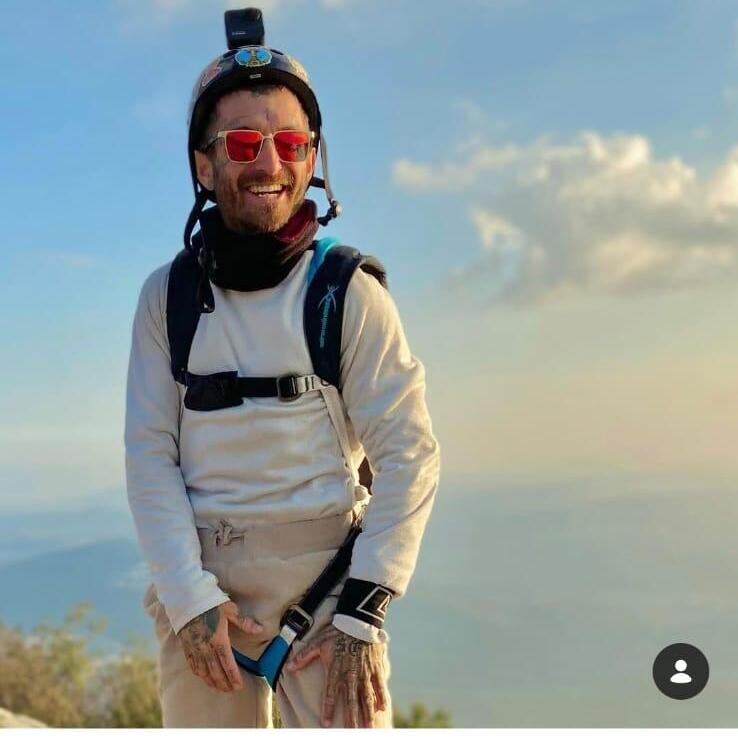
Sergey Shipitsin
“Sergey was born with a need for action,” says his mother, Katy. “He was always stubborn, knew how to stand his ground. He went through a lot of tough times and crises, and I learned alongside him how to support him. I didn’t always know how to help, but he needed to feel I was there for him."
Shipitsin turned to parkour during a period of soul-searching in his youth. At 18, he watched parkour videos on YouTube and immediately knew that was what he wanted to do. “He had no physical background for it, but whatever he tried, he got the hang of it right away.”
Before discovering parkour, Shipitsin had practiced snowboarding and skateboarding. But starting a completely new discipline at that age posed a challenge. Parkour, which combines gymnastics and acrobatics, required a different kind of training. To acquire those skills, he joined a class full of children. “They told him he was too old for it,” Katy recalls. “But he wanted it. They accepted him, and he trained with little kids. It didn’t bother him."
“He trained diligently; he fell, got up, went through trauma, broke bones, but he never stopped. He became a teacher, not just in training but in philosophy. He passed on messages that the kids now say shaped who they are today. They’re not on the streets; they’re coaches now.
"I remember him telling me how kids would approach him for help, and I realized they felt he had something to give. He inspired them to live in the moment, to do what they love. ‘Do it today, live today; tomorrow may not come,’ he used to say. And he tried to live that way, leaving nothing for tomorrow.”
“He did it, he fulfilled his motto,” Katy says. “Only now am I discovering how much I didn’t know about my own son. I thought I knew him so well, but with every story people tell me, I think, ‘Wow, that was my son?’ It’s a whole new world for me. I’m so proud of Sergey for living his dream. He left a mark on so many hearts."
'A man who knew how to take it easy'
“Sergey inspired an enormous number of people,” says Misha Leon, a longtime friend. “I met him 15 years ago at a gymnastics center. I was training with a group, and he was leading the sessions. That’s where our friendship began. We met over the years at events and workouts. He was incredibly talented, passionate about sports and passionate about life. He knew how to take things easy; he was fun, loved tattoos. We had a private nickname just between the two of us. He had ‘BIG SMOKE’ tattooed on his chest, and I have it on my arm."
“Six years ago, I suffered a serious spinal injury, and Sergey was one of the people who came all the way from Ashdod to the north to be with me,” recalls Leon. “He brought me money, food, stayed with me for two days. We had deep conversations. He always said that if something ever happened to him, he’d want it to happen while doing what he loved. Sergey is a legend; he elevated the entire extreme sports scene. We lost someone truly legendary."
Another friend, Yaakov Aviv, formerly head of the Israel Skydiving Association, noted the dangers inherent in the sport. “The skydiving community in Israel is very small, fewer than a thousand people. There's often a temptation to move from base traditional jumping to extreme, which is far more dangerous, and instructors always warn against it,” he says.
“Sergey was brave. He always smiled, said hello to everyone and joked with people one by one. He was adventurous and well-liked by all. But toward the end, he became more solitary with his jumps. He suffered serious injuries in the past, including three fractured vertebrae and a sprained ankle, but returned to jumping with even more intensity. In Switzerland, where he died, the location is extreme. They don’t call it ‘Death Valley’ for nothing; it’s notorious. Dozens of skydivers have died there.”
'The devastating news came quickly'
“Most extreme parachutists are always chasing the next challenge, relying on their split-second instincts during the jump. Most of them do it for the soul,” Aviv continues. “But when it becomes about Instagram and likes, it’s less about personal experience and more about content creation. Going to Death Valley is a statement. I’ve seen other jumpers go there, and we’d say, ‘What a madman; what is he doing?’
"The terrible news arrived very quickly. This field isn’t about creating content, but about pushing yourself to the edge, under control. It’s heartbreaking. Sergey was a dear friend. We’ll miss his energy, his outlook, his spirit, everything he brought with him."
At home, Shipitsin was a very different person from the adrenaline-fueled athlete seen online. He met his wife, Nadia, through Facebook. At first, they lived in different countries: she in Moscow, he in Israel. They married three years ago, and she and her daughter moved to Israel in January.
“They didn’t get the chance to do anything from what they planned,” Katy says. “At home, he loved soft lighting; it helped him unwind. He was a very loving husband. The girl has a biological father, but he isn’t present in her life. Sergey was like a real father to her. It’s a terrible blow for her; she’s 14. He loved her so much. There were things he wouldn’t buy for himself, silly treats, just so he could spoil her. They had a special bond. He and Nadia didn’t have a chance to have kids of their own. But he got to be a father, and I’m grateful for that.”
Nadia and her daughter currently have visas to stay in Israel for another six months, and Katy hopes they will be allowed to remain permanently. Both of them want to stay and make a life in Israel. Katy is exploring what steps can be taken to help that happen.
Katy describes her son as a nature lover, someone who in his childhood raised every kind of pet imaginable, until he decided animals belonged outside. Instead, he began cultivating plants, building a small garden.
“He did that while working two jobs. The garden was his own little world. He truly reconnected with nature. I’m proud of him. He always wanted to fly; that was his dream. God heard him and gave him angel’s wings. Now he’s free, not bound by a parachute, flying wherever he wants. I feel like he’s watching over us."
First published: 21:03, 12.22.25