

Take a dreamer who imagines building a Mediterranean team for the Winter Olympics, add a rugby player who can do flips, throw in three athletes who gave up on their disciplines and put them all into a bobsled. That is roughly how the story of Israel’s bobsled team begins — a team that has qualified for the Milan-Cortina Winter Games and will make its debut on the icy track in Italy on Feb. 21.
The driving force behind the Israeli team is Adam (AJ) Edelman, 34, the man with the vision who endured no shortage of jokes and smirks when he set out on his journey. you could call him the Theodor Herzl of the project. The famous balcony in Basel is replaced by a bomb shelter and, instead of 1902, it is the summer of 2006.
Edelman, then a teenager was visiting Israel when he was caught up in the Second Lebanon War, an experience that left a deep mark on him. The sirens and the dashes to shelters were seared into his memory, and he realized he had to give something back to the country that, in his words, “saved my life.” He also knew it would be through sports. “I still remember that moment in the shelter during the war — it was life-changing for me.”
An all-American by background, Edelman was exposed to winter sports and played ice hockey himself. In 2010, while preparing to study at a yeshiva in Beit Shemesh, he watched the Winter Games and was drawn to bobsled, which became his sport. Although he later gained citizenship and represented Israel at the 2018 Games, Edelman was not satisfied with personal representation. He decided he wanted to build a full-fledged team.
Thanks to his training as a mechanical engineer, he began making connections that same year and found an initial sponsor to help fund the project. Twenty years after that formative summer, Edelman, who is often seen wearing a kippah adorned with Olympic rings, wiped away tears of emotion as the Israeli team officially met the qualification criteria.
“It’s very hard to describe this journey because it’s anything but typical,” he said. “Usually a team registers with a federation, there’s an orderly acceptance process. That wasn’t the case with us. For 12 years I looked for the answer to how success in this sport would come. I needed not only a lot of money, but also help with infrastructure and more. There was nothing. I saw this as far more than a hobby — it was truly work from morning until night, every day.”
Druze history in Israeli sport
Looking back, when Edelman began his journey he encountered many mocking reactions, which continue to this day. “At first I took it personally. I felt like they were laughing at Israel. This country can do anything — what’s their problem? Later I understood that people could think it was a joke. Many thought an Israeli team was impossible, and at times even I felt it might not happen. Today I’m just waiting for people to see us slide and realize it’s not a joke.”
Edelman, who finances and manages the project, used two fronts to recruit athletes: in the field and online. He looked for athletes who had retired or were on the verge of retiring from their sports, went to watch them or reached out directly. Some thought he was crazy. “To be a bobsled athlete you need skills that athletes in the U.S. or Germany already have in their toolkit. They’re all sprinters, strong. Nobody starts out in bobsled as a first sport. It’s very rare for someone to begin this as a child,” he said, explaining why he mainly targeted athletes from athletics, CrossFit and rugby.
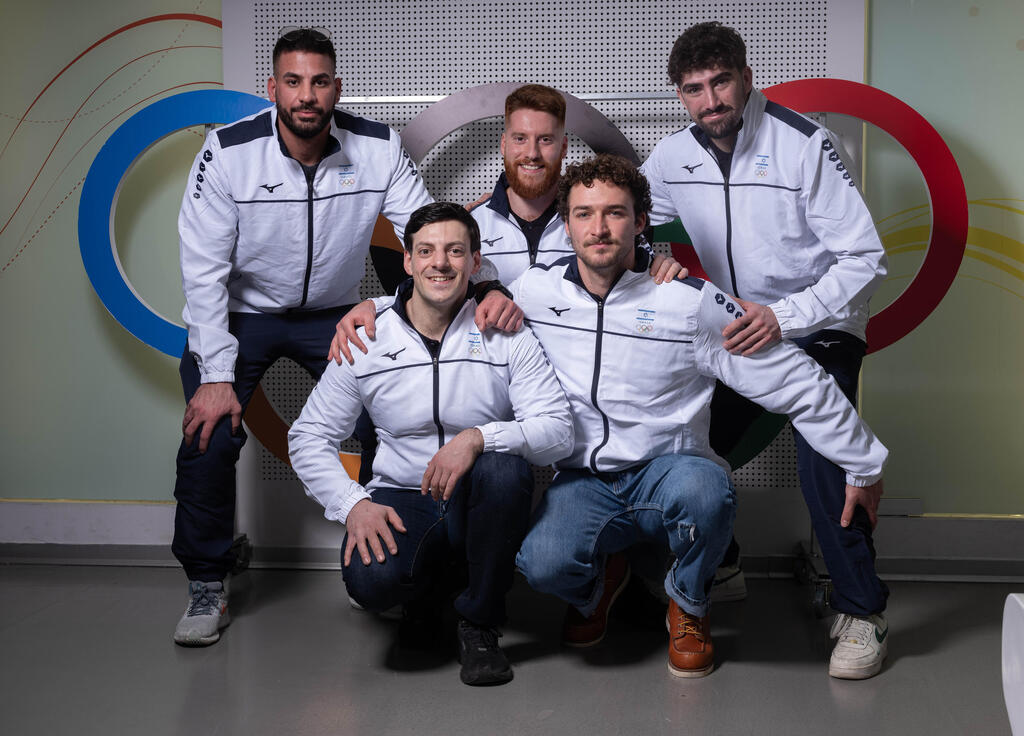
Meet the team: Standing from right: Katz, Schprinz, Prousa; Sitting from right: Zisman, Edelma
(Photo: Yuval Chen )
Before October 7, the bobsled team Edelman built consisted of himself and several Druze rugby players. He was convinced the lineup could carry them through the next two years and into the following Winter Games. When the war broke out, all of them were called up to reserve duty. Aside from Edelman, the only one left from that group is Ward Fawarsy, 30, from the Druze village of Maghar in the Lower Galilee. Until now, Israel’s only Druze representation at the Olympics was in the Paralympics — rower Salah Shaheen, who won bronze with Shahar Milfelder in the double sculls in Paris. Fawarsy will now become the first Druze athlete to make history at the Olympic Games.
Until Edelman approached him in 2019, Fawarsy saw rugby as his greatest love. “We don’t really do sports at the highest levels where I’m from. You finish high school, go to the army and then study. I loved sports — that was the difference. Even when people told me to study and work, I kept playing rugby,” he said with a smile. “Before that I did acrobatics. I can do flips.”
He remembers well the first conversation with Edelman. “I didn’t even know what bobsled was. I came with no expectations and told him I was in.” Then came competitions at minus 24 degrees, COVID and no shortage of hardships. Fawarsy did not let the tough start break him and today he is proud of the path he has taken. “I have my own club and I get a lot of kids whose parents want them to be athletes. I want to be a role model, to give inspiration and something to aim for. You can do sports too, not just the army and studies. Everyone is proud of me and sends me messages. I represent the Druze community and the country in another field beyond the military. It’s an honor. I’m waiting for this experience. I’ll carry it with me for life.”
'It’s a funny sport'
Uri Zisman, 25, came to bobsled from a completely different direction. The Tel Aviv native began his athletic career as a pole vaulter but eventually realized he had hit a glass ceiling. “I saw where I stood. I was mid-level, maybe reaching the European Championships. At the same time I worked and did the army. I went to India, and that’s where I got the call from AJ. It’s funny how life works. It came at a point when sport felt furthest from me. I never thought I’d return to being an athlete, certainly not an Olympic one. In that call I didn’t understand what Edelman wanted from me, but I had a good gut feeling.”
His parents are very supportive of this new chapter, alongside some laughter at the unconventional sport he chose. “It’s a funny sport,” Zisman said. “People don’t understand it and I have to explain how powerful it is. When you’re on the ice, there’s magic in the air. The change I made is crazy — from running shirtless in Tel Aviv to being in New York at minus 17 degrees. The moment we were told we’d met the criteria was strange. We were at a training camp in Canada. I got the dream — just not in the way I imagined.”
Omer Katz, 25, from Ra’anana also came from athletics, as a sprinter. “I realized I wasn’t going to be an Olympic sprinter. I broke through in 2023, then two hamstring tears six months apart set me back. I couldn’t even reach the podium at the Israeli championships and understood it was time to move on. Two weeks later, Adam called. At first I hesitated — the sport sounded a bit dubious. My mom encouraged me to join. True, there’s nothing more prestigious than the 100 meters, but not giving up worked in my favor. My big dream of being at the Olympics came true.”
The team includes a third athlete from track and field, Menachem Chen, 25, Israel’s champion in discus and shot put. His résumé includes first place in shot put at the European Team Championships and fourth place in hammer throw. Winter sports were not new to Chen, who tried to qualify with Edelman for the 2022 Winter Games in bobsled pairs. The two missed out by just one place in the world rankings.
The dog, the verse and the donor
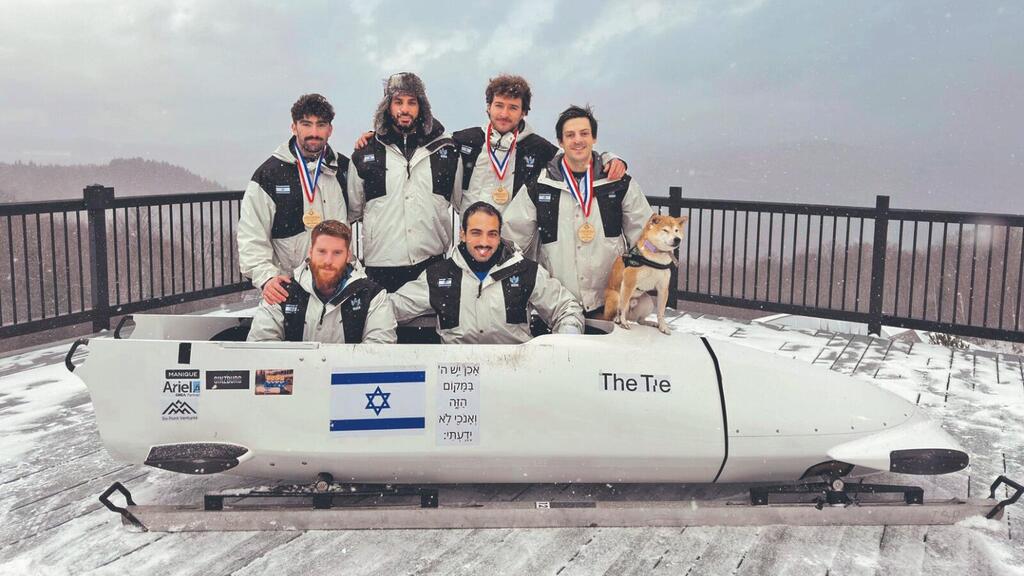
In the team photo released after qualification, two things caught the eye: a verse from the Bible written on the sled — “Surely the Lord is in this place, and I did not know it” (Genesis 28:16) — and a small dog. The dog, named Lulu, is Edelman’s pet, and sometimes accompanies him on trips and serves as something of a team mascot.
The story behind the biblical verse begins when their sled, which they had lent to another team, returned damaged. “The frame was bent and that has a huge impact. We’re like Formula 1 — without good equipment it doesn’t matter how good you are,” explained head coach Itamar Shprintz. “AJ panicked. We were two weeks before a competition and he posted on X that we were looking for a sponsor. Alongside insane hate messages because of the war, a call came from a man who asked to remain anonymous and said he would buy the team whatever it needed. The sled costs more than $100,000 and the next day it was already ordered. He asked for just one thing — that this verse be written on it. Some Jewish man found us and saw light in us.”
Shprintz, 23, from the northern Israel moshav of Tzurit, took on the coaching role because only four athletes are allowed on the team. He comes from weightlifting, where he was a former national runner-up, and CrossFit, and spoke about how sports helped him overcome difficulties. “I was a troubled kid who drank and smoked. Today I dream of being a world champion in CrossFit and influencing teenagers to make the change I made. I wanted to compete in the Winter Games. It broke my heart when I realized I wouldn’t be one of the four, but I’m here for my team. We’re a unit.”
Yael Arad, chair of the Olympic Committee of Israel and a member of the International Olympic Committee, praised the achievement. “Especially in these days, when the State of Israel wants to show the world its capabilities, excellence and its positive face, there is no more impressive stage than the Olympic Games to present excellence, passion for success, determination, love of the country and Zionism.”