

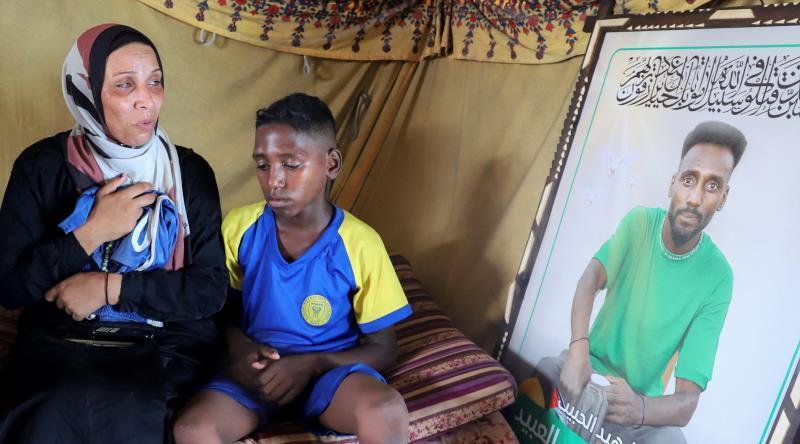
The death of former Palestinian football star Suleiman al-Obeid, known as the “Palestinian Pelé,” continues to reverberate internationally. Over the weekend, Liverpool forward Mohamed Salah responded to a UEFA tribute post honoring al-Obeid, writing on X (formerly Twitter): “Can you tell us how he died, where, and why?”
On Sunday, the IDF addressed Salah’s comment. IDF international spokesperson Lt. Col. Nadav Shoshani replied on X, directly under Salah’s original post: “After an initial review, we found no records of any incidents involving Suleiman al-Obeid. In order to take a closer look, we need more details.”
Salah’s post went viral, amassing over 87 million views and more than one million likes in under 24 hours, sparking widespread debate in both the sports and political arenas.
According to the Palestinian Football Association, al-Obeid — a former player for the Palestinian national team — was killed in an Israeli airstrike in southern Gaza while waiting in line to receive humanitarian aid. He was 41, born in Gaza and scored over 100 career goals.
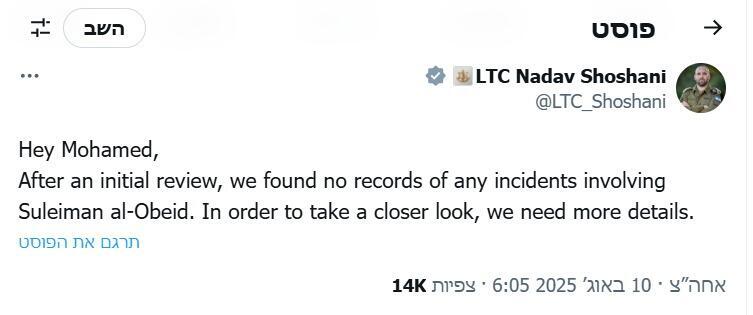
The response of IDF international spokesperson Lt. Col. Nadav Shoshani
Al-Obeid began his career at Khadamat Al-Shati, later playing for Markaz Shabab Al-Am’ari in the West Bank and for Gaza Sport, with more than 100 goals across all clubs, earning him the nickname “Pelé.” He debuted for the Palestinian national team in 2007, earning 24 caps and scoring twice.
Get the Ynetnews app on your smartphone: Google Play: https://bit.ly/4eJ37pE | Apple App Store: https://bit.ly/3ZL7iNv
In its original tribute post, UEFA wrote: “Farewell to Suleiman al-Obeid, the 'Palestinian Pelé.' A talent who gave hope to countless children, even in the darkest of times.”
The Palestinian Football Association later released a statement, claiming it included a message from UEFA President Aleksander Čeferin in Arabic, stating that al-Obeid “showed how joy, talent and pride can flourish even amid suffering.”
Salah, a four-time Premier League Golden Boot winner, has previously called for the immediate delivery of humanitarian aid to Gaza, an end to the fighting, and a halt to what he described as “massacres.”