


The Spartanion is no ordinary race. There are no sweeping views or far-off finish lines, just a flat, meticulously measured 1,459-meter circuit that runners circle over and over until time runs out.
It’s Israel’s only professional ultra-marathon and has already seen four world records broken. It also serves as a prestigious qualifying race for the Spartathlon, a 246-kilometer ultramarathon held annually in Greece between Athens and Sparta.
Gallery
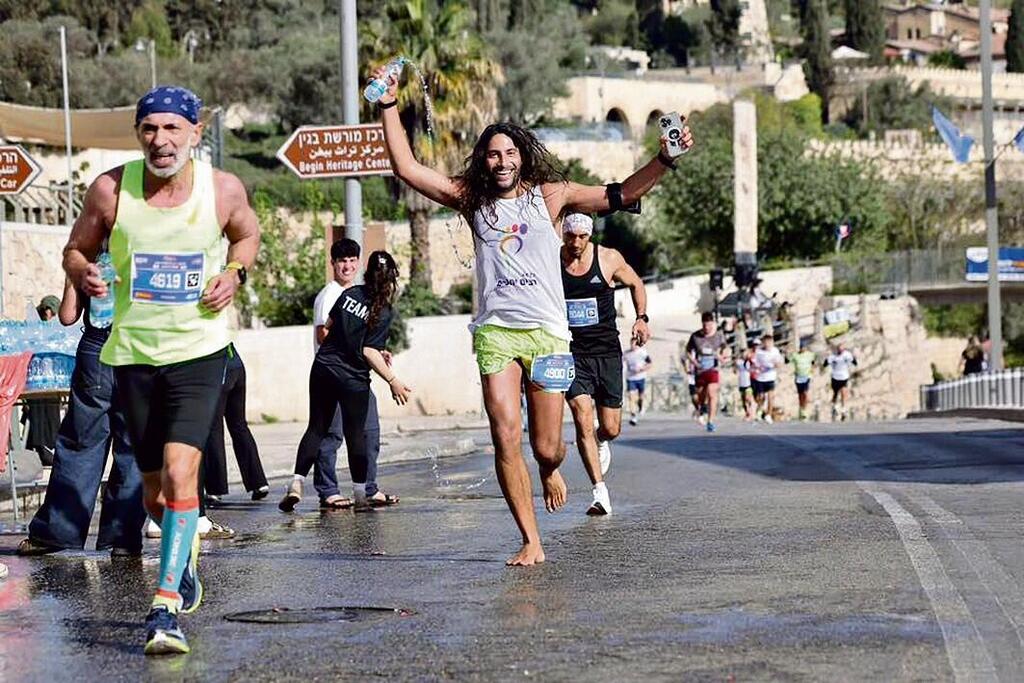
Rom Carmi known as Barefoot Rom. 'Barefoot running brought back my passion for life'
(Photo: Ronen Topelberg)
A week from now, on the morning of January 1, 2026, the Spartanion returns to Tel Aviv’s Ganei Yehoshua Park. Co-hosted by the Tel Aviv Municipality and its Sports Authority, the event offers some of the toughest challenges in endurance sport: from six-hour runs to the grueling 24-hour flagship race. Yes, you read that right: 24 hours of nonstop running.
Behind the dry stats are people for whom the word “limits” simply doesn’t exist, like Pnina Tzadikaryo, a new grandmother and the only Israeli woman to complete the Spartathlon in Greece three years in a row; Amir Meir, a combat veteran once declared dead, who reclaimed his life through running; and Rom Carmi, known as “the barefoot guy,” who runs everywhere shoeless, even on the beaches of Gaza while on reserve duty; and now, for the first time, he will take on the looped course.
Pnina Tzadikaryo: Grandmother, educator, ultra-athlete
At 51, Tzadikaryo is hardly your average grandmother in the park. A mother of three, who just a few months ago welcomed her first grandchild, and an educator by profession, she only took up running a decade ago, at 42. Since then, she has steadily pushed her limits, with her husband Eliyahu supporting every kilometer.
“I started with 10 kilometers and built up from there. My husband saw how determined I was, getting up at odd hours for my 180-kilometer weekly training plan. He’s the one who gave me the push to enter the world of ultras. He’s my main source of support,” she said.
Tzadikaryo is living proof that in ultra-running, mental strength overcomes age. At the 2022 Spartanion, she demonstrated just that painfully: “I fell flat on my face at the 90th kilometer. I picked myself up, regained composure and told myself: 'I’m not stopping'. I finished bleeding and injured, but with the Spartathlon qualifying time in hand."
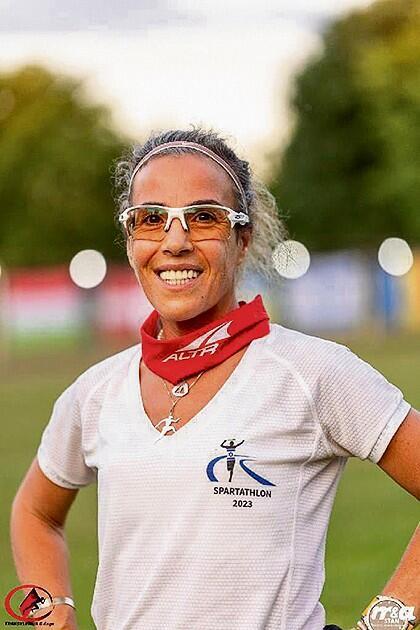
Pnina Tzadikaryo. 'I finished bleeding and injured, but with the Spartathlon qualifying time in hand'
(Photo: M&A Stan)
For Tzadikaryo, the Spartanion is a home race, a place where “runners run for runners.” Just this past September, she reached her peak in Greece, finishing the Spartathlon in harsh weather, under relentless rain and freezing-cold nights, while thinking of her daughter Lin, who was expecting her first child. “She was on my mind the whole way. At first I wasn’t sure if I should go, but I knew she would wait for me. And she did. I finished the race like a pro.” On January 1, she’ll return to the 24-hour race for the third time.
A second life: Amir Meir’s comeback story
If Tzadikaryo's story is one of willpower, Amir Meir’s, 53, is a story of resurrection. On October 25, 1992, while on a military mission in Lebanon, a roadside bomb exploded under his vehicle. He was declared the sixth fatality of the incident.
“They had already covered me with a blanket,” he recalls. “My head looked like a smashed watermelon. But a medic from Unit 669 noticed my hand move and performed an emergency tracheotomy under fire. He didn’t think I’d survive, but he tried anyway.”
Meir did survive, but the life he had known was gone. He woke up paralyzed on one side, with severe brain damage, and had to relearn how to speak, write and walk. For 22 years, he used a cane, battled depression and lived with cognitive impairments, until one day his wife Sharon bought him a gym membership.
In 2014, he made the unthinkable decision to ditch the cane and start running. Today, he’s a certified fitness coach. “I read that the brain is elastic and can form new neural connections through exercise. One day, I just said: Enough; I’m throwing the cane away.”
Since then he hasn't stopped running. From 10 kilometers to the Amsterdam Marathon, Meir’s path led him to the ultramarathon. He is now a familiar face at the Spartanion, nicknamed “the Singer.” “When it gets tough, I sing. It can be anything, Hebrew, English. It takes the pain away. At 4 a.m., I could be singing songs from a kids’ TV show.”
Now serving as a mentor to wounded soldiers from the 2023 Iron Swords war, Meir is back for the 100-mile (161 km) race, aiming to finish in under 18 hours. “Ultras are 20% physical and 80% mental and logistical," he says. He calculates every detail on Excel sheets, from electrolyte pills to the seconds it takes to urinate mid-run.

Amir Meir. 'When it gets tough, I sing'
The barefoot runner: Rom Carmi
While most runners approach ultras as life missions, Rom Carmi takes a different attitude. Known as “Barefoot Rom,” the vegan runner from Kibbutz Yotvata claims he was “born to go barefoot.” He began running in elementary school and abandoned shoes a decade later.
During recent reserve duty as an IDF combat soldier in Gaza, he even stirred controversy among Arabs by posting a video of himself running barefoot along Gaza’s beaches (surrounded by his fellow reservists providing security). “It made it all the way to Al Jazeera,” he laughs.
Carmi discovered barefoot running after watching a video of a marathoner who ran shoeless because no shoe fit. Since then, he’s been convinced that shoes cause injuries. “Barefoot running brought back my passion for life and for running. I started setting goals: 10 kilometers, then a half-marathon. Last year, I ran every single day. I still do at least 10 km daily, just for fun."
To him, the Spartanion is “a playground.” He intends to run the 6-hour race, but not for results. “I’ve never run in circles before. I’m planning to shake things up in a fun way. I will run with a camera, interview people mid-race and make content. People find it strange that I run purely for fun."
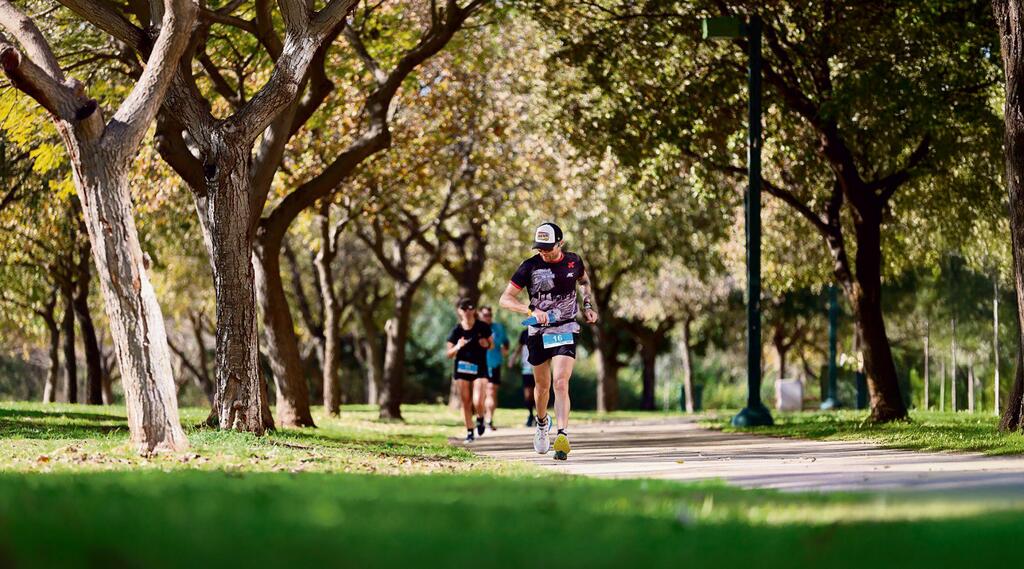
Rom Carmi. 'The word 'limit' doesn't exist'
(Photo: Tomer Feder)
Carmi, who also runs in memory of fallen soldiers and in honor of wounded comrades, dreams of breaking a Guinness World Record for snow running and completing a 100-kilometer barefoot ultra. The Spartanion is just another step along that road.
What does training look like?
Runner preparation varies and is individual. Carmi takes the minimalist approach: “No warm-ups, no shoes, no nothing. Before a long run I would drink some tea or coffee and eat a date. Even after a run, I never do any stretching."
Others follow meticulous regimens. Amir Meir worked with his coach to craft a strict nutritional plan: carb-loading, lots of fluids, avoiding spicy food pre-race and taking salt tablets every hour during running "even twice as many if it’s hot", alongside energy gels. Other options include pretzels, bananas, or even small chocolates.
'Better than therapy'
The driving force behind the Spartanion is Gilad Krauz, a real estate attorney and veteran ultra-runner who in 2012 became the first Israeli to finish the Spartathlon. Together with his wife Dganit (“the real athlete in the house”) and a team of volunteers, he founded the Spartanion out of necessity: there was no Israeli race offering qualification for international events.
“We launched the first race in 2020 with 27 runners,” Krauz recalls. “Today it’s a family. Everyone volunteers. The person handing you espresso on your 80th lap is an ultra-runner too, who knows exactly what you’re going through.”
It became a hit. Even during the peak of COVID-19, Krauz managed to bring Lithuanian ultra legend Aleksandr Sorokin to Tel Aviv, where Sorokin broke two world records on the course.
For Krauz, the race is more than sport - it’s therapy. “A participant who was at the Nova festival on October 7 told me, ‘No amount of psychological treatment compares to one Spartanion.’ That broke me. It shows the power of this community, allowing each person to reach their full potential."
The race enjoys official support from the Tel Aviv Municipality, which considers it a flagship sporting event.
“Tel Aviv-Yafo is proud to host Spartanion Tel Aviv 2026, Israel’s ultra-marathon that draws elite runners from across the country and around the world for an extraordinary challenge,” said Deputy Mayor, attorney Lior Shapira. “Over the years, four world records have been broken here, cementing the Tel Aviv Spartanion’s status as one of the world’s premier ultra events.
"It’s more than a race; it reflects the spirit of Tel Aviv - determination, community, inspiration and a genuine love for challenge."