

Lionel Messi keeps breaking records. The brace he scored Monday evening against Austria made him the all-time leading scorer in World Cup history.
Messi now has 18 goals in the tournament, moving past Germany’s Miroslav Klose, who had held the prestigious record since 2014.
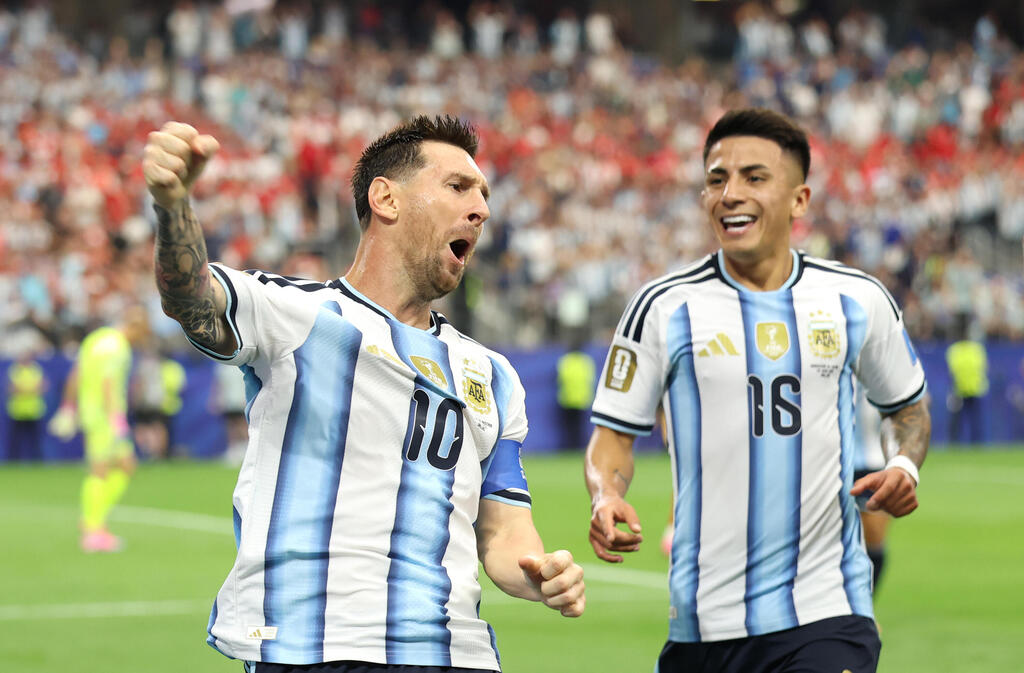
(Photo: Charlotte Wilson/Getty Images)
The match began badly for Messi, who missed a penalty in the 10th minute. But in the 38th minute, the historic moment arrived: he gave Argentina a 1-0 lead and claimed the World Cup scoring record for himself.
In the 95th minute, he scored again, this time with a goal built on pure determination. Messi fired once at goal, took control of the rebound and finished for his 18th World Cup goal.
Argentina beat Austria 2-0, a victory that secured first place in Group J and qualification for the knockout stage. Argentina’s next match will be against Jordan between Saturday and Sunday at 5 a.m.
Messi reached the milestone in his 201st appearance for Argentina, two days before his 39th birthday.
The Argentine genius also became only the third player ever to score in six consecutive World Cup matches. If he scores against Jordan, he will become the first player in history to score in seven straight World Cup games.
He also owns a less flattering record: Messi is the first player in World Cup history to miss three penalties, while scoring seven.
The timing carried its own symbolism. Exactly 40 years ago, Diego Maradona scored his famous brace against England in the 1986 World Cup quarterfinal, including the “Hand of God” goal.
The remarkable road to the record
Messi’s journey to the record began at the 2006 World Cup, when he was still a 19-year-old prodigy. Coming off the bench, he scored his first World Cup goal in Argentina’s 6-0 rout of Serbia and Montenegro.
Four years later, at the 2010 World Cup in South Africa under the legendary Maradona, Messi was already Argentina’s leader. But terrible luck kept him from finding the net, and the Albiceleste were eliminated in the quarterfinals.
His correction began in Brazil in 2014, where he carried Argentina with four goals all the way to the final at the Maracana. That tournament ended in heartbreak and tears against Germany in extra time.
At Russia 2018, Messi endured a difficult World Cup with an unsettled Argentina side that was eliminated in the round of 16. He finished with one goal, against Nigeria in the group stage.
The true peak came at the 2022 World Cup in Qatar, in what is widely considered the greatest tournament of his career. Messi dazzled throughout, scored seven goals, including an unforgettable brace in the wild final against France, and lifted the golden trophy, the only title missing from his case for being the greatest player in history.
Maradona finished his World Cup career with eight goals. Messi’s great rival Cristiano Ronaldo also has eight.
The latest achievement joins another historic milestone Messi set recently, when his hat trick in Argentina’s win over Algeria made him the first footballer in history to appear in multiple World Cups across different editions. Ronaldo joined him in that distinction a few days later, in what may be the final World Cup for both of them.
In the current tournament, Messi’s pace appears only to be increasing. With five goals after just two matches, he has made clear he is not slowing down. He now stands alone at the top of the World Cup’s all-time scoring list.
But the record may not be safe forever. Kylian Mbappe is behind him with 14 goals after scoring twice in France’s opening match against Senegal. More importantly, Mbappe is only 27, meaning he likely has at least one more World Cup ahead of him.
For now, however, the summit belongs to Messi alone.