

A shot against pain
They enter the locker room at the national teams’ complex in Shefayim and get ready for practice. It is a lively, upbeat locker room made up of Jews, Arabs and new immigrants, but everyone sees one another at crutch level. “At Ichilov, I’m king,” Shlomo, one of the players, jokes, drawing laughter. “I can get you an appointment whenever you want,” he adds, reminding everyone what really matters here.
‘He could barely walk. Now he wants to be Ronaldo’
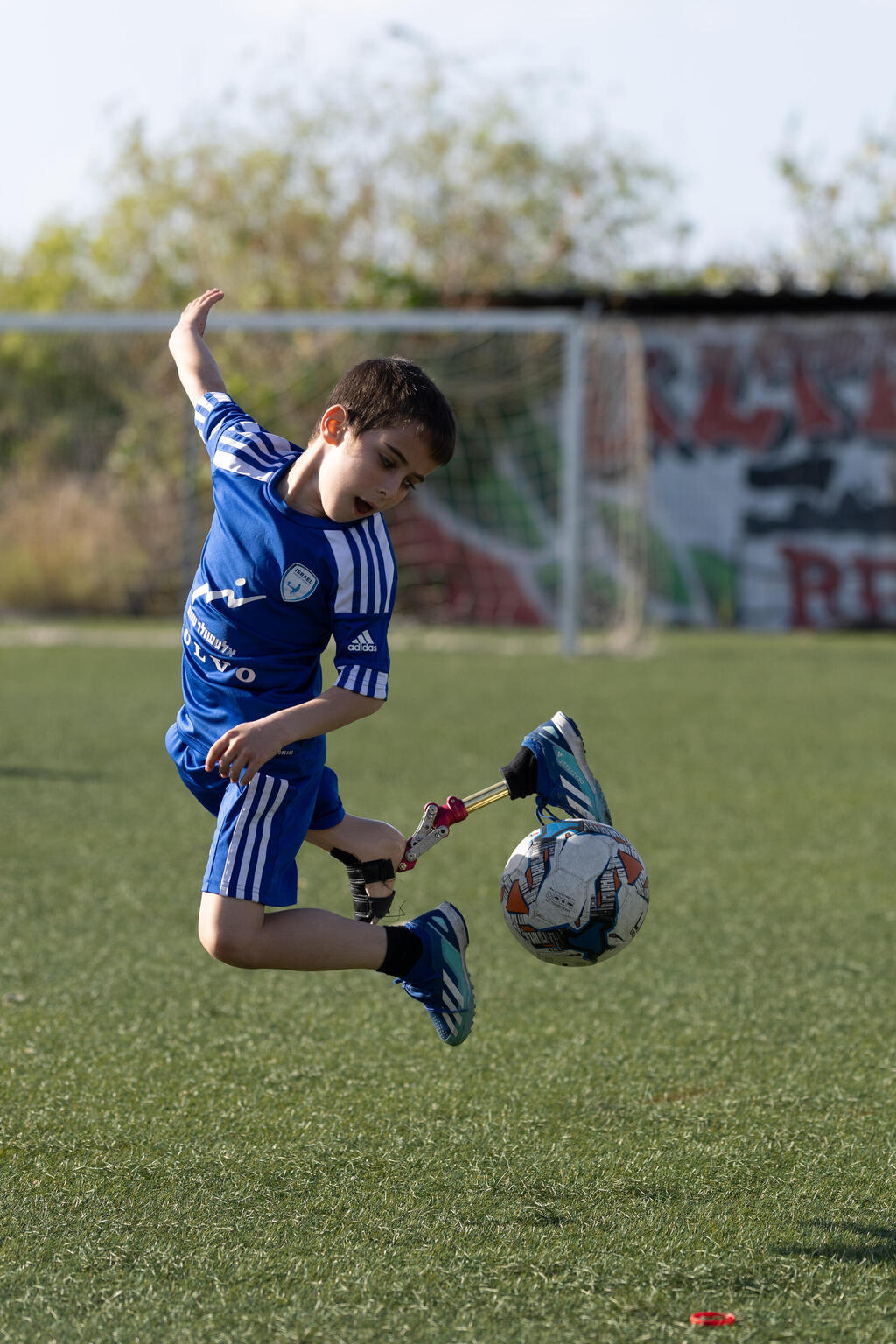
Michael, 8, was born in South Africa with a rare defect and underwent an amputation when he was just 1. His mother, Maor, says: “In rehab, they recommended sports activity, and I didn’t know what would suit Michael because, as a mother, I was a little afraid. His other leg is not amputated, but it underwent many surgeries to save it. So I was always worried about him, but over time, Sharon and Tzach helped me learn to let go.
“Soccer is everything to Michael. He has developed a lot through soccer, and his physical condition has improved greatly. He wasn’t like this before. Michael was bent over, limping, he could barely walk. Every two minutes of walking, he would say, ‘Mom, I have to rest, I need to sit.’ He didn’t believe how much ability he had. He is flourishing in soccer. If you ask him today what he wants to be when he grows up, he’ll say Ronaldo.”
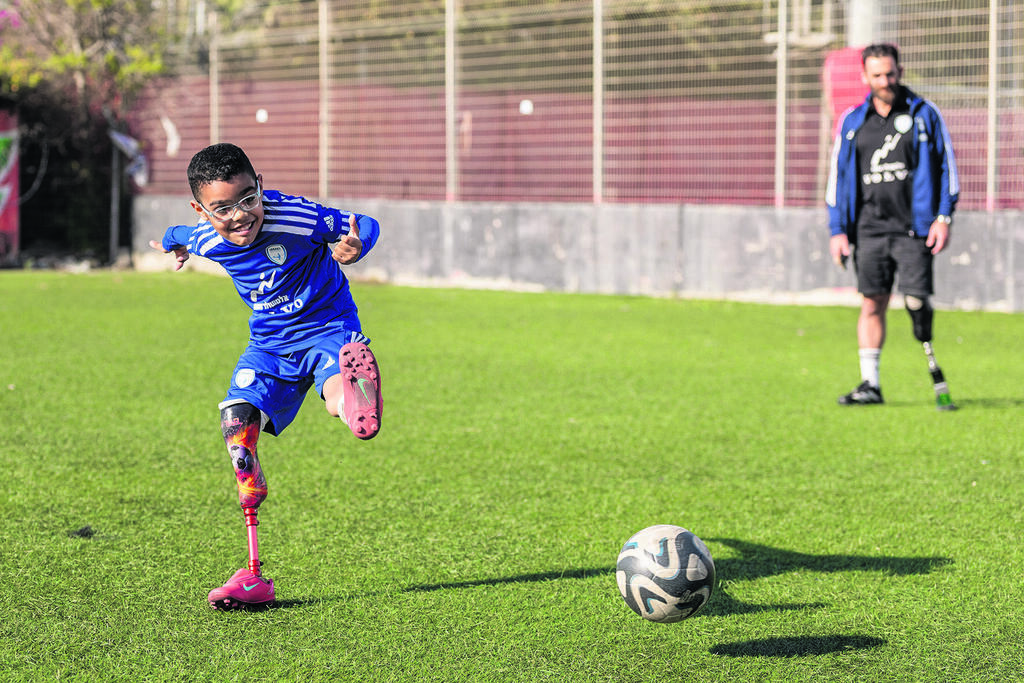
Yehuda
(Photo: Oz Moalem)
How much has it helped him socially?
“Once, when Michael was at school, the children around him played soccer, and he would sit and watch. He didn’t believe in himself. At first, he would hold the ball in his hand, and the kids would shout, ‘Michael, no hands.’ Come see him today. In his class WhatsApp group, they just tell him, ‘Michael, come downstairs, we’re playing soccer.’ At first, he had tears of joy. Today it’s natural for him: ‘Mom, I’m going down, I need to play, my friends are waiting for me.’ Equal among equals.”
The children are the team’s next generation. The adult players empower them and show them that anything is possible. At the start of practice, I looked for the prosthetics to photograph them and emphasize the complexity, but within minutes, that limitation simply disappeared from view. It is easy to forget they are amputees when you realize they have no intention of letting that define them, not even for a moment.
(Photo: Oz Moalem)
Other children have joined the team, among them Yehuda, who was born with a leg amputation.
One of the children’s coaches is Ben Maman, one of the dominant players on the senior national team. He has scored many goals in tournaments and is a star on a global scale. In his youth, he played in Beitar Tubruk’s youth department and was marked as one of Israeli soccer’s future talents. At 17, he worked as a pizza delivery driver to help his family financially. During one shift, a motorcycle ran a red light and hit his dominant leg directly. He had to undergo an amputation of his stronger leg.
“Working with these children gives me a feeling far greater than any goal I will ever score,” he says.
Israel’s amputee soccer team
(Photo: Oz Moalem)
‘This is a national team no one would want to join’
“Are you a photographer for the National Insurance Institute?” Eliyahu, the veteran player, threw at me as soon as I arrived at the first practice. “They never stop looking for us. They want us to sit at home and feel sorry for ourselves.”
I had walked past the field where they train several times. My daughter practices on the adjacent field. After 20 years of sports photography, I found myself drawn from the sidelines to this demanding sport, imagining the powerful photos one could take there. I came for the photography, but once I began, I was completely pulled in by the people. It grabbed me from the first moment I entered practice. People from different backgrounds, each with his own burden, but on the grass, the new life they were given unites them.
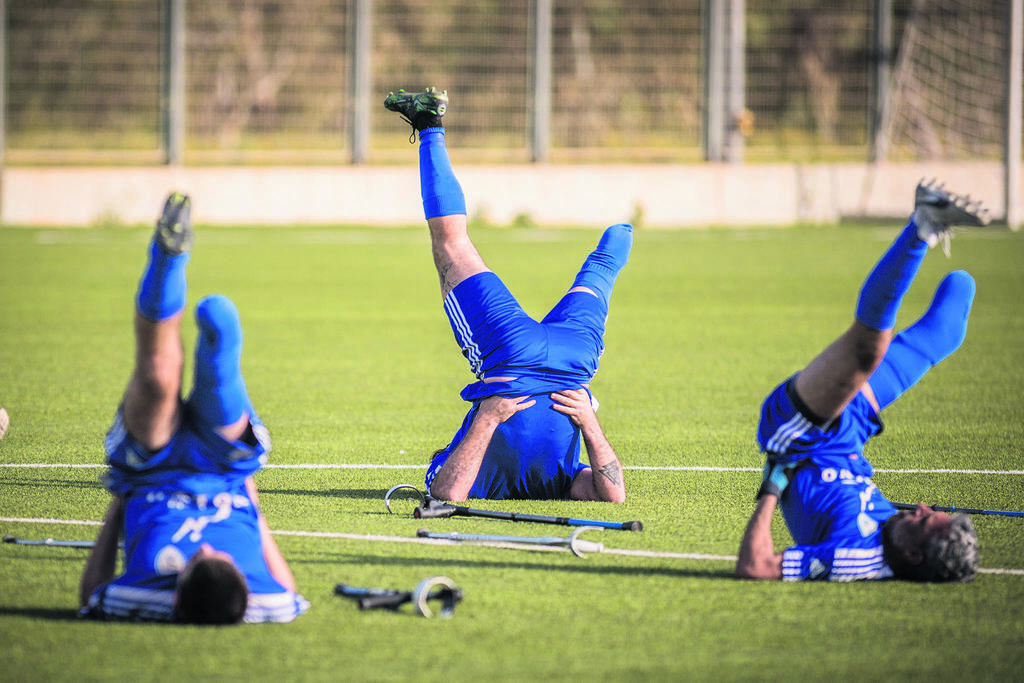
They arrive at practice from their daily lives — from work, home, rehab — remove their prosthetics and change clothes. The National Insurance Institute really has nothing to look for here. The moment they step onto the grass, take off their prosthetics and lean on their crutches, the only thing amputated there is self-pity.
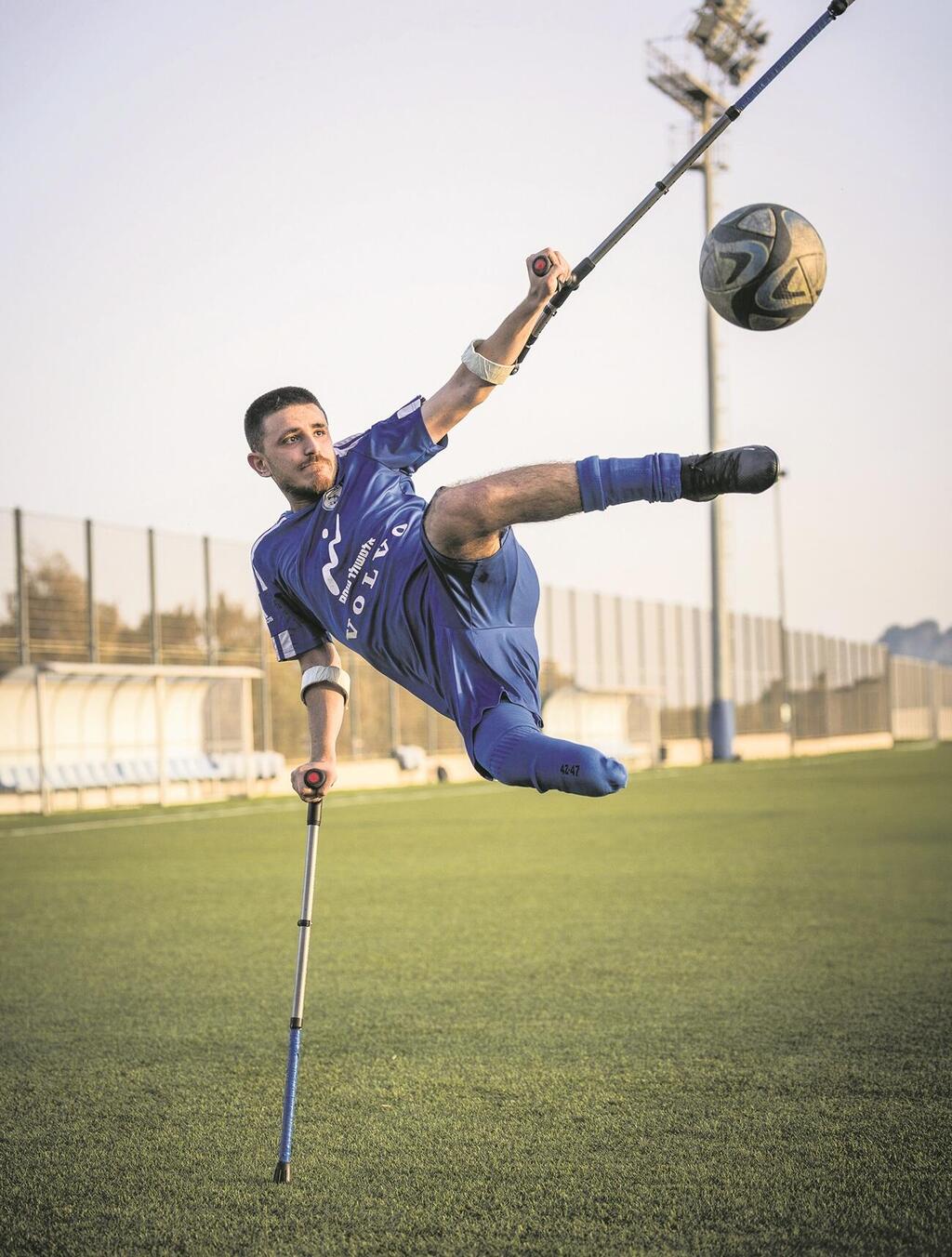
“Everyone here is material for a Netflix series,” says Tzach Shichrur, 38, the team’s captain and founder. At 8, he was injured in a traffic accident when a bus ran over his foot and crushed it. He underwent seven surgeries and lived with pain all his life.
“Every step wounded my leg. I couldn’t do sports or school trips. Excruciating pain that kept getting worse over the years,” he says.
At 30, the situation led him to ask doctors to amputate his leg.
“I took a gamble to improve my life. When there is no danger to life, they don’t rush to amputate, but when they understood how poor my mental state was, they agreed.”
In August 2018, he underwent the amputation, and since then he celebrates his “ampu-birthday” every year.
“It was a rebirth. I never imagined how much it would improve my life. I was freed from the pain, and a gate opened to a new life. Suddenly, every step no longer wounded me but strengthened me. After a month of rehab, I went out into life with superpowers, like Spider-Man.”
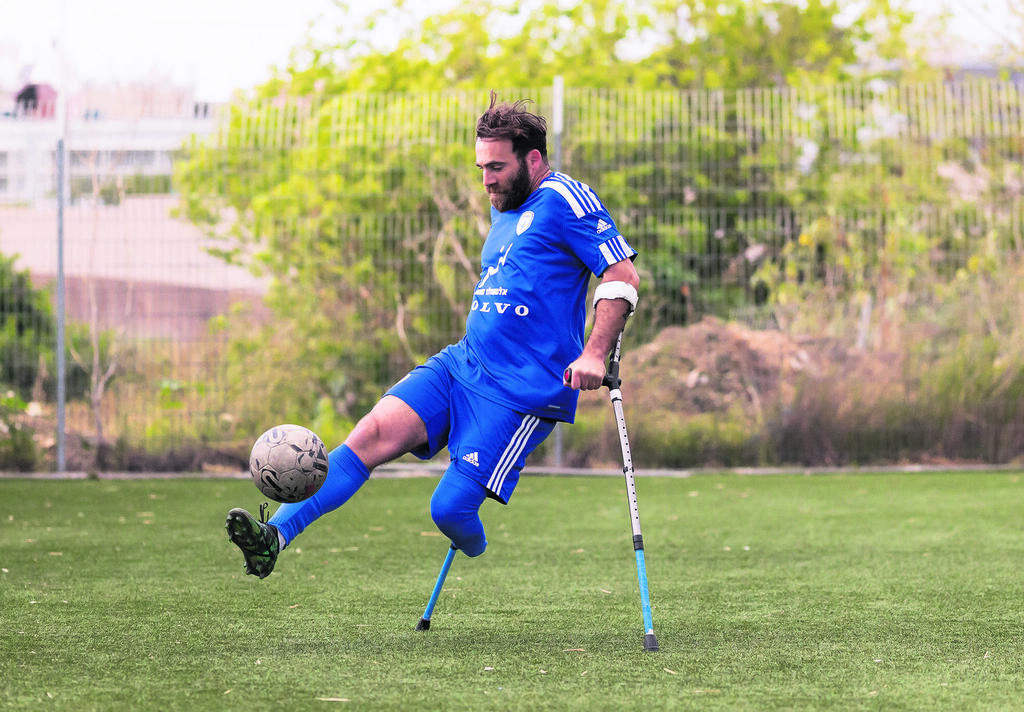
Tzach Shichrur, captain and founder of Israel’s amputee soccer team
(Photo: Oz Moalem)
Shichrur took a break from his job as a lawyer at a successful firm and set out on a journey through sports: yoga, surfing, snowboarding and more, all with a prosthetic.
“I found amputee soccer on Google and then discovered there was no such team in Israel. A year later, I met more amputees at conferences and events, told them about the game and saw the spark in their eyes. I downloaded FIFA’s rules and translated them for everyone, brought in my cousin, a soccer coach, and that’s how the first practice happened.
“In August 2019, I put up a post that led more players to join. We were invited to play against the Greek national team, and I scored a historic goal in our first game. We had to pay for the flights out of our own pockets. When we returned to Israel, I understood we needed to bring in a professional staff, find fields and recruit sponsors because we are Israel’s national team. We go out to play with the Israeli flag on our uniforms and sing the anthem.
“A month later, I met coach Sharon Paz, who understood within two minutes that he was in. I was an 8-year-old boy with a dream of playing soccer, and they told him, ‘Dream a different dream. You will never be able to play soccer again.’”
Since October 7, Tzach and Sharon, who coaches the team with Moti Gamliel, have been visiting wounded soldiers from the war to strengthen them.
“They see us and gain a perspective that strengthens them. That is worth everything.”
“Almost every amputee says at the start of rehab that his life is over,” Sharon explains. “When they see the players, they understand life is not over.”
Sharon is the psychologist, the responsible adult and the friend who must navigate everyone’s stories, lift them up when needed and know that sometimes dark humor is the best medicine for what happens off the field. Sharon has been with the team since 2020 and coaches it with Moti Gamliel, assisted by Michal, the physiotherapist. They run practices with great passion and never let the players off easy.
“Every day moves me. Every practice. On the way home, I replay what happened and how it went, and I am moved every time, first of all by their progress.”
“You are in a group of people who share a very strong common denominator and empower one another,” Tzach says. “They don’t give up and don’t feel sorry for themselves. On the national team, there is no option to give up on yourself. It is a very difficult sport, and when you are in a group like this, it lifts you. It is a forum where you can consult with all the players. It’s a language we all understand without words. No one will understand you if you say, ‘I woke up swollen today and couldn’t get into my prosthetic,’ but here they’ll give you a tip and change your life in a second.”
Professionally, the team has made remarkable progress.
“We are in the top 10 in Europe,” the captain says proudly. “The goal is to establish a league. Much of this is thanks to our sponsors — Altshuler Shaham, Ya’ankele Shahar, the Elron family, the Israel Football Association and Hapoel Tel Aviv, which lets us train on its field.”
Sharon adds: “Without heart, you can’t be here. This is a national team no one would want to join, but it exists and it has somewhere to go.”
‘I moved between teams in my career, but this is a team for life’
Ben Binyamin, 31, was an active soccer player on October 7. He had played for many teams in the National League and Liga Alef. On Oct. 6, he went to the Nova music festival with his fiancée, Gali. When the rocket barrages began, they fled and reached the Alumim junction, where they hid with many others in a roadside shelter. The terrorists arrived quickly with Kalashnikovs and also threw grenades. Ben and Gali were evacuated separately in critical condition. At the hospital, each underwent surgery to amputate their right leg, without knowing what had happened to the other. In an astonishing moment, Gali came out of the recovery room after surgery and was wheeled past Ben’s bed. Since then, they have gone through rehabilitation together and recently married. Ben did not give up soccer.
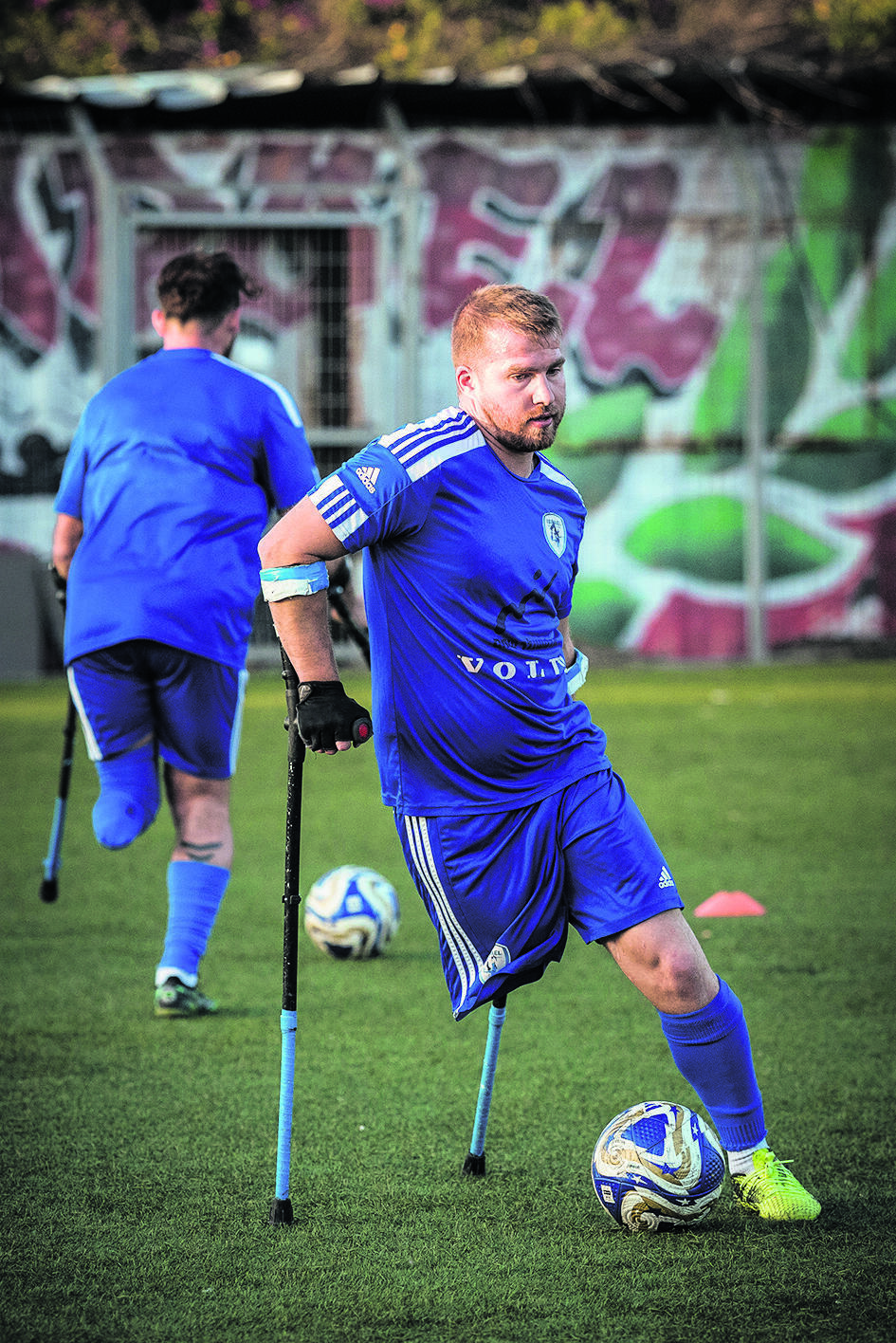
Ben Binyamin, player on Israel’s amputee soccer team
(Photo: Oz Moalem)
“At the hospital, my father and sister went room to room looking for us everywhere,” Ben recalls. “When my father moved the curtain and saw me, I couldn’t speak. I just cried and pointed to my leg. He was in shock. Since I was little, he came to every game and was very involved in my career.
“After the injury, many friends came to me, soccer players who came to help, wanted to ease things for me and boost my motivation. Along with them came players like Ben Maman, from Israel’s amputee national team, and they told me about the sport. Tzach and Sharon also came in the first week. In those days, I didn’t understand at all what they wanted from me. I was in shock from the injury. Every morning, you check and feel your leg to see if it has come back and hope it was just a bad dream.
“After three months, they agreed that I could start practicing soccer. In retrospect, I can say it really helped me. It strengthened my legs and upper body. Running on crutches is not easy. Physically, it is a much harder game, and they also took my stronger leg, so I had to start again like in soccer school. I thought I would never get out of a wheelchair, but I returned to playing soccer, and on Israel’s national team, which is an honor in itself. I even took part in a Euro tournament, something every player in Israel can dream of. This team is a family for me. I moved between many teams in my career, but this is a team for life.”
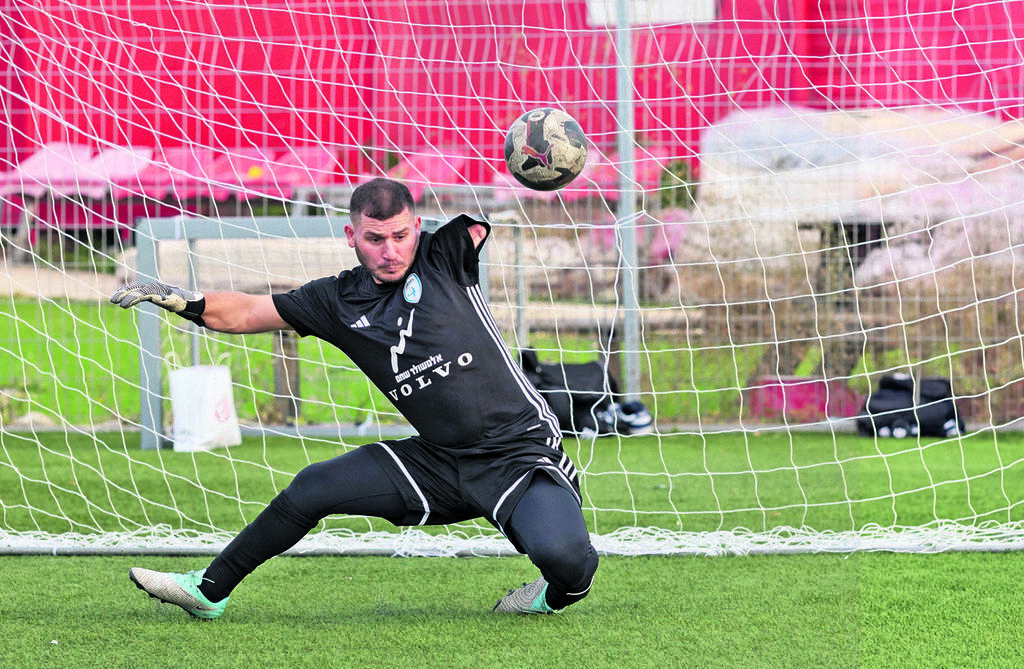
Tigram, goalkeeper for Israel’s amputee soccer team
(Photo: Oz Moalem)
‘The guys buy a pair of shoes and give each other the shoe they don’t need’
Under the rules of the game, players play on crutches, without one leg or with an injured leg that does not participate in the game. Goalkeepers play without one hand or with an injured hand tucked under their shirt, and any touch of the ball by the crutches is considered a foul.
Tigram, one of the team’s goalkeepers, immigrated to Israel from Georgia and recently added the name Meir. He lost his hand after being electrocuted as a child and proudly shows me his goalkeeper glove.
“This is Daniel Peretz’s glove,” he says. “It can’t handle the load.”
He urges the players on from the goal and pushes them to the limit.
“The guys here buy a pair of shoes and sometimes give each other the shoe they don’t need,” he says with a smile.
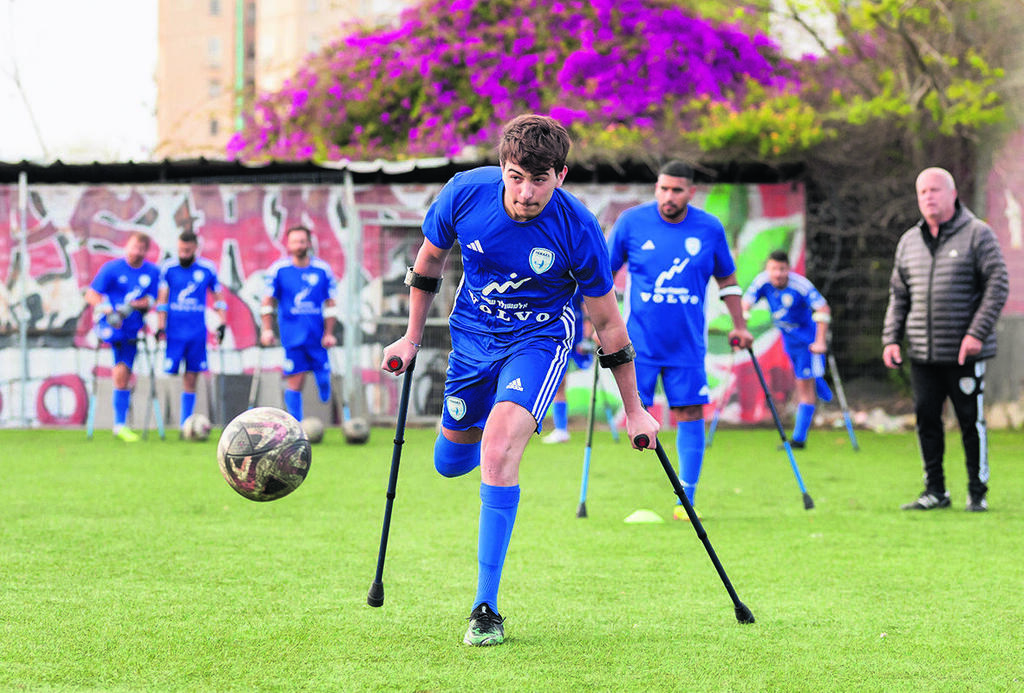
Yanir, player on Israel’s amputee soccer team
(Photo: Oz Moalem)
‘I am more determined to fulfill my dreams’
Yanir, 20, is still hospitalized. He served in the 101st Battalion of the Paratroopers Brigade in Gaza and Lebanon until he was wounded during his service.
“In the past, I played soccer in Modiin’s youth department, and then after October 7, I decided I needed to enlist in a combat unit, and my entire service was in combat,” he says. “The first period after the injury was not simple. Seeing all your friends continue fighting while you are lying in bed, taking painkillers. A difficult time. After that, slowly, you move to a chair and the pain eases a little. You meet people like Tzach and others like him, and slowly you understand that everything is possible.
“It is an amazing sport with amazing people, guys like Ben Maman, who, together with Tzach and Sharon, really brought me into it. It helps a lot, beyond the sport too. It gives a feeling of real life and adds to my confidence. It is important to me not to give up, not to collapse into myself. Losing a limb sounds terrible, but it’s really minor. I still have big dreams.”
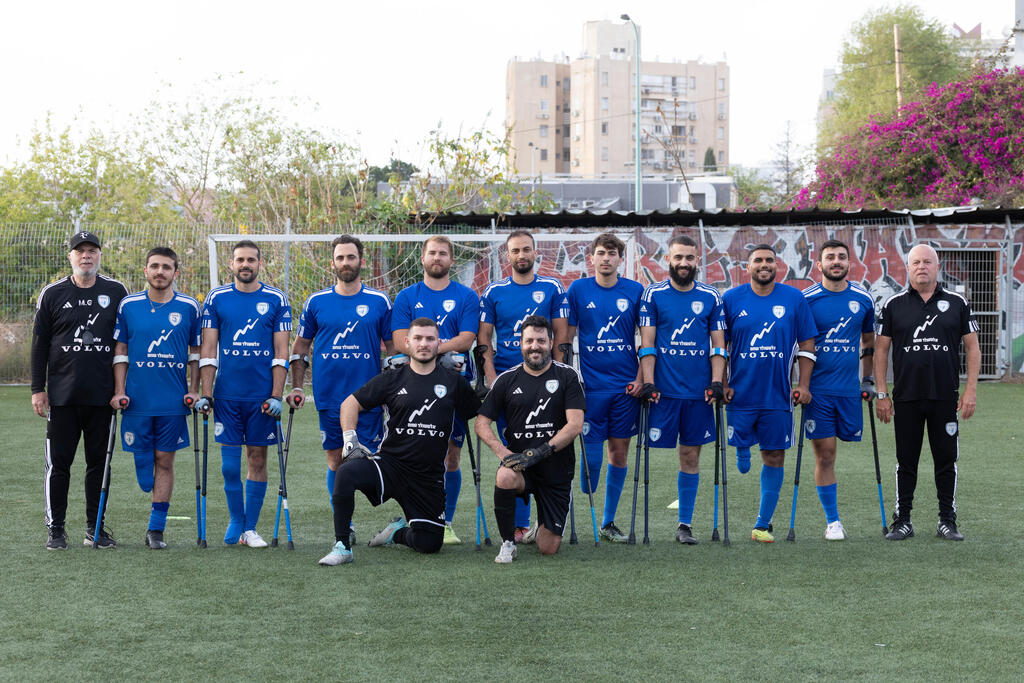
Israel’s amputee soccer team
(Photo: Oz Moalem)
Like what?
“I still want to climb Mount Kilimanjaro. It is important not to give up on dreams. It doesn’t matter what sport you love, the main thing is that you do it and invest in it, especially now after an injury. That is even more important.”
Do you have new dreams since the injury? Or are they the same dreams you had before, and now you say, 'I am more determined to fulfill them'?
“No, the same dreams. I’m just truly more determined to fulfill them. Mainly, I want to return to normal life.”