

Jordan Adams is a 31-year-old British man. Within the next decade, he will develop dementia. Not long afterward, after losing almost all control over his life, he will die. His brother Cian, 25, faces a similar fate. There are no question marks here. It is going to happen.
It happened to their mother, Geraldine, who died in 2016 at the age of 52. They watched her decline for six years, watched the disease strip away her sense of humor and dignity, watched her lose the ability to speak and other motor skills. They watched her before they understood that what they were seeing was a preview of their own lives. They have lost another 12 family members to the devastating disease.

The Adams brothers are also known as the FTD Brothers — FTD stands for frontotemporal dementia. It is an aggressive genetic disease that affects personality and function. It is also the form of dementia from which Bruce Willis suffers. After their mother’s death, Jordan decided to undergo genetic testing in 2018 and learned that he, too, carried the faulty gene. In 2023, Cian was tested and discovered that he carried it as well.
The implication is stark: They have a 99.99% chance of developing the disease themselves when they reach their 40s.
Brothers Jordan and Cian Adams
(Screenshot)
“It’s incredibly tough that my brother and I face the same fate as our mum. Unless new treatments are found, we will develop dementia in our 40s and will lose our lives to this devastating condition,” Jordan said. “But I see the diagnosis as actually a license to live. It allows me to make choices to live a fulfilled life.”
One of those decisions was to become involved in supporting dementia research in Britain, to tell their story in order to raise awareness and to begin raising money through a special foundation they established.
“While there is so much uncertainty about my future,” Jordan said. “What I am certain of is the power of research to find a cure for the diseases that cause dementia. Once upon a time there were no treatments for cancer, no treatments for HIV/AIDS and no treatments for spinal muscular atrophy. Now, through research, there are life-changing treatments for those diseases. We can do the same for dementia. I firmly believe we are at the beginning of the end for dementia.”
“When we want to start families, we can use IVF, which selects embryos that don’t carry the gene. My wife, Agnes, and I decided to terminate a pregnancy at 12 weeks in 2023 after discovering that the fetus carried the mutation. It devastated me because I felt guilty, but it also told me that FTD in our family ends with us. That is an incredibly powerful thought and feeling.”
Running for a cure
The brothers decided to raise money for their foundation through running. Jordan completed the virtual London Marathon in 2020 and the actual race in 2021. A year later, he completed seven marathons in seven days, the last of them the 2022 London Marathon. The following year, the brothers completed the London Marathon together.
Several months later, Jordan ran 160 kilometers — about 100 miles — in 24 hours in the park where a memorial bench dedicated to their mother stands. The brothers later covered nearly 1,500 kilometers, or more than 930 miles, running the length of Britain from north to south, a route Jordan later had tattooed on his right calf.
Through their initiative and foundation, the brothers have raised millions of pounds for medical research and support for people with dementia, hoping a treatment can be found before they begin developing symptoms. But simply running a marathon, running consecutive marathons or covering the length of Britain was no longer enough. Their million social media followers needed something new.
‘Fuck dementia’
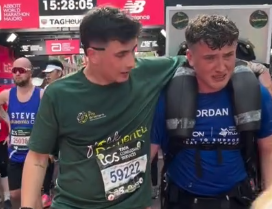
Against the advice of his brother, his father and his wife, who thought it was an idiotic idea, Jordan Adams arrived at the starting line of the London Marathon in April with a 25-kilogram, or 55-pound, refrigerator strapped to his back.
He ran the entire marathon leaning forward at an awkward angle. Any attempt to straighten himself would have sent him falling backward. In the months before the race, Jordan trained while carrying 20 kilograms of weight on his body.
Cian ran alongside him, poured water over his face, encouraged him, handed him energy gels and shouted, “Why are you running so slowly?”
“If he were a normal patient of mine,” Cian said, “I would have told him to stop immediately. But I knew he wouldn’t listen.”
“Carrying the refrigerator on my back was not just a physical challenge,” Jordan said. “It symbolized the weight we carry on our backs — dealing with a disease, a diagnosis and a future that human beings cannot truly process or understand.”
The grueling stunt worked, they said. It is difficult to ignore anyone walking around with a refrigerator strapped to his back, let alone someone running an entire marathon that way while shouting “Fuck dementia” every few miles.
At the finish line, Jordan collapsed into Cian’s arms. They embraced and sobbed. Images from the finish went viral on Instagram. Another bit of weight added to public awareness.
But there was little time for tears or social media posts. Immediately after the refrigerator marathon, Jordan began running a marathon a day across Ireland, covering all 32 counties over 32 consecutive days, with Cian, a physiotherapist, treating him along the way. Together with the London Marathon, Jordan completed 33 marathons in 33 days.
When they reached the finish line in Dublin, hundreds of people were waiting for them. Some held posters bearing an image of Geraldine Adams.
“I remember we had a wonderful childhood, mainly because of my mother’s personality and her joy for life,” Cian said. “What frustrates me now is that because of the six years in which we watched her die from the disease in front of us, I have no sweet memories left.”
“But when I was running in Ireland,” Jordan said, “suddenly all the memories of feeding her, making sure she didn’t wander off and get lost, taking her to the bathroom and watching her die disappeared, and what came back were the memories of her stories about Ireland and the accent she would put on when she wanted to make us laugh.”
“I remember that after they both found out they carried the gene, I was overwhelmed by terrible survivor’s guilt,” said their older sister, Kennedy Frampton, who did not inherit the mutation, nor did their father, Glen. “But now I mostly live with this awful feeling that in 15 or 20 years, I’ll be the only one in the family left alive.”
In October, Jordan, who left his job as a decorator and painter, is due to climb Mount Kilimanjaro. Cian will tend to his muscles at the end of the climb.
“We have to leave our legacy long after we die,” they wrote on their Instagram account.
A mechanism of acceptance
“At first, I didn’t really understand why I chose running, or why I chose all these strange and crazy running challenges,” Jordan said. “There are other, simpler ways to attract attention.
“Later I told myself it was escapism — running away from the images and memories of living with my mother during the last six years of her life, after she had been the life and soul of our family, or running away from the fate waiting for me and my brother, or from the end of our family.
“But with every run, I realized it was something completely different. I realized that running helps me accept my fate. It is like running through a tunnel, a mechanism of acceptance.”
Accepting that you will become ill at precisely the age when most people are at the height of their professional and family lives, when wisdom and experience begin to replace the energy and rebellion of youth.
Accepting that you are heading down the same cruel road your mother traveled in the final years of her life.
Accepting that this treacherous disease will not simply make them forget in the way Alzheimer’s disease does, but will take hold of them like a possession, changing their personalities, causing them to lose empathy and decency, become tactless, grow angry quickly and focus only on themselves — without even noticing those changes.
Accepting that parts of your brain will simply die while neighboring regions continue to function.
Accepting that one day you will no longer be able to speak or control your muscles.
Watching your brother go through it.
Accepting the memories of your loving, joyful mother lying in a hospital bed in the middle of the house, wearing a diaper, a blanket pulled up to her neck, only her eyes following you as you move around the room — and knowing that in a few years, that will be you.
“It’s surreal,” Jordan said. “I’ve never felt better.”
Accepting that there is no cure. Accepting all of it and continuing to run through that tunnel of acceptance.
Cian lost the desire to disappear after his mother’s death. Jordan stopped getting drunk and getting into fights in pubs. He got up after the six weeks of sick leave he had taken following the 90-second Zoom call in which a doctor told his younger brother that he, too, carried the damned gene.
Both decided to stop moving through the world with the crushing feeling that nothing was fair, that all of life’s injustice had somehow been directed specifically at them.
Run a marathon. Fly to Mexico to watch a World Cup match. Fly to Atlanta and have your heart broken in an Argentina-England semifinal. Watch tennis at Wimbledon. Climb mountains. Go on a honeymoon in Hawaii. Speak in Parliament about dementia.
Panic every time you forget someone’s name or misplace your keys, because who knows whether it is nothing or the beginning of the nightmare.
Every birthday is a countdown.
The brothers with the refrigerator, as people now recognize them on the street, will live short lives.
Their legacy will be timeless.