

The moment a young athlete is labeled “the heir to” someone, it automatically creates a heavy load of expectations and pressure. It is natural to search for the next big thing in a sport, but at the same time, it places a serious weight on the shoulders of a gifted young athlete.
Now imagine what that does to a 17-year-old whose role model is Artem Dolgopyat, a two-time Olympic medalist, with gold and silver, a world champion, a two-time European champion and the winner of numerous other medals at world and European championships. Gymnast Noam Berkowitz is flattered, but he is trying not to let it interfere with his progress.
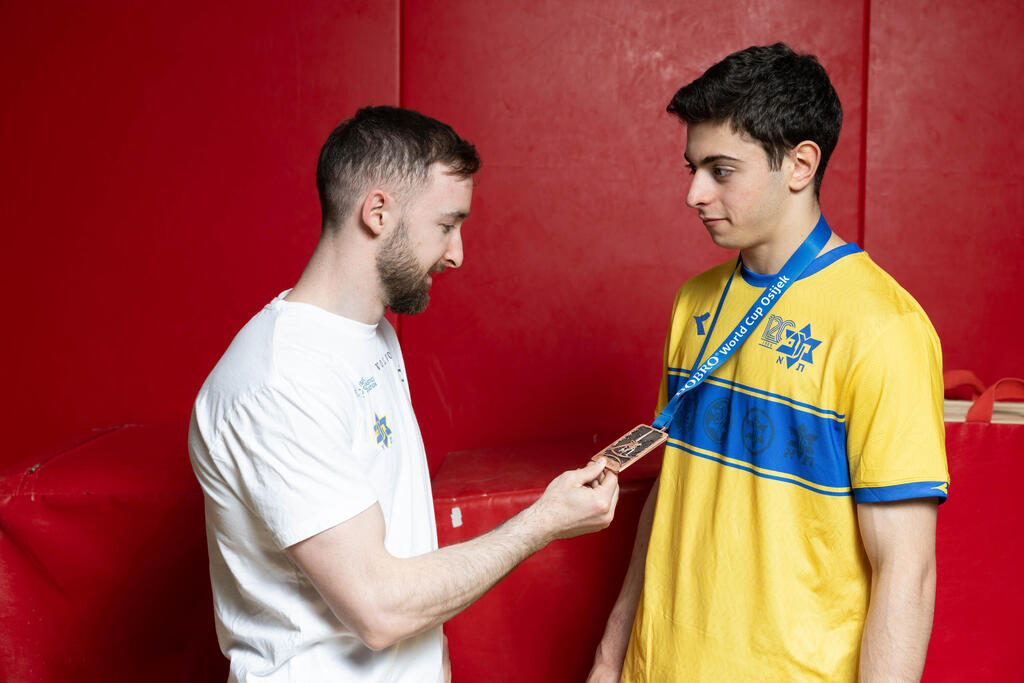
Dolgopyat, who some would call the greatest athlete in Israeli history, will turn 29 this summer. Even as he sets his sights on the Los Angeles Olympics, the pipeline built by national team head coach Sergei Weisburg and Maccabi Tel Aviv keeps producing new talent.
About two weeks ago, in only his second international senior competition, the World Cup in Croatia, Berkowitz reached the podium in the floor exercise after scoring 14 points and winning bronze. First place went to Dolgopyat, with 14.5 points, the same athlete the young Noam had posed with less than five years ago, after Dolgopyat returned from Tokyo with his Olympic gold medal. This time, they posed together on the same podium.
Dolgopyat’s blessing
Coach Weisburg first met Berkowitz when he was 7, and immediately spotted his potential, especially in his strength and leg movement. “He ran like a horse, even as a little kid,” Weisburg said.
Ten years later, he sees the young gymnast as someone who could help carry on the successful generation that came before him. “Today, it is not easy to prove your place when the results are so high, and I am very happy that after Alex Shatilov and Artem, there is a new generation, and Noam is one of them,” he said.
“We managed to prove that we are not stopping, that we have a next generation. Until the last moment before they step onto the floor, you do not think your gymnasts are the best. Then the podium comes, and you see it. You feel pride.”
He added that beyond talent, Berkowitz’s character and his ability to execute skills in training could take him far.
Dolgopyat smiles warmly when describing the feeling of sharing a podium with another Israeli gymnast. “It’s very exciting. I shared a vault podium with Andrey Medvedev many years ago, and back then I was stepping into his territory. This time, Berkowitz was with me. We were also together in the final at the competition in Germany in January. It’s a lot of fun. There’s someone pushing me now. It doesn’t let me ease up, and I have to stay more focused. He’s a good kid, a very good one, and I hope he continues both alongside me and after me.”
Berkowitz did not receive a tip from the Olympic champion during the competition itself, only during their joint practices. “He has what it takes. He gets into things pretty quickly,” Dolgopyat said. “I congratulated him after he won the medal.”
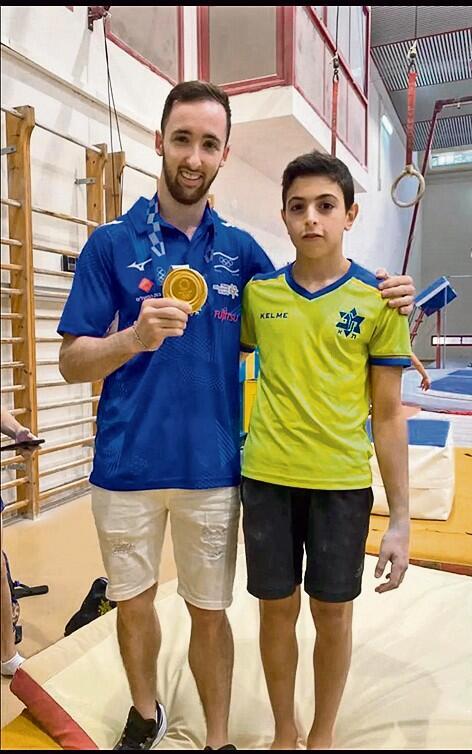
Artem Dolgopyat and Noam Berkowitz in 2021
(Photo: Courtesy)
Berkowitz himself says he was deeply moved to receive Dolgopyat’s blessing, and even more by the moment he saw his name among the three medalists. “I thought it would be enough for the final, and suddenly I won bronze,” he said. “It was crazy. I looked and couldn’t believe it. In my head, I imagine that I can develop, that this is only the beginning and I am still at an early stage in the senior ranks. To achieve results already now? I flew there to gain experience, to reach the final. Suddenly winning a medal is proof that I can do it.”
What does that mean for what comes next?
“Now I need to know how far I can get and what I need to improve. There is always something to improve. The drive, the fire in my eyes to work hard, all of that only grows. I want to feel this as many times as possible, to be on the podium as much as possible. I am not satisfied with third place.”
Did you hear that Sergei and Artem have marked you as the future generation?
“I got goose bumps when they said that. I heard it from my personal coach, Ilan Korchak, too, and I feel all the support and belief in me. That support gives you confidence. Not long ago, my mother sent me the photo of me as a child with Artem and told me to imagine what it would be like to stand on the podium with him. That is not something that comes easily."
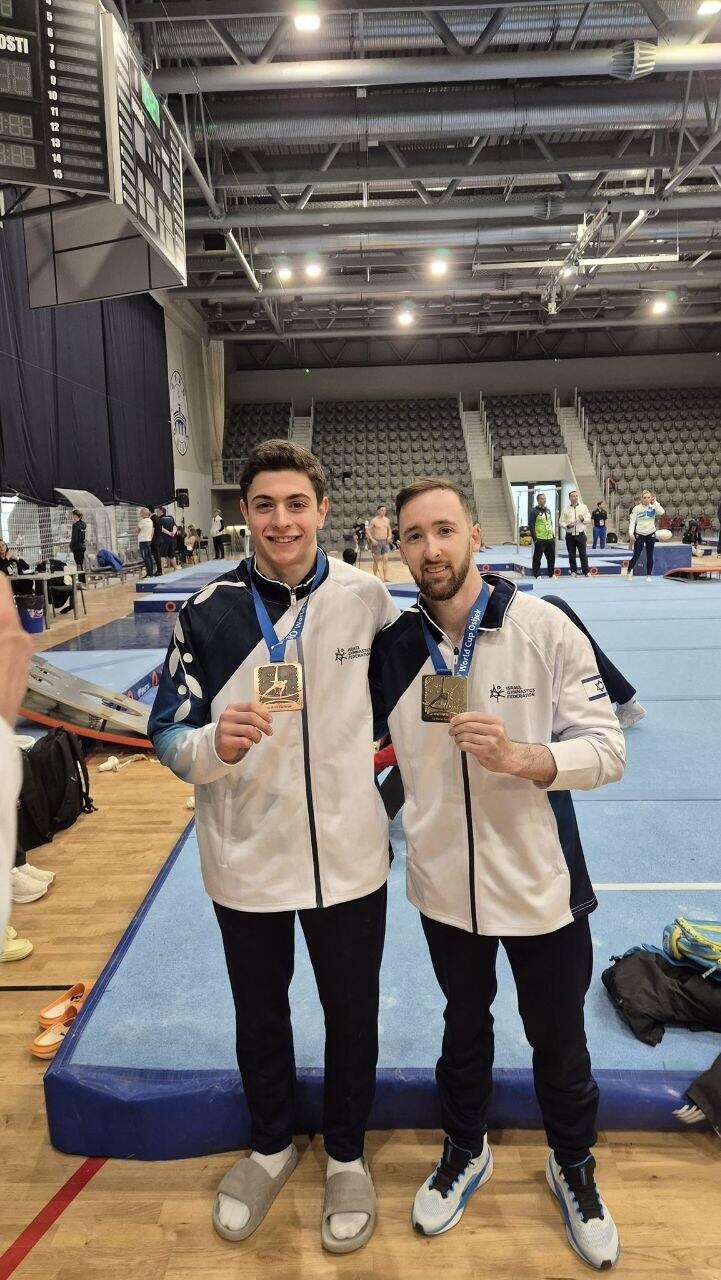
Artem Dolgopyat and Noam Berkowitz at the World Cup in Croatia
(Photo: Israel Gymnastics Federation)
‘I did not recognize a single gymnast’
One of the questions Berkowitz hears most often, right after he tells people which sport he competes in, is whether he was born in the former Soviet Union. He has gotten used to it, but the answer is no. His parents’ roots are in Yemen, Morocco, Poland and Romania, and he laughs about people telling him, “Bro, you look Russian.”
Berkowitz is from Givatayim. Everyone around him played soccer, but he was looking for something else. “I did not like playing soccer, and that was what we did in gym class,” he said. “I was full of energy and needed to release it, so I was in an acrobatics class until my mother saw an ad for Maccabi Tel Aviv gymnastics.
"I came to practice, I did not know what was going on, I had never seen the sport on TV. I did not recognize a single gymnast either. I did not know who Alex Shatilov was back then.” But he quickly fell in love with the sport, and the coaches saw real potential in him.
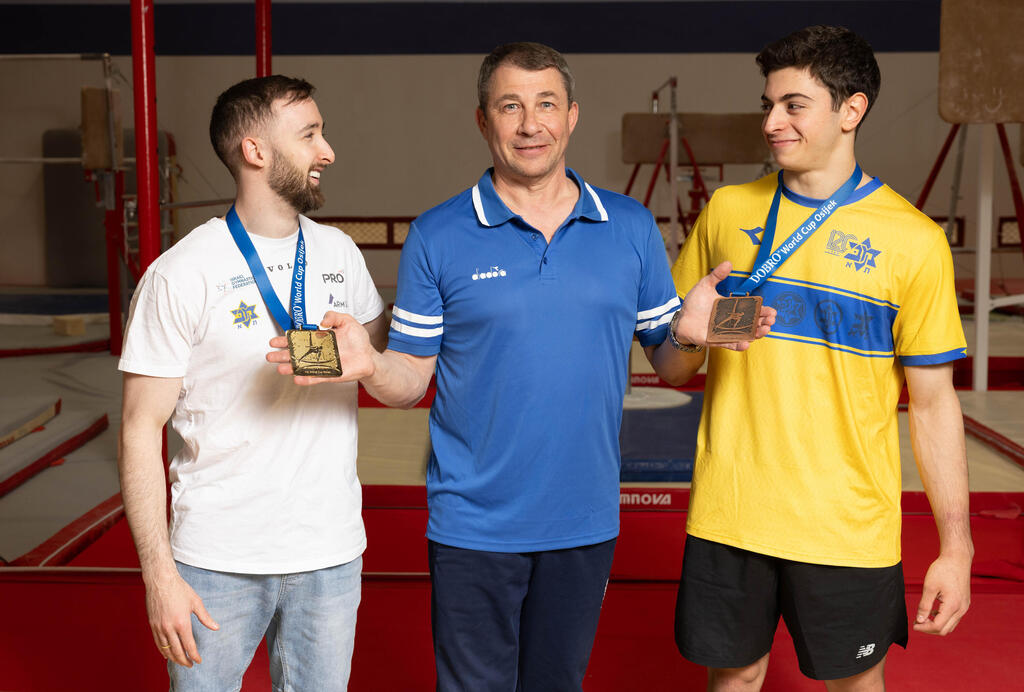
Coach Weisburg with his two gymnasts
(Photo: Oz Moalem)
His major achievements came at the junior level, including a third-place finish at the European Youth Olympic Festival. Last November, he finished eighth at the World Championships.
Beyond the intensive training, he invests in his studies. He is still a 12th-grade student at Kalai High School and is not willing to postpone his matriculation exams until his 20s. “I pick things up quickly. School comes easily to me. I like studying. I am taking advanced math, English and biology. I am interested in viruses and bacteria.”
He gets to practices with his mother, Gitit, who drives him between the gyms at Hadar Yosef and the Wingate Institute until he begins driving lessons and gets his license. How involved is his mother in nurturing his talent? She does not work and has devoted herself to her son’s career.
He appreciates the close support but admits he does not like it when she and his father, Nir, attend his competitions. “They both support me. My mother is up front, but she still does not know the terms. My father is behind the scenes.”
In addition to his parents’ support, Berkowitz is also supported by a foundation established by former judoka Peter Paltchik to help young athletes early in their careers.
Like Dolgopyat, Berkowitz has also found the floor exercise to be his preferred event. “I have a body type that fits the floor: strong legs and explosive power.” Only at the Tokyo Olympics did he begin paying attention to the level of the competitors in the event.
“At that time, I was competing a little in Israel, but I already saw what they do at those levels. I noticed the mistakes. I saw how the top gymnasts compete, and I told myself, ‘That is where I want to get.’”
Not just talent
Only recently did Berkowitz return to training and competing regularly after two serious injuries sidelined him for more than a year. The first was a stress fracture in his hand, which was even placed in a cast. After he recovered from that injury, he suffered a knee injury that forced him to train only with his hands, which worsened the first injury. Eventually, the young gymnast had to undergo surgery in which several millimeters of bone were removed.
“In February, I returned to full function,” he said. “During a period when you are not training, your fitness and endurance are affected. Every stoppage because of injury takes me backward.”
You are now on the senior national team, where there are demands and skills with high difficulty levels.
“Even as a junior, Sergei would watch me, even though I worked with Ilan, who is my personal coach. The demands are the same, and it is always hard work. I invest in training, give 100%, and I believe that with time I will improve on all the apparatuses. Artem has a high difficulty level. I hope that in the next competition I will add another element to my floor routine.”
How do you feel about the title “the heir”?
“On one hand, it is exciting. On the other hand, there is now an expectation from people. The ideal is for me to adapt myself to what fits me. The system is efficient and good, because look, they know how to bring gymnasts to the top, like Shatilov and Artem, and it works. It is not only something you are born with; it's not just talent.”
Are you aiming for the 2028 Los Angeles Olympics?
“Everyone around me thinks it is a realistic goal. I think so too, but at the same time, I know I will be only 20, and it is very difficult to get in at that age. I am not thinking about it right now. In August, I will have my first senior European Championship, and that is where things start to get serious. I am aiming for the final. I cannot think about the big goal when I do not yet have the smaller ones. “The Olympics are the long-term goal.”