

Romain Grosjean ended the 2020 Formula 1 season deeply frustrated. It was far more than just a bad year. Poor results were one thing, but in 2020 he also came frighteningly close to losing his life on the track.
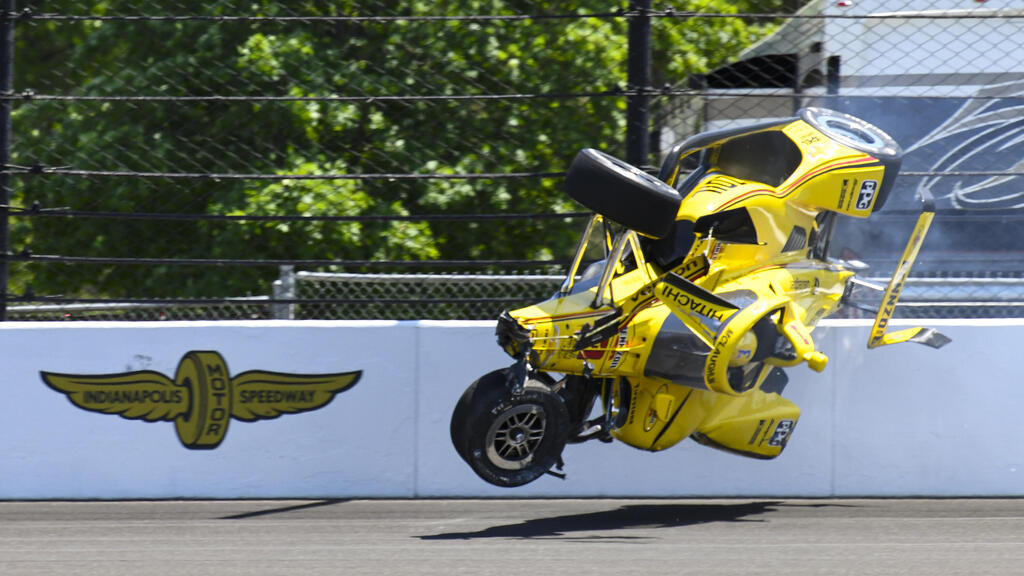
The French-Swiss driver was involved in a horrific crash at the Bahrain Grand Prix, slamming into the barrier at high speed. Within seconds, the car became a massive fireball, with Grosjean trapped inside for nearly half a minute. With some help and a great deal of luck, he managed to escape, suffering burns to his hand. Serious burns, but he was very much alive.
His worried children tried to persuade him to quit racing, while Grosjean himself began reassessing his place in the sport. It was not only that famous crash, but also a string of mediocre seasons that had made him a less-than-desirable commodity in the ruthless drivers’ market. The accident was a wake-up call: Grosjean realized that even if he chose to continue as a professional racing driver, he had to make a change.
Failure and disappointment are an inseparable part of sport, any sport. And a true athlete does not allow setbacks to defeat him. He finds a way to lift his head and fight again.
Grosjean’s problem was the feeling that things were not really in his hands. The Haas car he was driving simply was not good enough, no matter how hard he trained, improved or fine-tuned it. As long as he was in such an inferior machine, he had no chance of beating the leading drivers.
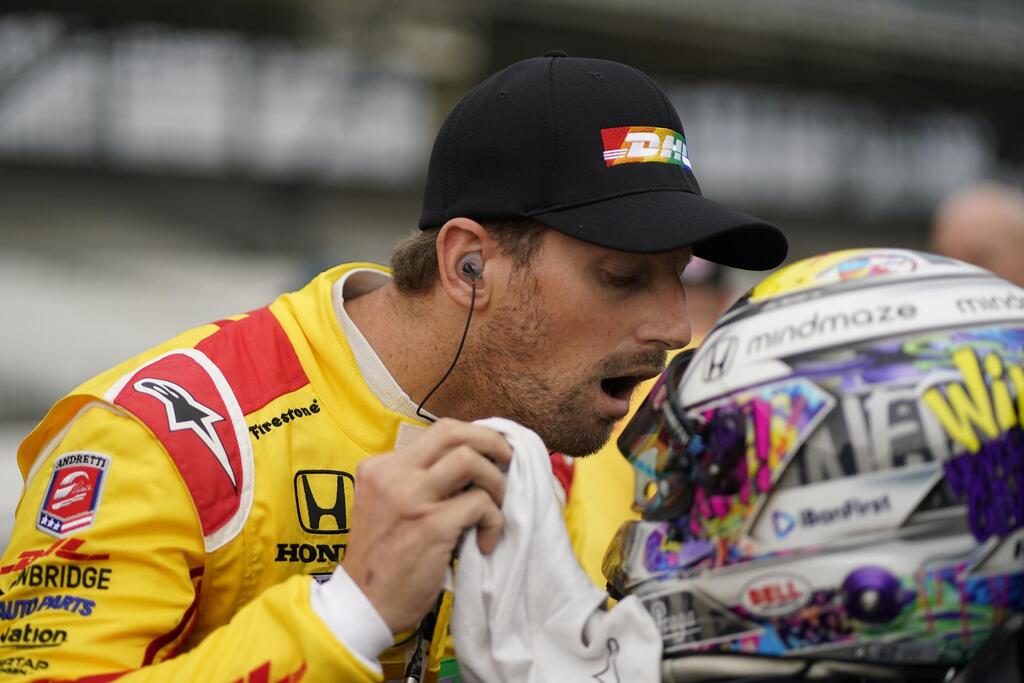
(צילום: AP)
Grosjean realized he had to find a way to neutralize the machine as much as possible from the outcome. One thing led to another, there were consultations with friends and colleagues, and the likable French-Swiss driver found himself across the Atlantic in America’s IndyCar series.
Fast-forward, and a racing career that seemed to be on the brink was given a new lease on life. From a fairly anonymous driver, Grosjean became a regular podium contender in a star-studded field and earned the nickname “Phoenix,” a reference to his remarkable comeback.
By his third race, Grosjean had already qualified on pole after setting the fastest lap in qualifying. He finished the race second.
More equal, less equal
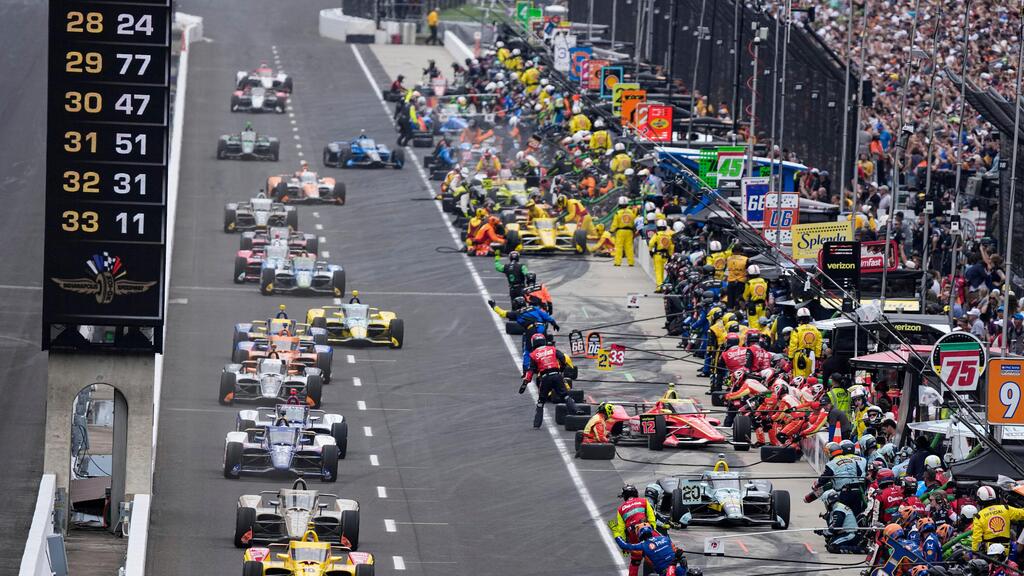
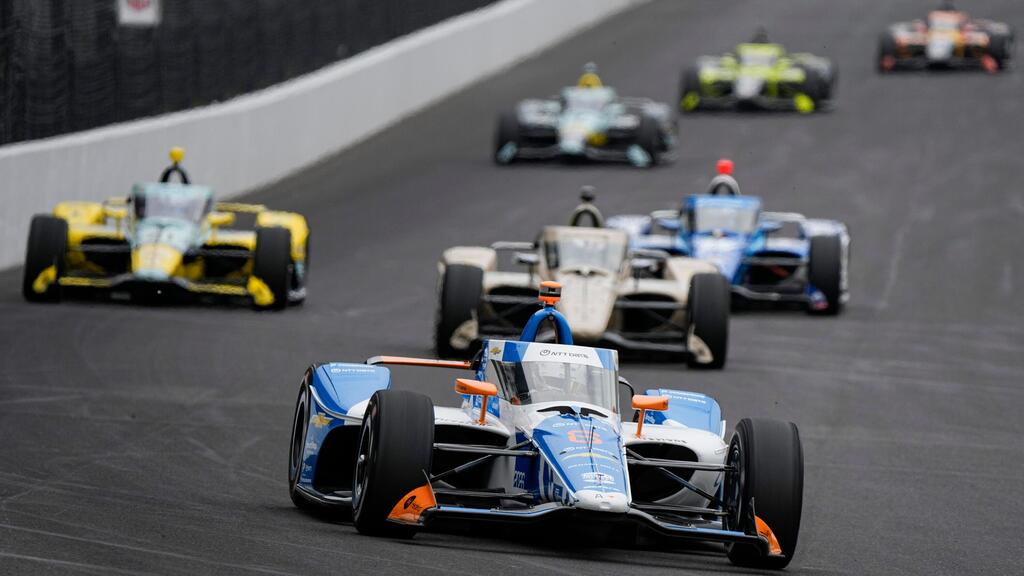
IndyCar is the closest thing the United States has to a counterpart to the more European Formula 1. It also features purpose-built, open-wheel cars driven by top drivers from around the world. On the surface, they look similar. In practice, they are very different.
To understand how different, it helps to go back to Grosjean.
What prevented him from succeeding in Formula 1 is at the heart of the world’s most prestigious racing series, and also one of the main criticisms leveled against it: The competition is not really between drivers, but between manufacturers.
(Photo: AP)
It is an extreme technological arms race in which whoever can raise the most money, allowing it to develop the best car, is also likely to achieve the best results. Even the best driver in the world cannot win a championship in an inferior car.
In principle, the argument is correct. In practice, there are countless examples that undermine it.
For instance, there are teams with virtually unlimited budgets — hello, Ferrari, how’s it going? — that for many seasons fail to seriously challenge teams spending less. There are also excellent drivers who have failed in the best car — hello to anyone who has found himself alongside Max Verstappen at Red Bull — and that is far from the whole story.
But at its core, the argument stands.
The enormous cost of running a competitive team capable of fighting for race podiums, let alone a championship, creates haves and have-nots on the grid. In Formula 1, every team designs its car from scratch and introduces staggeringly expensive changes and upgrades throughout the season. In IndyCar, all teams use the same chassis.
Engines? In Formula 1 there are multiple suppliers, which intensifies the technological competition. In IndyCar, all cars use either Honda or Chevrolet engines. Those strict standardization rules shift much of the competition toward the drivers and the talent of the technical teams.
The financial differences are enormous as well. The annual budget for an IndyCar team is around $11 million to $14 million per car. That is roughly a quarter of the annual salary of a top Formula 1 driver. In Formula 1, the development and team operating budget is capped at $215 million, and teams are not allowed to exceed that figure. All the teams reach it.
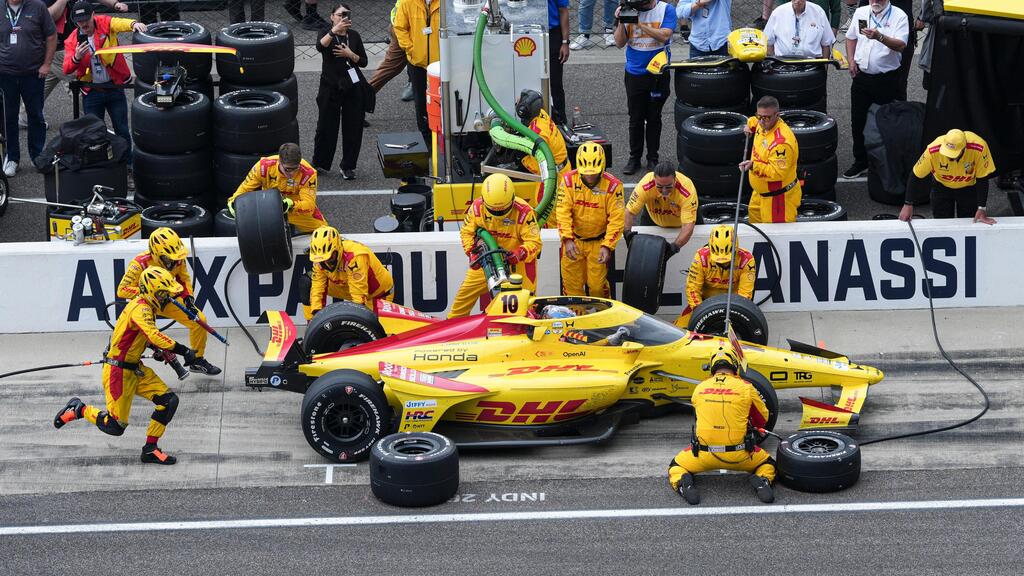
IndyCar racing
(Photo: AP)
But — and it is a very big but — the top teams spend another $200 million to $300 million on areas not covered by the cap. Engines, for example, or driver salaries, public relations, hospitality, logistics and travel, senior executive salaries and much more.
It is not an exaggeration to estimate that the leading Formula 1 teams — Mercedes, Ferrari, Red Bull and McLaren — spend more than half a billion dollars a season. That is enough to run the entire IndyCar field and still leave a handsome surplus.
This is no accident.
Formula 1 has always been a glittering showcase for motor racing, an arena where the richest and most powerful car companies in the world compete to develop the fastest, most technologically advanced and most powerful machines they can build.
IndyCar, by contrast, is the more populist version of racing. The cars are less glamorous, the technology is not groundbreaking, but the competition is far more authentic and rewards talented drivers more directly because the machinery is so similar.
As befits a more down-to-earth racing series, IndyCar is also much more family-oriented, warm and sociable than the cold and distant world of Formula 1.
In Formula 1, the biggest stars are elevated to almost godlike status and surrounded by polished public-relations operations and large teams that keep them separated from the outside world, and especially from rival teams and drivers. In IndyCar, the drivers, including the stars, travel around the United States in RVs with their families, park behind the track and hold barbecues together.
“The atmosphere among the drivers is great. We laugh with each other and have fun,” Grosjean said. “We are very competitive on the track, but the moment you take off the helmet, you are friends with the other drivers, and surprisingly, that’s something you don’t find anywhere else.”
But it is not only the barbecues and family outings that make IndyCar more accessible than its glittering counterpart. Take, for example, the coveted paddock pass, the one that lets spectators wander near the pit area, where they can see drivers up close, lose their hearing from screaming engines and get intoxicated by the smell of fuel.
In Formula 1, that is a very expensive VIP experience. Even a three-day package at the “Paddock Club” for the Barcelona race, including food and drinks and costing about NIS 20,000, will not actually get you into the pit area. It only gets you onto a balcony above it. The drivers will not see you, and the overall feeling is: “Fine, you paid, enjoy yourself, but don’t bother us.”
(Photo: AP)
In IndyCar, a weekend paddock pass will cost around $150, and some races allow that access at no extra charge. The drivers walk around freely among the crowd, and there is a good chance there will also be an organized autograph and selfie session.
Splits and reunions
IndyCar’s roots go back to the early 20th century. In 1909, Indianapolis Motor Speedway opened in Indiana, and two years later it hosted the first Indianapolis 500, which eventually became the centerpiece of the entire series and one of the most prestigious motor races in the world.
It is part of motor racing’s Triple Crown, alongside the Monaco Grand Prix in Formula 1 and the 24 Hours of Le Mans. Only one driver in history, Britain’s Graham Hill, has won all three.
But as often happens in sports, the long road to the IndyCar series we know today was marked by disputes, ego battles and breakaways. In the late 1970s, for example, team owners became increasingly dissatisfied with the governing body, the United States Auto Club, or USAC. They believed USAC was nowhere near realizing the commercial potential of the races and was focusing almost all its attention on the Indy 500 while neglecting the rest of the series.
One of those team owners, Dan Gurney, drafted a landmark position paper known as the “Gurney White Paper,” proposing the creation of a new organization called CART that would pressure USAC to increase prize money and improve television contracts.
At the height of the crisis between the sides, tragedy struck: Eight senior USAC officials were killed in a plane crash, leaving the organization in a leadership vacuum and further weakening its position against the team owners.
The CART leaders, determined to push through the changes they wanted, presented their demands to USAC’s new leadership. Every one of them was rejected outright. That was the moment CART decided to break away from USAC and create a rival series.
Unlike the outdated championship, the new league was modern and glamorous, with international sponsors and television broadcasts. Racing fans quickly abandoned the declining organization in favor of the shiny new kid on the block.
Seventeen years later, another split once again turned the series upside down. Tony George, owner of Indianapolis Motor Speedway, decided in 1996 to leave CART and create a rival championship called the Indy Racing League, or IRL. The dramatic move badly hurt both sides, reducing the popularity of the races and sponsors’ interest.
For CART, it was an economic blow that brought it to the brink of collapse. And so everyone limped into mediocrity until 2008, when the two bodies finally reached a reunification agreement. CART was absorbed into the IRL, and together they created the IndyCar series in the form familiar today.
Milk instead of champagne
In its current format, the series includes 18 races across the United States.
The races are held on classic oval tracks, where drivers turn only left and cars race at speeds approaching 400 kph, but also on conventional road courses with different types of turns and even on street circuits. The high point of the season comes in May, when the Indy 500 is held over Memorial Day weekend.
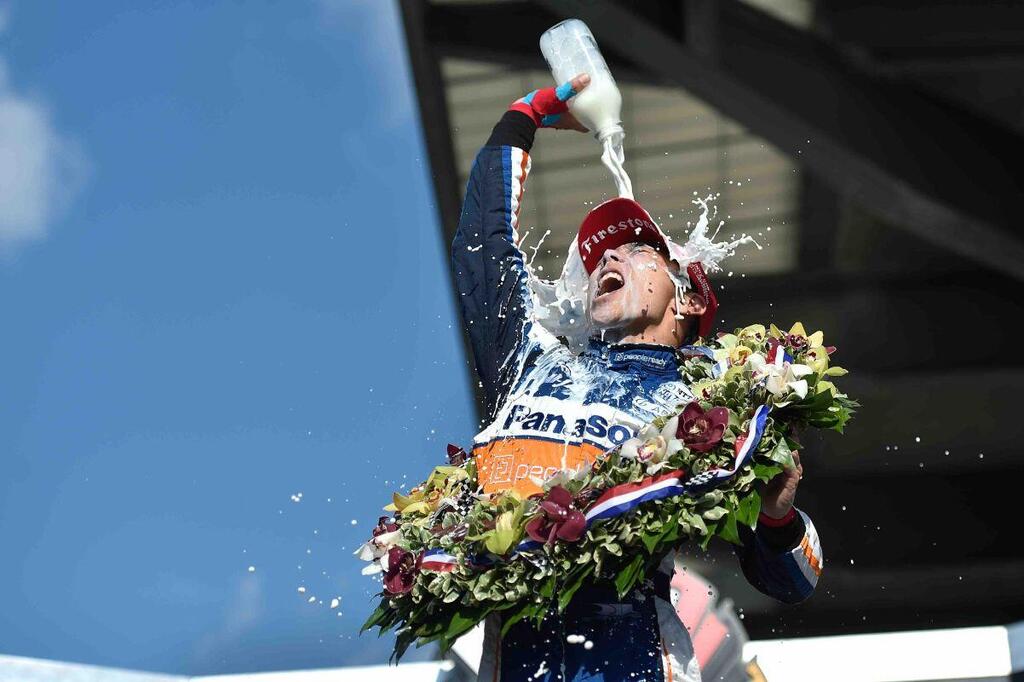
Celebrating victory with milk instead of champagne
The historic race is much more than just a race. It is a carnival known as “The Greatest Spectacle in Racing,” with a host of events and traditions. Drivers and teams spend two weeks at the circuit practicing, making adjustments and qualifying.
An estimated 300,000 to 400,000 excited spectators attend the celebration, filling the area around the track with an enormous number of vehicles of every kind, including thousands of RVs and motorhomes. And in one magical moment, they all sing “Back Home Again in Indiana,” the state’s unofficial anthem, just seconds before the start.
For the past 30 years, tradition has dictated that the winning driver, his family and his team kiss the strip of bricks across the start-finish line after the race, a remnant of the bricks used to build the original track in 1909.
The winner’s trophy, the Borg-Warner Trophy, is considered one of the most magnificent in sports. It stands 160 centimeters tall and includes three-dimensional reliefs of the faces of previous race winners.
But with all due respect to the trophy, the bricks and the mass singing, the most famous Indy 500 tradition is the milk. Unlike the champagne used in other sporting celebrations, the Indy 500 winner drinks a bottle of cold milk.
The tradition dates back to 1936, when driver Louis Meyer won the Indy 500 for the third time and asked for milk afterward to refresh himself. Although he asked for a glass, he was given a bottle, and a photographer captured him drinking from it while holding up three fingers to mark his third victory in the race.
A local dairy company spotted the marketing potential and began offering the winners a bottle of milk every year. And so a tradition was born. Today, every driver must declare before the race what kind of milk he wants: 2%, whole milk or fat-free.
That’s how it is in 2026.
One unusual moment in the long tradition came in the 1993 race. That year’s winner was Brazilian Emerson Fittipaldi. The legendary driver refused to drink the bottle of milk offered to him and instead drank orange juice.
He had a reason. Fittipaldi owned large orange groves in Brazil and hoped to promote his business. But the American crowd felt that the Brazilian winner had insulted them and disrespected a local tradition, and responded with loud boos.
Fittipaldi tried drinking milk afterward, gave up $5,000 in prize money and publicly apologized in an effort to calm things down. It did not help. Even when he returned to the Indy 500 in 2008, 15 years after the orange juice incident, the crowd booed him.
A champion’s meal
Thirty-three drivers from 14 countries are competing for the championship this season.
Among the familiar names besides Grosjean is Mick Schumacher, son of Formula 1 legend Michael Schumacher, who is making his debut in the series this year. For an Israeli angle, last year IndyCar featured Robert Shwartzman, who was born in Israel and raised in Russia.
But the biggest star today is not an American driver, but a Spaniard: Alex Palou, 29, who has won four championships in the past five years. He celebrated his 2021 title by taking his victory lap in a limousine shaped like a chicken, a tribute to his favorite post-victory meal: fried chicken.
And what about women?
The Indy 500 once maintained an openly sexist policy. Women were not only barred from competing in the race, but until the early 1970s female journalists were not allowed in the pit area, unlike their male counterparts.
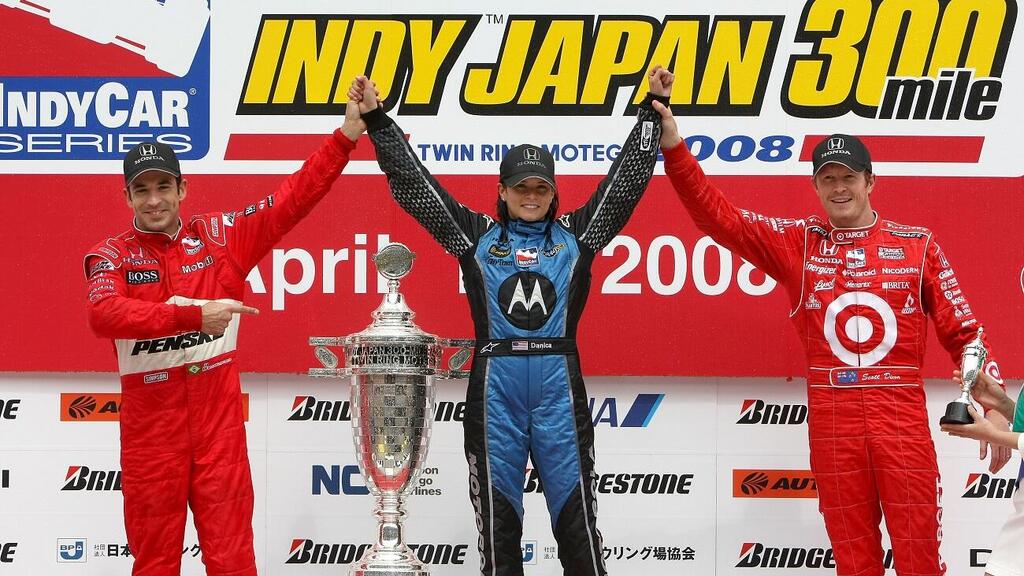
The most famous woman in IndyCar history is Danica Patrick
(Photo: Getty Images)
The pioneer was driver Janet Guthrie, the first woman to qualify for and compete in the Indy 500. She raced in it three times and finished ninth in 1978.
But the most famous woman in IndyCar history is Danica Patrick. In her first Indy 500 in 2005, she finished fourth. In 2009, she improved on that achievement by finishing third in the race and fifth in the series overall. She became a sporting icon, appearing in advertisements and on the covers of popular magazines, and her influence on women’s participation in motorsport has been enormous.
These stories — from drinking milk to the great orange juice betrayal and Patrick’s groundbreaking success — are what define and distinguish America’s IndyCar series.
Formula 1’s popularity cannot and should not be challenged. The prestigious championship is expected to remain, especially given the impact of Drive to Survive, the most popular series in motorsport.
But for anyone looking for racing that puts the person, rather than the machine, at the center, IndyCar is a terrific alternative.
Enjoyment is guaranteed even for those who are lactose intolerant.