

Things you can do in half an hour: drive from Tel Aviv to Netanya without traffic, take a healthy power nap, cook a simple meal, shop at the supermarket, go for a five-kilometer run, swim a little over a kilometer or fly from London to Amsterdam.
Now take a deep breath and imagine doing all of those things without breathing even once. No oxygen in, no air out. It sounds impossible. It goes against every reasonable survival instinct. The average person can hold their breath for 30 to 90 seconds. After three minutes, loss of consciousness is possible. After five minutes, brain damage may occur. Dolphins and professional freedivers can manage about 10 minutes. Seals can last up to half an hour.
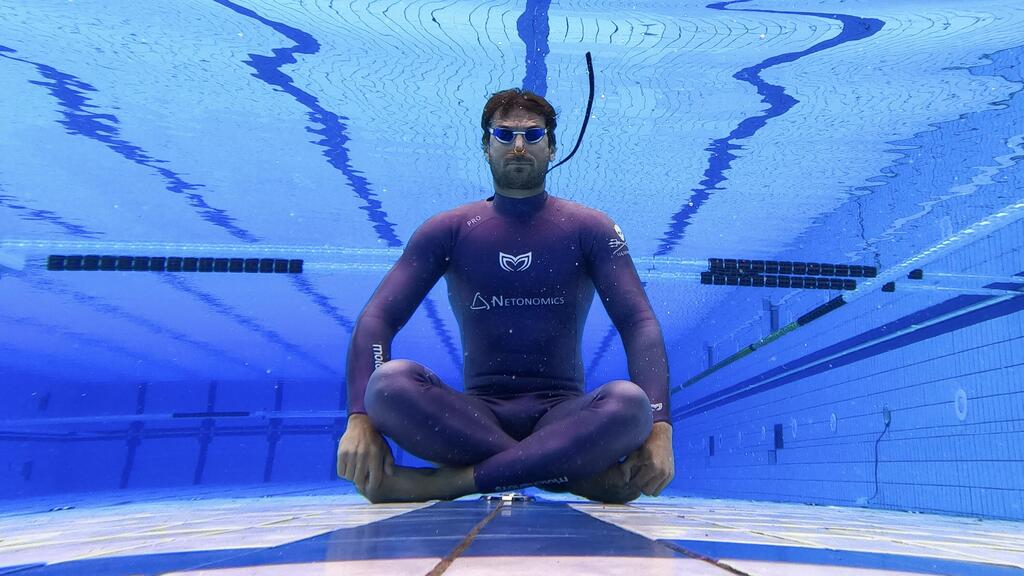
Vitomir Maricic, trained for countless hours to gain iron control over his body and mind
(Photo: Damir Sencar/ AFP)
And now meet Vitomir Maricic, a 40-year-old Croatian freediver.
Maricic entered a circular pool three meters deep that had been installed inside the ballroom of the Bristol Hotel in the Croatian resort town of Opatija. One hundred spectators and five judges were present. Wearing a swimsuit, goggles and a nose clip, Maricic lay on the pool floor with his hands behind his head and held his breath for 29 minutes and three seconds.
The achievement broke the previous world record, held by fellow Croatian Budimir Sobat, by nearly five minutes and earned Maricic a place in the Guinness World Records.
With the help of pure oxygen
Before trying to understand the scale of the achievement, one important clarification is required. Maricic set his record in a category known as Static Apnea with Oxygen. He breathed pure oxygen for 10 minutes before submerging, a method called denitrogenation, which increases the concentration of dissolved oxygen in the blood plasma and tissues. This process can raise the amount of oxygen in the body to as much as five times the normal level.
The record for static apnea using regular air belongs to Serbian freediver Branko Petrovic, who held his breath for 11 minutes and 35 seconds. Maricic’s own personal best in that category is 10 minutes and eight seconds.
Even with that caveat, the achievement remains extraordinary. Reaching it required countless hours of training to achieve iron control, both physical and mental, over body and mind, with the goal of suppressing the most basic survival instinct.
What instinct is that exactly?
The urge to breathe does not come directly from a lack of oxygen. It is triggered by rising levels of carbon dioxide in the blood. This buildup begins the moment breathing stops. Once carbon dioxide reaches a certain threshold, sensors in the brain and throat begin sending intense distress signals.
That is why freedivers like Maricic train not only their lungs but also their nervous systems. The goal is to teach the body and brain to delay and tolerate those distress signals. The methods include overfilling the lungs with air, meditation techniques designed to induce deep calm and absolute self-control, and intensive training of the diaphragm, the most important muscle involved in breathing.
“After 20 minutes underwater, I started having severe diaphragm contractions,” Maricic said after emerging from the pool. “But surfacing to breathe was not an option. Giving up was not in my vocabulary that day. My training focuses mainly on the mental side, meditation, relaxation, living each breath. Then there is also the technique of oxygen transfer while you are underwater. All of this is meant to defeat the reflex and the fear.”
For most people, those waves of diaphragm contractions mark the end of any attempt to hold their breath. For freedivers like Maricic, they signal the beginning of the real battle, a battle of willpower.
Once his adrenaline subsided, Maricic returned to his other hobbies: bungee jumping and walking on a tightrope stretched between cliffs.
“I have no fear of death,” he has said in the past.
Walking underwater
Freediving is an exercise in anatomical rebellion. Under normal circumstances, the brain issues a demand and the body responds almost immediately. There is little room for negotiation.
For years, feats like these were viewed as parlor tricks rather than athletic achievements. In 2008, the world record holder was magician and endurance performer David Blaine, who held his breath for 17 minutes and four seconds during an appearance on Oprah Winfrey’s television show. The sport has evolved significantly since then.
In addition to his latest record, Maricic also holds world records for underwater walking at 107 meters, the most backflips performed at a depth of 20 meters and underwater squats while carrying the heaviest weight.
Next, Maricic plans to challenge the world record held by Russian freediver Alexey Molchanov, who reached a depth of 156 meters in the variable weight freediving category. Maricic intends to attempt a dive to 160 meters. “Underwater, you deal with two opposites,” Maricic said after setting the record and recovering from headaches and internal bleeding. “Meditation takes you somewhere else, outside your body, but the body hurts and pulls you back. You keep thinking that this is it, that you have no more answers to the pain. Then another window opens, with more questions you have to answer for yourself.”