


How can water be used to actually reduce the amount of carbon dioxide, or CO₂, in the environment?
On the shores of Kibbutz Ma’agan Michael, Israeli climate-tech company CarbonBlue is working to harness a mechanism nature has been using for millions of years: the ability of water — particularly the oceans — to absorb carbon dioxide from the atmosphere.
CarbonBlue
(CarbonBlue)
Founded in 2022 by physicist Dr. Dan Deviri, a Technion graduate, and Ido Tzur, a graduate of Israel’s elite Talpiot program, CarbonBlue is developing technology that removes CO₂ already dissolved in water, allowing that water to subsequently absorb more carbon from the air.
The connection between the two founders began during their military service. Deviri came to the venture with a scientific background spanning physics, chemistry and biology, following an unusual academic path that began when he started studying at the Technion at just 14 years old. Tzur brought technological and management experience from Israel’s defense establishment.
After their military service, the two reconnected around a shared desire to address the climate crisis. They began looking at one of the biggest challenges facing carbon removal: How can significant quantities of CO₂ be removed from the environment without constructing enormous and expensive systems whose sole purpose is to process air?
The answer led them to water.
The oceans naturally absorb a significant portion of the carbon dioxide emitted by human activity, with a continuous equilibrium between CO₂ concentrations in the water and in the atmosphere. CarbonBlue is attempting to use that equilibrium to its advantage. When carbon already dissolved in water is removed, the chemical balance changes. When the water comes into contact with the atmosphere again, it can absorb additional CO₂ from the air.
Put simply, CarbonBlue is not trying to teach nature a new trick. It is trying to create more room in the water for a process nature already performs.
The company separates dissolved carbon through a process involving minerals and energy, producing concentrated CO₂ that can later be permanently stored or used in other processes. If the cycle can be repeated at large scale, every quantity of carbon removed from the water could enable the absorption of additional carbon from the atmosphere.
One of the key materials in the process is something humans have used for thousands of years: lime.
Traditionally, limestone, or calcium carbonate, is heated to high temperatures, breaking it down into lime and carbon dioxide. The problem is obvious: the process requires large amounts of energy and generally involves burning fuels and generating additional emissions. When the goal is carbon removal, relying on a material whose own production is emissions-intensive can undermine the benefits of the entire process.
CarbonBlue therefore developed an electrical process it calls EcoLime, which allows lime to be produced at ambient temperature without kilns or the burning of fossil fuels.
In the carbon-removal process, the lime is used to bind dissolved CO₂ in the water, while the system separates the carbon and recycles some of the materials needed for the next cycle. The company is also exploring the production of lime from alternative calcium sources, including industrial waste and construction materials, as part of an effort to make the process more circular.
The need for technologies like these is growing.
Reducing new emissions remains essential to tackling global warming, but an entire industry is also emerging around removing some of the carbon that has already accumulated in the environment.
The biggest challenge is scale. For carbon-removal technologies to have a meaningful impact, they will ultimately need to handle enormous quantities of CO₂.
That is where CarbonBlue’s approach could offer an advantage. Rather than necessarily building entirely new infrastructure dedicated solely to carbon removal, its systems could potentially be integrated into facilities that already process large volumes of water.
In May 2025, the company took a significant step in that direction.
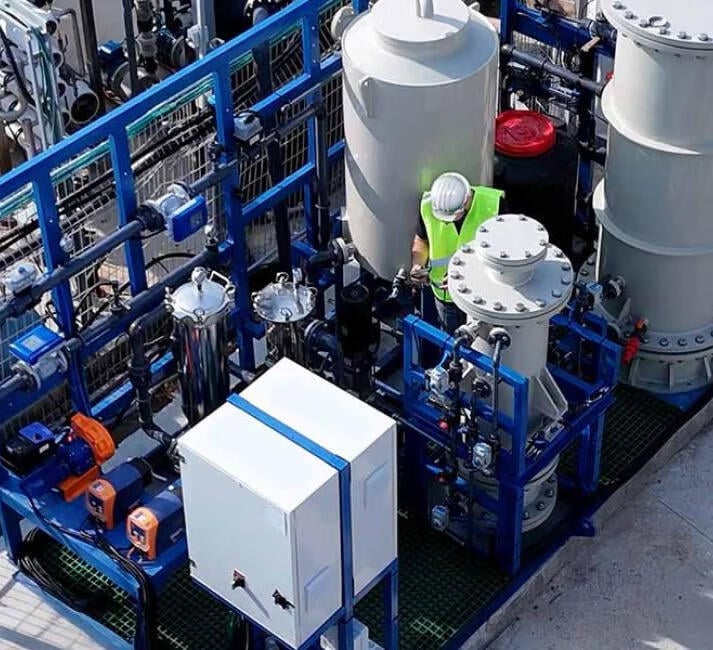
As part of Project Midway, CarbonBlue integrated its technology into an operating brackish-water desalination facility at Ma’agan Michael, in what the company describes as the first continuous integration of carbon-removal technology into an industrial desalination plant.
In its initial phase, the system processes approximately 15 cubic meters of water per hour, with the capacity to remove around 40 metric tons of CO₂ annually. The next phase is expected to increase capacity tenfold, to approximately 150 cubic meters per hour and around 400 metric tons of CO₂ per year.
According to the company, the system can remove approximately 90% of the dissolved CO₂ from the water. The integration could also improve the desalination plant’s performance and increase the amount of usable water it can produce.
About four and a half years after Deviri and Tzur founded CarbonBlue, the central challenge is no longer simply proving that the concept works, but demonstrating that it can be scaled.
And the vision extends beyond desalination. The company aims to integrate its technology into other water infrastructure and industries such as steel, construction materials and paper, where mineral processing, material reuse and emissions reduction could potentially be combined.
The road to global-scale impact is still long. But at Ma’agan Michael, CarbonBlue is already demonstrating how a seemingly simple natural mechanism can be transformed into an industrial tool in the fight against climate change.