


Sometimes a breakthrough begins not with a carefully crafted business plan, but with a question thrown into the room.
In 1999, Prof. Amnon Shashua, a computer vision researcher at the Hebrew University of Jerusalem, was invited to meet with automotive industry executives in Japan. During the visit, he was asked whether a car could be identified using a camera — and then whether it could be done using just one camera.
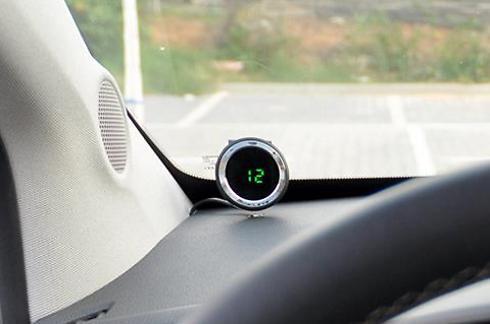
Shashua believed it could.
Ziv Aviram, who would later co-found Mobileye with him, told ynet that the Japanese company gave Shashua $250,000 to develop a proof of concept. “We took a student, built a computer and presented the company in Japan with a concept four months later,” he recalled. The demonstration succeeded, the Japanese company invested additional funds, and Mobileye was founded that same year.
Years later, Aviram summed up the beginning simply: “We stumbled upon a huge market and a big idea completely by chance.”
The idea grew directly out of Shashua’s academic research in computer vision. At a time when the automotive industry largely assumed that advanced safety systems would require radar, or at least two cameras, to estimate distance and movement, Shashua demonstrated that a wealth of information could be extracted from the image of a single camera — provided the algorithms analyzing it were sophisticated enough.
Shashua, who remains a full professor and holds the Sachs Chair in Computer Science at the Hebrew University, partnered with Aviram, who took responsibility for management, finance and the business side of the company, while Shashua led its technology, research and vision.
The goal, in a sense, was to give the car eyes and a brain.
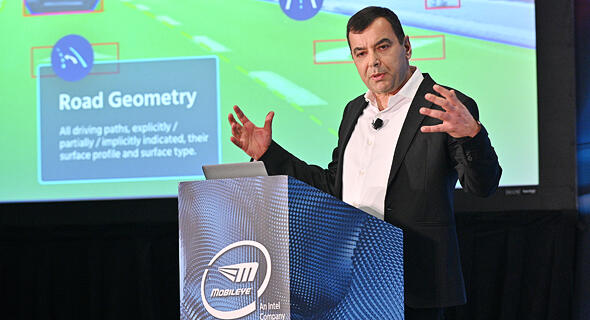
Mobileye co-founder Amnon Shashua
(Photo: Walden Kirsch/Intel Corp.)
A camera mounted at the front of the vehicle captures the road, while a computer vision system analyzes lanes, vehicles, pedestrians, traffic signs and other potential hazards in real time. Based on that information, the system can warn the driver or enable the vehicle to perform actions such as emergency braking and lane keeping.
But Mobileye realized early on that software alone would not be enough. In 2001, the company made an unusual and expensive decision: to develop its own dedicated processor capable of performing the necessary calculations quickly and with low power consumption.
The result was EyeQ, a chip designed specifically for computer vision and driving applications. The first generation was completed in 2004, and by 2007 Mobileye’s systems were already being incorporated into mass-production vehicles.
What initially looked like a gamble gradually became one of the biggest success stories in Israeli high-tech.
In 2014, Mobileye went public on the New York Stock Exchange in what was then the largest IPO ever by an Israeli company. Three years later came the deal that made Mobileye a household name in Israel: Intel acquired the company for $15.3 billion, at the time the largest exit in the history of Israeli high-tech.
The relationship between the two companies had deepened in part through their joint work with BMW on the development of autonomous vehicles. Following the acquisition, Aviram stepped down, Shashua became CEO, and Mobileye’s headquarters and primary R&D center remained in Jerusalem.
In 2022, Mobileye returned to the public markets with a new listing on Nasdaq, while Intel remained its controlling shareholder.
But the acquisition was not the end of the story. Quite the opposite.
As of July 2026, more than 250 million vehicles worldwide had been produced with Mobileye’s EyeQ technology, with its systems incorporated into more than 1,400 vehicle models.
At the same time, the company is attempting its next major leap: moving from systems that warn and assist drivers to systems that take over an increasingly significant share of the driving task.
SuperVision and Surround ADAS are designed, among other capabilities, to enable advanced hands-off driving under certain conditions, while Mobileye Drive is a complete system intended for fully autonomous, driverless vehicles. The company is also developing REM, a system in which vehicles already traveling on roads collect data that helps create and continuously update detailed maps for automated driving systems.
And that vision is no longer confined to a handful of experimental vehicles.
During 2026, more than 100 Volkswagen ID. Buzz vehicles equipped with Mobileye Drive took part in road testing across six cities in the United States and Europe. Volkswagen Group’s MOIA also began trials in Hamburg carrying members of the public, at this stage with safety drivers on board.
In June, Mobileye took another step, announcing plans to operate its own robotaxi service in the United States beginning in 2027, rather than limiting itself to supplying autonomous-driving technology to automakers.
“Mobileye has spent more than two decades building the technologies required for autonomous driving,” Shashua said in the company’s announcement. “Today, we are taking the next step.”
More than a quarter of a century after that question was put to Shashua in Japan, Mobileye has already demonstrated that its original idea can work on a global scale.
A single camera and an algorithm born out of research at the Hebrew University have evolved into technology embedded in hundreds of millions of vehicles.
Now, the Jerusalem-based company is trying to complete the most ambitious part of that vision: taking the “eyes” it gave the car — and connecting them to a system capable of driving on its own.
First published: 13:49, 09.09.26