


The printing machines of the Be'eri Press, restarted by its employees a week after the massacre, are churning out hundreds of colorful children's books in which the child is the main hero. The technology belongs to the Israeli company MeBook.AI, which produces a personalized book that includes the child's name and picture, combining AI with stories written by humans.
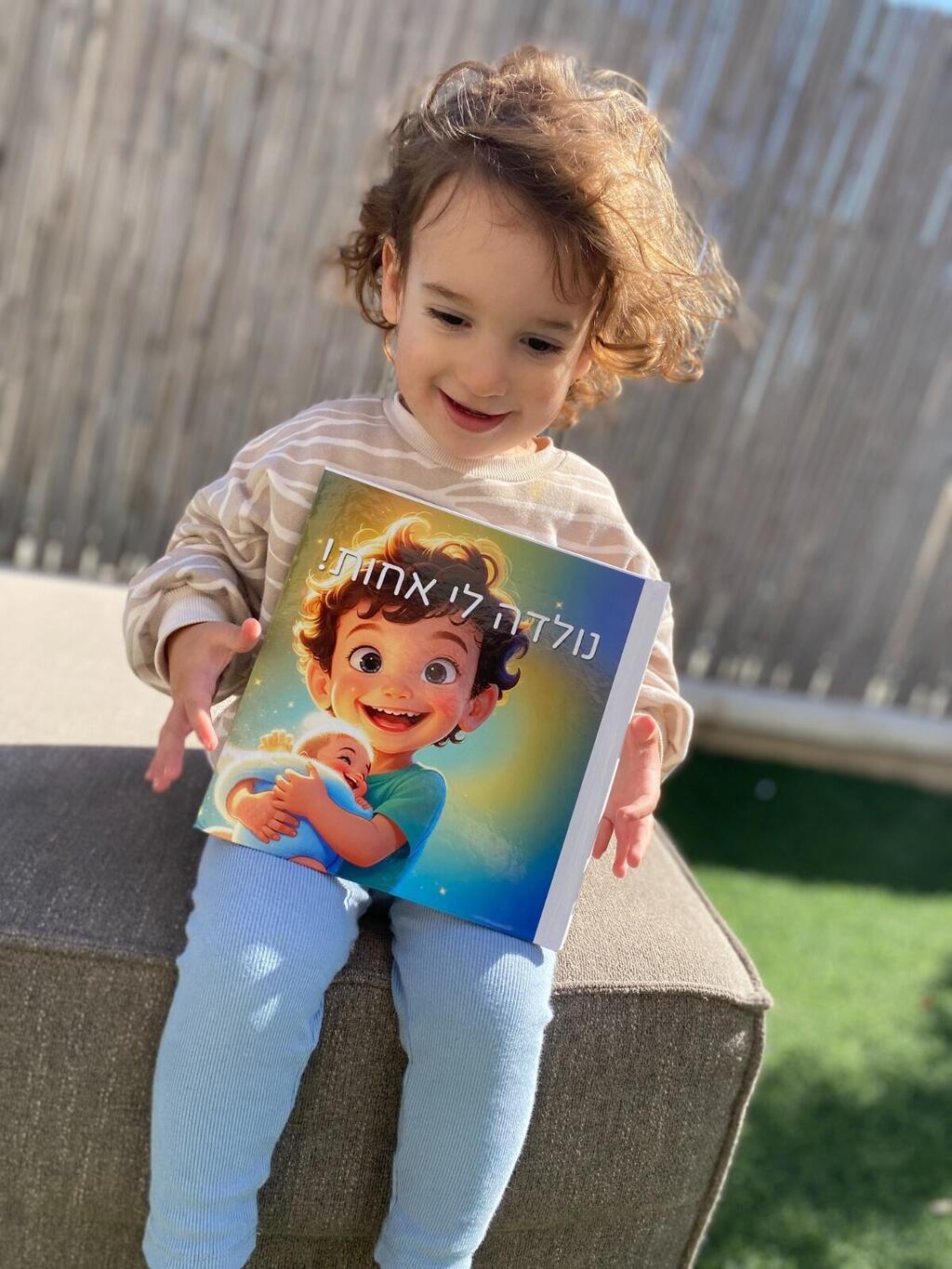
In recent months, the production floor of the Be'eri Press in Kibbutz Be'eri, located near the Gaza border, has been lively with new and colorful life. The printing machines, which resumed operation shortly after October 7, are churning out hundreds of new children's books one after another. These are not ordinary books: in popular titles like I'm Having a Birthday, The Superhero and Fun on the Animal Farm, the main hero is always a specific boy or girl, the one for whom the book was ordered.
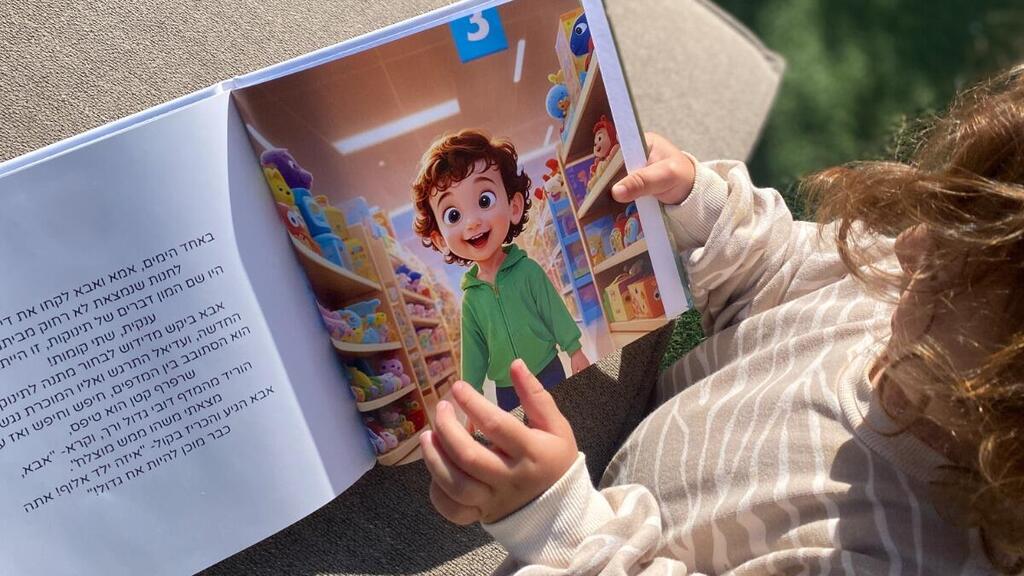
The children immediately fall in love with the plot, but mostly with the large, colorful pictures of themselves integrated into the story. Behind this wonder is the Israeli start-up company MeBook.AI, which has developed a system that uses AI technology and requires only two components: the child's name and their picture. The artificial intelligence face-processing technology makes the illustrations particularly fascinating and adds to their popularity.
'Their emotional connection to the book is much stronger than with any other gift'
Idan Frost, CEO of MeBook.AI, describes the enthusiastic reactions of the young customers: "The kids' reactions are insane." Frost recounts how "it took me a month to get my son's book out of his hands, just because I wanted to have some examples here in the office." According to him, "The kids are crazy about the books, and their emotional connection to the book is much greater than with any other gift."
Parents report moving successes. Yinon David, MeBook.AI's CMO, shares: "People write to us that their son or daughter was weaned off diapers or a pacifier with the help of the books on weaning from diapers or pacifiers." One special case was that of a child who asked to dress up as the Hero of Light for Purim, a character invented in a MeBook book. "We were in shock. We couldn't believe that a character in a book would become something so significant in a child's life."
During the war, the company even released a dedicated series of books that might not have seen the light of day in other times. Titles like "My Dad is on reserve duty" and "It's Nice in the Mamad (Safe Room)" provided a response to a current need. The book "It's Nice in the Mamad" became particularly popular during the war and was downloaded in thousands of copies (for free, in this case). However, the question remains whether such books can truly help the children of the Gaza border region cope with the trauma they have experienced.
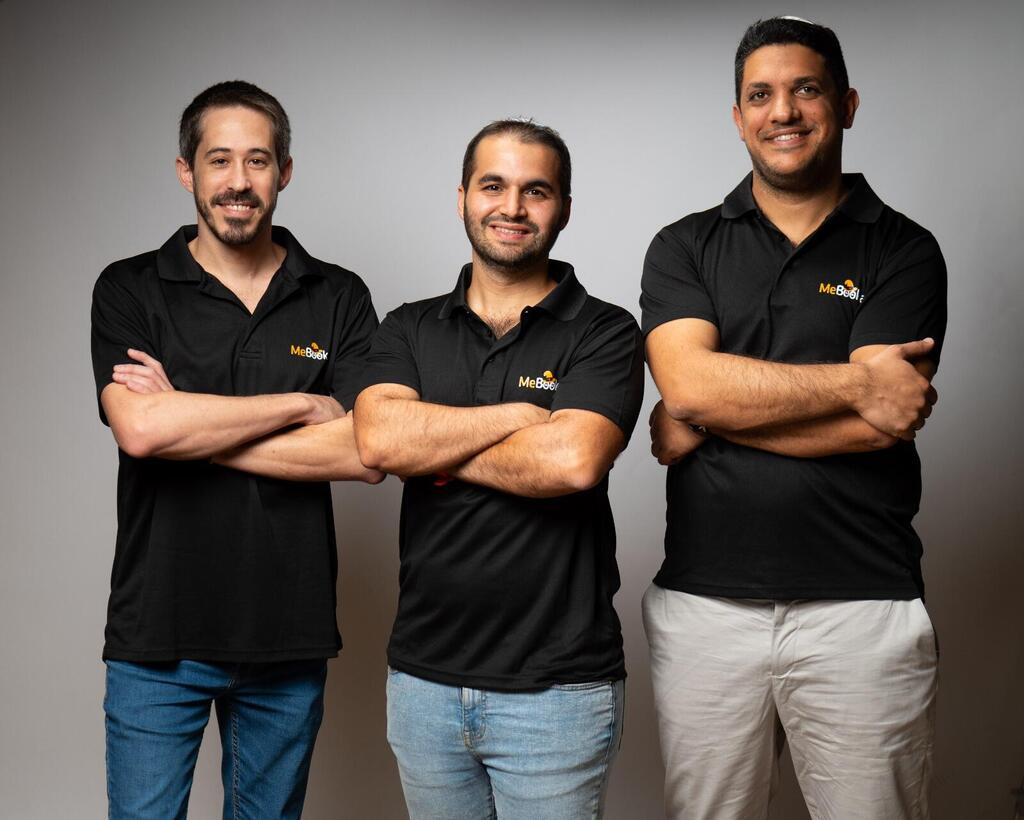
MeBook CEO Idan Frost, CMO Yinon David and CTO Idan Ben Shimon
(Photo: Courtesy)
MeBook was founded exactly one year ago by Frost (CEO), who previously founded the company Originality; Idan Ben Shimon (CTO), the owner of the app development company Popapp; and David (CMO), the owner of the website development company Webtailors. The common denominator for all three is that they are fathers who were looking for a way to give their children a gift that would last more than a month or two and would also disconnect them from screens. The initial idea was to generate the stories (text and images) entirely using artificial intelligence and turn them into a printed, hardcover book.
The failures of AI: Humor and rhyme
Despite the advanced capabilities of artificial intelligence, the path to creating the books is not a simple "press of a button" by AI. The founders discovered that artificial intelligence is still not suitable for writing gentle children's stories without close supervision. "It can insert strange sentences and mix in topics that a child won't really like," explains David. For example, a child who is a superhero doesn't necessarily want to see a sword dripping with blood in the illustration.
"We initially tried to use Hebrew language models, but the models still needed improvement," says David. The most significant limitation, he says, is the inability to create quality content: "Even today, if you try to generate a book with value and meaning, most models will not succeed in the task of rhyming. That, for a certainty, no model to this day knows how to do.”
Therefore, the books are based on pre-written stories by various creators, into which the child's name is inserted in fixed places. However, all the illustrations in the books are indeed the creation of AI. MeBook.AI promises that soon, new capabilities will be launched that will allow customers to receive a book on any topic of the child's choice, and not just pre-written stories. "In the next version, there will be such an option. You'll say the child wants a book about skiing on the moon with strange animals, no problem at all," David promises.
In parallel, the company has opened up an opportunity for external creators to write their own children's books, with parents able to purchase the book and integrate their children into it. For every sale, the creator receives a share of the revenue. About 30 creators, including influencers and children's service providers, are already active in the system.
The survival of Be'eri Press: A surprising collaboration
The difficulties did not bypass the printing domain. Be'eri Press, which had only recently entered the field of book printing, joined the collaboration even before October 7, working with MeBook on developing a system that would allow for the printing of a single copy for each order. Publishing houses do not know how to handle the printing of single copies, so MeBook turned to printing machines usually intended for photo albums.
(Photo: MeBook)
The October 7 massacre tragically cut the collaboration short. Amit Yesodi, the commercial activity manager for Be'eri's online sites and a member of Kibbutz Kfar Aza, recounts: "Unfortunately, on October 7, 102 members of Kibbutz Be'eri were murdered, eight of whom were employees of the press."
Yesodi, who was in "the last family to be rescued alive" from Kfar Aza, says that the press resumed its activities after just one week to keep the kibbutz active and to continue providing essential printing services for the economy. "A few brave members put on protective vests, got on an armored bus, and traveled from the Dead Sea... and turned the switch back on at the Be'eri Press."
Initially, the Be'eri Press was forced to cancel the collaboration. "We weren't in survival mode," says Yesodi, "We had to scale back the work... we gave up on them out of necessity." MeBook.AI, understanding the situation, moved to work with another printing house. However, fate intervened: "After two months, the Be'eri Press acquired the printing house we were working with, and we came back to them through the back door. So this time they had no choice..." says Frost. Since then, the two companies have been working in "perfect synergy."
"They were a perfect fit for us," Yesodi says of MeBook.AI. "If you look at our production line today, you can recognize their books; they have a significant presence." According to her, the success stems from MeBook.AI's ability to provide a personal and emotional product with relative ease, a trend supported by the user-friendliness of AI.
The next target: The American market
The success in Israel is keenly felt: "From August of last year until now, we have grown like crazy. We've sold close to 30,000 copies in Israel alone." The company is also already selling in countries like Denmark, Germany, the Philippines, and the U.S.
The entrepreneurs at MeBook.AI are making far-reaching plans, including further expansion overseas. David notes that out of 22,000 kindergartens in Israel, only 200 have placed bulk orders so far, which indicates great growth potential. But the truly great potential is in the global market, especially in the U.S. "We did the math, and if we sell the same quantity of books relative to the population as we sold in Israel (globally), we'll only need one year - and then we can retire," he says jokingly.
The company has developed technology that will allow the system to be operated by franchisees in different countries. In the U.S., they plan to launch an independent marketing campaign. "There's no doubt that the potential there is insane. We are already at thousands of dollars in sales in the U.S., and we see the market potential at hundreds of millions of dollars with a growth rate of at least 9% per year." David concludes: "We still have so much room to grow, We haven’t even scratched the surface."