


From the familiar molded chair to furniture, storage and modular living spaces, Keter has spent decades transforming a simple material through technology and design — making resin look and feel increasingly like wood, rattan and other natural materials.
Some products become so familiar that we stop noticing the technology behind them. The stackable plastic chair is one of them: lightweight, durable, inexpensive and produced as a single molded piece in a matter of seconds. For Keter, however, that simple chair became the starting point for a much bigger question: How much more could be done with the same material?
Keter
(Video: Yaron Sharon)


One of the milestones came in 1985 with the monobloc chair. Instead of manufacturing individual components and assembling them, the entire chair could be injection-molded as one piece. What once took roughly a minute to produce now takes about 30 seconds, with approximately 800,000 chairs sold annually. But manufacturing efficiency was only the beginning. Over the following decades, Keter began experimenting with how resin itself could look and feel. In 2009 came surfaces designed to evoke rattan; in 2016, knitted and woven appearances followed. The challenge was shifting from simply creating new shapes to giving the material depth, texture and visual character.
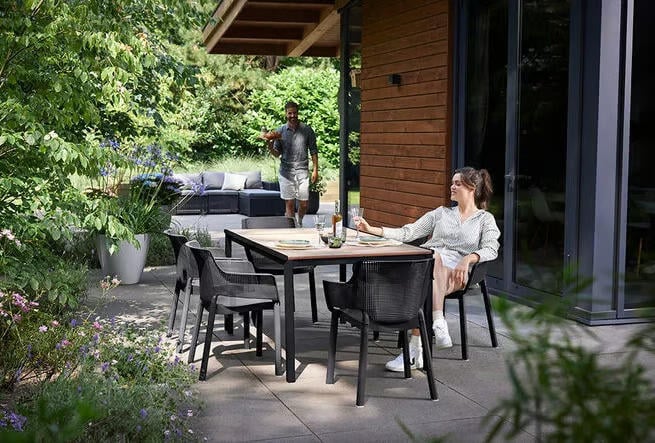
“It's a combination of a deep consumer understanding with great design and innovation,” says Yael Betser Fridman, Keter’s chief marketing officer. “We know how to work with the material and make it different in terms of appearance, design and also durability.” That approach reached another stage with DecoCoat, introduced in 2024. The technology creates surfaces that reproduce the appearance and texture of materials such as wood and stone while retaining the practical characteristics of resin. “It was a breakthrough in product design,” Betzer-Friedman says. “It's not only plastic anymore. It looks like wood or stone or marble.”
Keter
The technology is now being used across garden furniture, storage boxes, planters and sheds. The appeal is not simply aesthetic: resin can provide weather and fade resistance while requiring considerably less ongoing maintenance than many natural materials. For Keter, the development also reflects a broader philosophy in which innovation starts not with technology itself, but with the consumer. “Every time we start product development, we fully understand the needs of the consumer,” Betser Fridman says. “This is the driver for our innovation.”
Now the scale is changing again. At spoga+gafa 2026 in Cologne, Keter showcased outdoor flooring using DecoCoat technology, fencing and cladding with natural-material appearances, alongside outdoor kitchens and solar lighting. The idea is expanding from individual products to the outdoor environment as a whole — the furniture, storage, surfaces and structures that together create a living space.
One of the clearest examples is My Studio, a modular garden room designed not simply for storage, but as a space that can potentially function as a home office, studio or clinic. The structure incorporates preparation for electricity and air conditioning, while taking acoustics and natural light into consideration. It is a striking evolution from a chair emerging from a single mold every 30 seconds to a room people can actually work in.
Today, Keter products are sold in more than 100 countries across categories ranging from outdoor living and home organization to storage and toolboxes. Yet the material at the center of the story remains largely the same. What has changed is what Keter expects it to do.
“Every new product starts with an idea,” Betser Fridman says. “It starts with a sketch on paper, and then you can see it in production and you can see it in the end user's yard.”
Four decades after the monobloc chair, the question is no longer simply how efficiently something can be made from plastic. It is how far the material can be pushed — and what else it can become.