


Artificial intelligence is no longer a futuristic concept or a technological luxury reserved for major corporations. It is rapidly transforming how businesses operate, how people work and how consumers experience everyday services. But according to Ori Stoliar, the co-founder & CTO of Israeli technology company Directeam, the real revolution is only beginning, and businesses that fail to adapt may not survive.
“I look at artificial intelligence as an industrial revolution, with all the implications that come with it,” he says. “The revolution is accelerating every year.”
Founded nearly nine years ago by two former members of the IDF's prestigious Mamram computing unit, Directeam helps startups and established companies navigate cloud infrastructure, reduce technological expenses and integrate AI into their operations. The bootstrapped company, which today employs approximately 25 people, works with businesses ranging from early-stage startups to enterprises with thousands of employees. Its mission is to handle the technological complexity so clients can focus on growing their businesses.
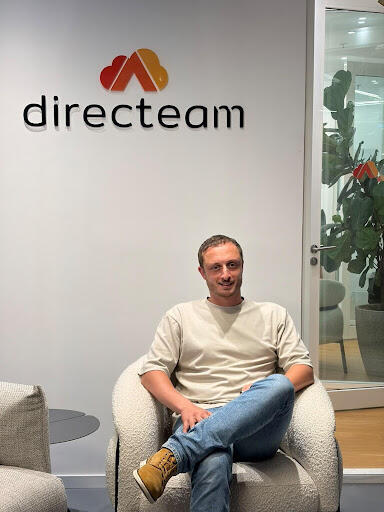
The impact of AI, he explains, extends far beyond chatbots and automated customer service. Entire professions are being redefined, traditional responsibilities are merging and new positions are emerging as organizations rethink how they operate. Software development is one example, with AI increasingly performing tasks previously handled by developers, quality assurance specialists and project coordinators.
“Some positions will disappear, others will merge, and entirely new roles will emerge,” Stoliar explains. “Even when a job retains the same title, what the person actually does may look completely different.” At the same time, new professions, including AI engineers and specialists responsible for integrating intelligent systems into businesses, are becoming increasingly important.
Yet, he warns, many companies are still approaching AI as a fashionable buzzword rather than a fundamental organizational transformation. “Many companies talk about becoming AI-native, but very few actually get there," he says.
Directeam is helping organizations make that transition, from developing AI-powered products to redesigning internal processes, and has created Spike, a platform designed to give AI systems access to organizational knowledge and context so they can assist employees across different departments, including finance, operations and research and development.
Despite operating in an intensely competitive industry, Directeam's founders believe their most important advantage is not necessarily technological, but philosophical. Having worked in startups and large enterprises before establishing their company, they experienced firsthand how technology suppliers sometimes pushed unnecessary products, charged excessive fees or recommended solutions that ultimately failed to meet customers' needs. “We saw situations where companies were pushed toward products they didn't need simply because they didn't understand the technology,” Stoliar recalls.
That experience inspired a different business model built around understanding customers' actual challenges before recommending solutions. “We put ourselves in the customer's shoes. If something isn't right for them, the deal doesn't happen. We can also tell a customer that they don't need us,” he said.
'Israelis don't accept 'no' or 'impossible' as an answer. We don't accept no for an answer, whether in business or technology'
The company develops its services and products by working backward from real business problems, an approach he believes is especially important as organizations become increasingly dependent on complex technological systems they may not fully understand or control.
As the global technology landscape changes, Stoliar remains confident that Israel's reputation as the Startup Nation is well deserved. Despite political instability and security challenges, he points to the continued establishment of technology companies and the investment flowing into the industry as evidence of its resilience.
But Israel's real advantage, he believes, lies in its entrepreneurial mindset. Having worked extensively with international companies, he says Israeli professionals demonstrate a distinctive combination of critical thinking, determination and willingness to challenge conventional assumptions.
“Israelis don't accept 'no' or 'impossible' as an answer,” he says. “We don't accept no for an answer, whether in business or technology.”
Military service also plays a crucial role, particularly in elite technological units such as Mamram, where young soldiers are entrusted with extraordinary responsibilities. “Just as an 18-year-old can be given a weapon and enormous responsibility, young people in technological units can be responsible for systems that save lives,” he explains.
He credits his own military experience with providing a foundation that helped shape his career, emphasizing that the advantage comes not merely from serving in a prestigious unit but from the practical experience and responsibility gained at such a young age.
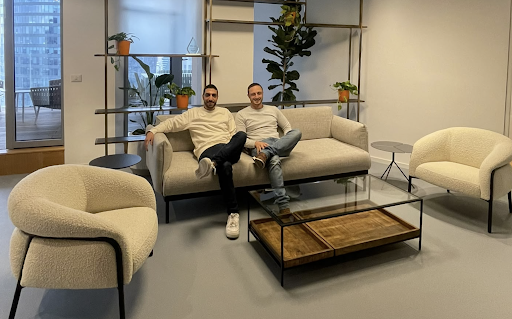
Ori Stoliar and Hagai Tobelem
(Photo: Directeam)
When asked what children should study to prepare for an increasingly automated future, his answer is surprisingly focused on human abilities rather than programming languages or advanced technical qualifications.
As the father of two daughters, he says the question occupies his thoughts frequently, adding that “One of the things I believe we need to focus on much more is soft skills.”
As knowledge becomes instantly accessible through AI, Stoliar believes communication, negotiation, critical thinking, understanding economics and knowing how to motivate others will become increasingly valuable. Even using artificial intelligence effectively depends on the ability to ask intelligent questions and communicate clearly: “The model doesn't know what's inside your head. You need to provide the right context and ask the right questions to get the right answer.”
Technical skills will remain important, he emphasizes, but human capabilities may increasingly distinguish successful professionals from those who struggle to adapt.
Looking five years ahead, he also believes the next major technological disruption may come not from software but from robotics and intelligent hardware. “Think about robots, or even your refrigerator. Every electronic device in your home,” Stoliar says. “When you walk into a house five years from now, it could look significantly different.” He predicts that intelligent physical devices will increasingly transform households, industries and the broader economy.
For the Directeam co-founder, the journey from a young Israeli growing up in an immigrant family to building a successful technology company is also deeply personal. His parents arrived in Israel from Russia in the 1990s with very little, and he remembers the family's first decade in the country as particularly difficult.
“They came here with nothing. The first 10 years were very difficult,” he recalls. His eventual arrival at Mamram opened doors that would shape his future, including meeting his longtime friend and future business partner, Hagai Tobelem. Their friendship stretches back so far that his wife jokes they shared a bank account before he had one with his wife.
Together, they built Directeam without outside investment, developing a growing business that now provides employment for approximately 25 families, with additional positions planned. “We built a real business from zero. It's alive, it's growing, and it supports 25 families. That's not something to take for granted,” Stoliar says.
Today, he speaks Russian with his daughters, preserving a connection to his family's roots while preparing them for a future that may look radically different from the world in which he grew up. And although his career revolves around technology, his outlook remains distinctly human: in a world increasingly powered by artificial intelligence, the ability to think independently, communicate effectively and adapt to change may ultimately matter more than ever.