


It took 10 years, but Israeli company StoreDot is delivering on its promise: electric vehicle batteries that can charge in just 10 minutes. The company has completed the development stage and signed agreements with several companies in China and South Korea that will manufacture the groundbreaking batteries. The companies’ names have not yet been disclosed.
StoreDot has developed silicon-based battery cells for extreme fast charging, or XFC, which it says outperform competing technologies. The cells charge within minutes and retain their capacity even after more than 2,400 fast-charging cycles. The company demonstrated the technology in a Polestar 5 prototype, the innovative premium model from Polestar, which is backed by Sweden’s Volvo and China’s Geely, charging the battery from 10% to 80% in 10 minutes.
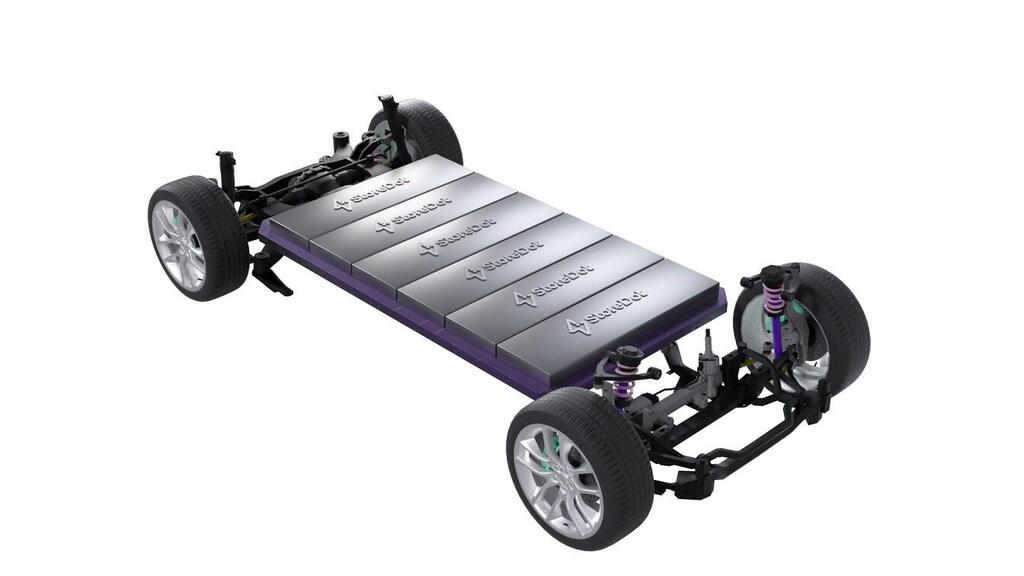
StoreDot will not manufacture the batteries itself. Instead, it will license its technology to battery plants around the world, which will be able to manufacture them on existing lithium-ion production lines without having to replace them. The battery’s manufacturability has been demonstrated at five battery plants worldwide, and production agreements have already been signed with two of them. The company is now turning its attention to integrating the battery into future models from automakers around the world.
AI replaced dozens of employees
StoreDot faced a crisis early this year after its fundraising efforts and plans for an IPO on Nasdaq fell through. The company was forced to carry out layoffs, reducing its workforce from 150 employees to just a few dozen. Despite that, the company successfully completed the development process, due in part to the use of advanced artificial intelligence tools that allowed a small number of employees to complete tasks and use computer models for thermal simulations and to screen thousands of chemical material compositions in short periods of time.
“There was a revolution here that I could hardly believe,” said Dr. Doron Myersdorf, StoreDot’s founder and CEO. “I previously had 150 researchers, including 35 Ph.D.s, who worked for about a decade. But today, tasks that once required a team of physicists and thermodynamics experts working for an entire month are performed by one person using AI tools. Artificial intelligence allowed us to dramatically reduce our workforce while maintaining our development capabilities.”
According to Myersdorf, the company is now hiring again, including some employees who left during the most recent round of layoffs, to support the integration process in the field.
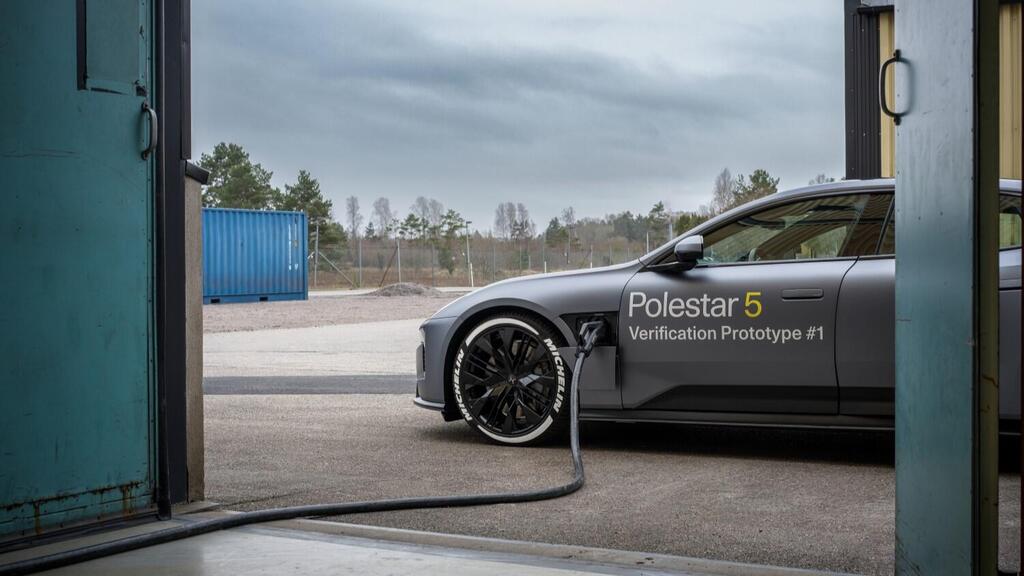
StoreDot technology demonstrated in a Polestar 5
(Photo: Polestar)
StoreDot is now announcing its first commercial agreements with several leading European automakers, which will pay to integrate XFC technology into their future vehicle platforms. About a year ago, automakers completed an independent, in-depth evaluation that confirmed the effectiveness of the XFC cells. The test results verified that the cells fully complied with the manufacturers’ stringent safety standards and international certifications. The results also demonstrated fast-charging performance that exceeded that of competing solutions tested at the same time.
What brought you to the finish line now? How do you explain the timing?
“The timing was determined by the fact that enough time had passed for testing. With Volvo and Polestar, for example, we are already in the fifth year of testing. These are mainly safety tests, not performance tests. Every time they tell you, ‘Come fix this or change that a little.’ But now enough time has passed, and we have started receiving approvals from more and more manufacturers. I’m talking now about three or four manufacturers that are already interested in selling and are ready to pay.”
StoreDot’s technology is based on a silicon anode combined with an NMC cathode made of nickel, manganese and cobalt, with an energy density of 300 to 330 watt-hours per kilogram. That is about 30% higher than the energy density of LFP, or lithium iron phosphate, batteries widely manufactured in China, allowing an electric vehicle to achieve significantly greater driving range with the same battery weight.
The battery is expected to cost about 10% more than Chinese batteries, but Myersdorf said this would increase the price of the vehicle as a whole by only about 4%, a relatively minor premium for high-end vehicles.
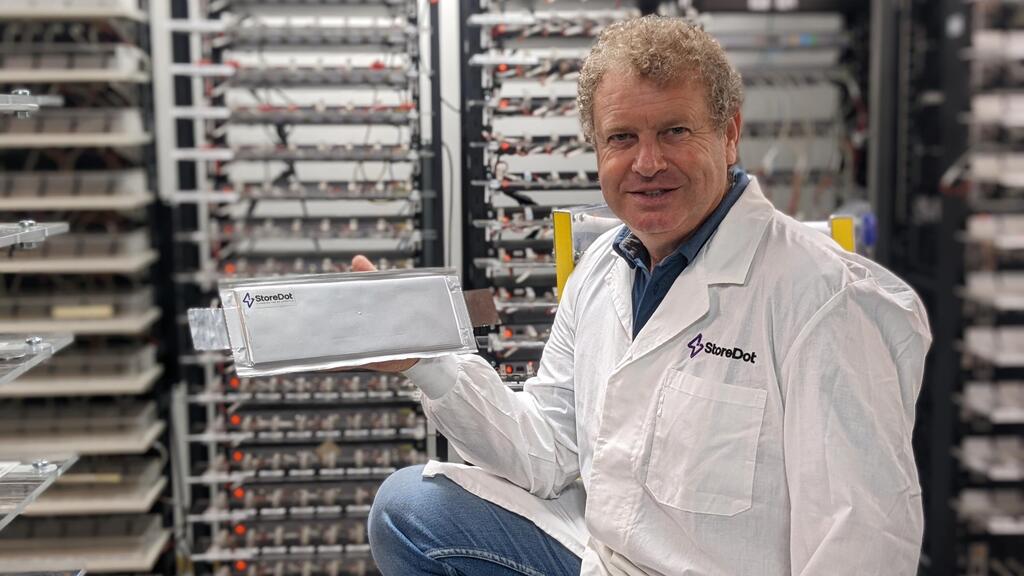
'There was a revolution here that I could hardly believe,' Dr. Doron Myersdorf said
(Photo: StoreDot)
The company has achieved technological validation of more than 2,400 consecutive fast-charging cycles, with a full charge taking 10 minutes, without significant deterioration in battery capacity. The result challenges a long-standing assumption in the energy industry that fast charging severely damages battery life.
Myersdorf cited a senior executive at energy company BP who said the company had designed fast-charging stations on the assumption that rapid charging would damage batteries. But after seeing that thousands of charging cycles did not harm StoreDot’s battery, the executive said, “Our entire working assumption collapsed.”
Batteries for humanoid robots
StoreDot previously planned to build its own manufacturing plant, or gigafactory, at a cost of hundreds of millions of dollars. It later shifted to a different business model: licensing its intellectual property and developing manufacturing process expertise, similar to the model used by semiconductor companies.
The model is familiar to Myersdorf, a former senior executive at SanDisk and Msystems who took part in the development of the SSD and flash-memory industries.
“I had a dream of building a factory, and I was in the process of raising $400 million,” he said. “But when I looked at the spreadsheet, I saw that the company would continue burning cash in the first few years until it reached sufficient production capacity. We were talking about $1 billion in expenses. Where was I going to get that money?”
StoreDot now operates under a model in which it licenses the use of its 100 patents and other technologies to existing battery manufacturers in South Korea, Canada and China, including EVE Energy, which is also an investor in the company. The manufacturers pay StoreDot an access fee and licensing fees for use of the technology, with StoreDot integration engineers providing support during the planning stages.
Alongside the automotive industry, StoreDot is expanding into other fields that require exceptionally fast charging and discharging, including civilian and defense drones, which could charge in five minutes, humanoid robots and a new application for data centers: a battery designed to handle millisecond-long spikes in processor power consumption. The technology could replace expensive ultracapacitor components.
“Our vision doesn’t stop here,” Myersdorf said. “We believe charging batteries within a few minutes will become the standard in every electrical field: in vehicles, robotics, drones and any machine that currently has to wait hours for a full charge.”
Heading toward another funding round
StoreDot was founded in 2012 by Doron Myersdorf, Prof. Prof. Simon Litsyn and Prof. Gil Rosenman. The company initially planned to develop displays and memory devices, later moved into smartphone batteries and eventually focused on batteries for cars.
Since its founding, the company has raised more than $200 million. Its investors include Vietnamese automaker VinFast, Volvo’s investment arm, Mercedes-Benz, formerly Daimler, BP, Japan’s TDK, Samsung Ventures and billionaire Roman Abramovich.
The shift to a leaner, AI-based business model accelerated amid changes in the macroeconomic environment and capital markets. In February 2026, StoreDot’s planned SPAC merger at an $800 million valuation was canceled by mutual agreement following difficulties completing an accompanying $30 million to $50 million PIPE financing round. The company subsequently reduced its cash burn and focused on licensing revenue.
StoreDot is now preparing to return to the capital markets in an effort to expand its licensing agreements and reach additional automakers in the United States and Europe. The company says the process will be conducted more cautiously than previously planned, while it considers alternatives including an initial public offering or a new strategic merger.
“We haven’t given up on that dream,” Myersdorf said. “On the contrary, some of our earliest existing investors are pushing very hard in that direction. There are all kinds of ways to raise capital, not necessarily through the SPAC route we tried. Maybe we’ll do it through a merger or another type of IPO. We believe this is a very strong story for the public markets, and it could bring us substantial amounts of capital that we can work with and use to achieve truly significant growth.”