
Even when reaching for the stars, humans must contend with challenges they almost never encounter on Earth. The AstroRad protective vest, developed by Israeli company StemRad in collaboration with Lockheed Martin and the Israel Space Agency, was designed to address one of the most fundamental challenges of deep-space travel. Exposure to high-energy particles during solar storms is considered one of the major risks NASA must confront as it prepares for extended crewed missions to the Moon and Mars.
The idea behind the AstroRad vest actually began here on Earth. In 2011, following the Fukushima nuclear disaster in Japan, Israeli company StemRad developed its GAMMA 360 technology, a protective system designed to shield emergency and rescue personnel operating in environments exposed to gamma radiation. The principle was simple: rather than trying to protect the entire body, which requires heavy layers of shielding material, the system focuses on the areas where protection matters most. When the company began applying the same concept to space, however, it had to contend with a different type of radiation, and therefore develop a different solution.
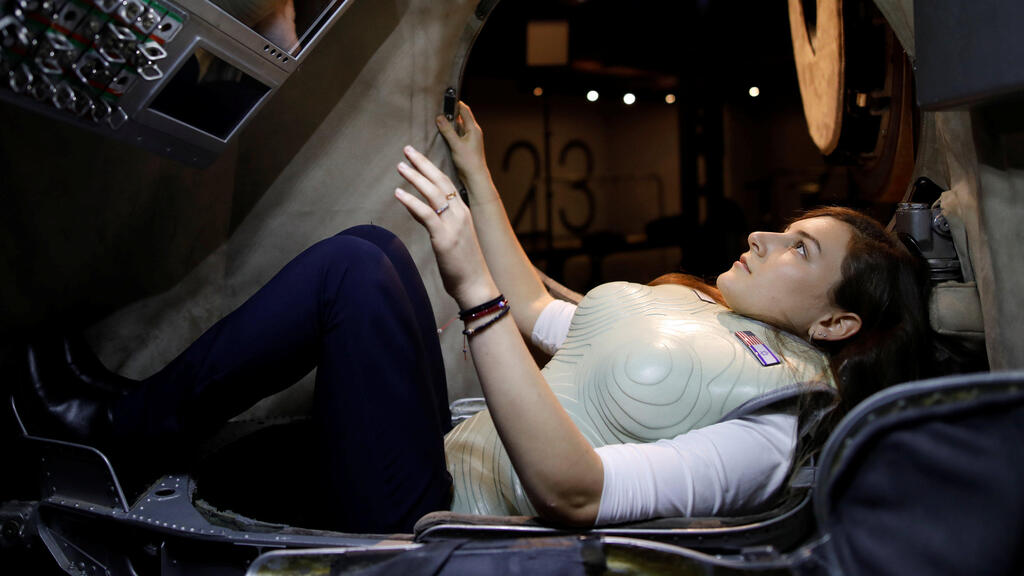
(Photo: Reuters)
The space vest, which has already undergone a series of experiments and studies, is made from hydrogen-rich materials, including high-density polyethylene, which are effective at reducing exposure to the energetic charged particles released during solar storms. But the innovation lies not only in what the vest is made of, but also in how its protection is distributed across the body. Its thickness varies according to the organs it is designed to protect, providing greater shielding to areas particularly sensitive to radiation, including the lungs, stomach, breasts, ovaries and bone marrow.
The latter is especially important. Bone marrow is responsible for producing the body’s blood cells, and exposure to high levels of ionizing radiation can severely damage it, impairing its ability to replenish blood cells and weakening the body’s capacity to fight infection. Other organs protected by the vest are also vulnerable to radiation damage and to an increased risk of developing cancer as a result of cumulative exposure.
This targeted approach allows AstroRad to provide significant protection without wrapping astronauts in a heavy, cumbersome layer that would make it difficult to move and work. That is particularly important during solar storms that can last for days. Instead of remaining inside a shielded area throughout the entire event, the vest is intended to allow crew members to continue functioning while reducing radiation exposure to the body’s most vulnerable organs.
The effort to determine whether AstroRad could make the leap from an engineering concept to a practical solution reached space as early as 2019, when a prototype was sent to the International Space Station. There, female astronauts tested not only the protection itself, but an equally fundamental question: whether they could actually function while wearing it. They wore the vest while performing various activities in microgravity, evaluating its comfort, mobility and ergonomics. After all, even a vest that provides excellent protection is of limited use if astronauts cannot work, move or wear it for hours while a solar storm rages outside.
The most significant test came in 2022, during NASA’s Artemis I mission. Two human-shaped measurement mannequins, “Zohar” and “Helga,” were placed aboard the Orion spacecraft, equipped with thousands of sensors to measure radiation exposure. Zohar wore the AstroRad vest, while Helga made the journey without it. For 25 days, they traveled beyond the Moon and back, allowing researchers to compare the radiation doses absorbed by a shielded body with those absorbed by an unprotected one under conditions that cannot be replicated on Earth.
And the exciting news came this past August: a study published in Science Advances used measurements from Artemis I to examine how the vest would perform during powerful solar particle events. The researchers found that, in the scenarios examined, AstroRad could reduce radiation doses to different organs by approximately 40% to more than 60%, depending on the intensity of the event and the organ being measured.
More than a decade after the concept of targeted radiation protection was born in Israel, AstroRad has already been worn aboard the International Space Station, traveled around the Moon and undergone testing under deep-space conditions. It does not eliminate the danger of radiation, nor can it solve all the challenges of a journey to Mars on its own. But reducing exposure by as much as—and in some cases more than—60% from one of the major radiation threats represents a significant step toward making longer and more distant human journeys into space safer.