

Tesla has released new footage showing its Cybercab arriving in Austin, Texas, as the company begins integrating its purpose-built autonomous vehicle into its growing Robotaxi service.
The gold-colored two-seater, which has no steering wheel or pedals, is designed specifically for driverless ride-hailing and represents a major step beyond Tesla’s current Robotaxi fleet, which has until now relied primarily on modified Model Ys.
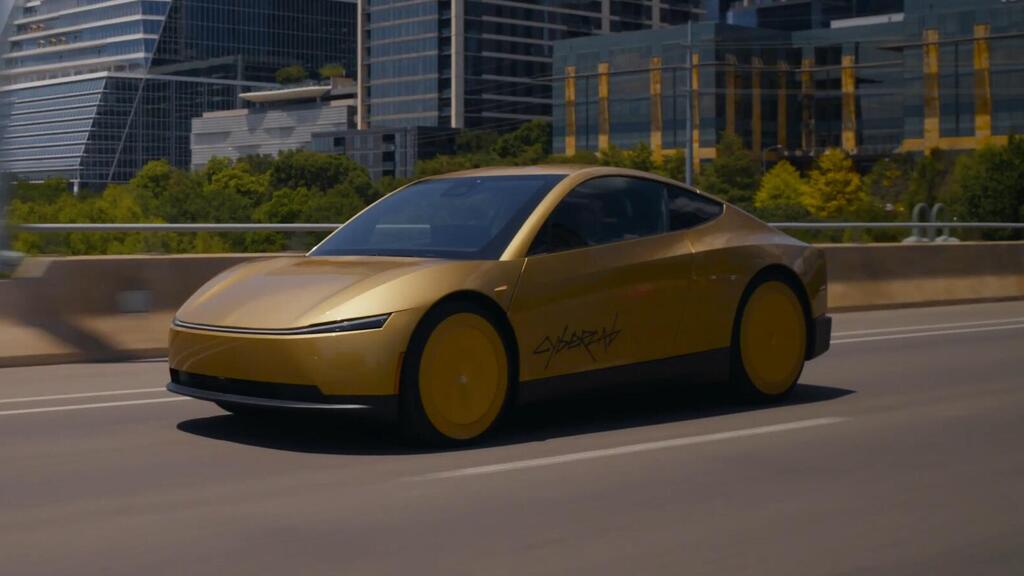
Tesla Cybercab
(Photo: Screenshot)
Tesla had already begun engineering tests of production Cybercabs on public roads in Austin earlier this summer. In July, the company also began offering employee rides in Cybercabs on the grounds of Gigafactory Texas, describing those tests as precursors to broader deployment.
The company then scheduled a dedicated Cybercab launch event in Austin for September 3, inviting selected Robotaxi users and promoting the vehicle as the next addition to its autonomous ride service.
Tesla’s Robotaxi app now allows riders to choose between a Cybercab and a Model Y, according to updated app screens reported Thursday. The Cybercab carries two passengers, while the Model Y option can carry four.
Tesla currently offers autonomous Robotaxi rides in Austin, Dallas and Houston in Texas, as well as Miami, Orlando and Tampa in Florida. Its own website says Cybercab rides will be offered more broadly in the future.
The company said in its latest quarterly update that Cybercab production had begun and that engineering test drives of production vehicles were already underway on public roads. Tesla also said it had expanded unsupervised operations in Austin and launched unsupervised rides in several Florida cities during July.
Cybercab is central to CEO Elon Musk’s long-running effort to turn Tesla from primarily an electric-car manufacturer into an autonomous transportation company.
Unlike rivals such as Waymo, which rely on lidar and radar in addition to cameras, Tesla has continued to base its autonomous-driving approach largely on cameras and neural-network software. That strategy remains controversial among autonomous-driving experts and regulators, particularly as Tesla seeks wider approval for vehicles without conventional controls.
For Tesla, however, the arrival of Cybercab in Austin is an important symbolic and operational milestone: the company is moving from adapting existing consumer vehicles for robotaxi use toward deploying a car designed from the outset to operate without a human driver.