

Two days before polls open in Israel's 26th Knesset election, perhaps the most intriguing political question is no longer simply who will form the next coalition, but who is advising us on whom to vote for. And that comes at a time when social media is flooded with countless AI-generated videos designed to influence our choices, even when they appear humorous at first glance.
A practical experiment in which an identical questionnaire on political positions was submitted to four leading AI platforms - ChatGPT, Claude, Gemini and Grok - offers a revealing look at how large language models interpret Israel's political landscape. It also raises a broader question: Can technology replace voters' own judgment?
Gallery
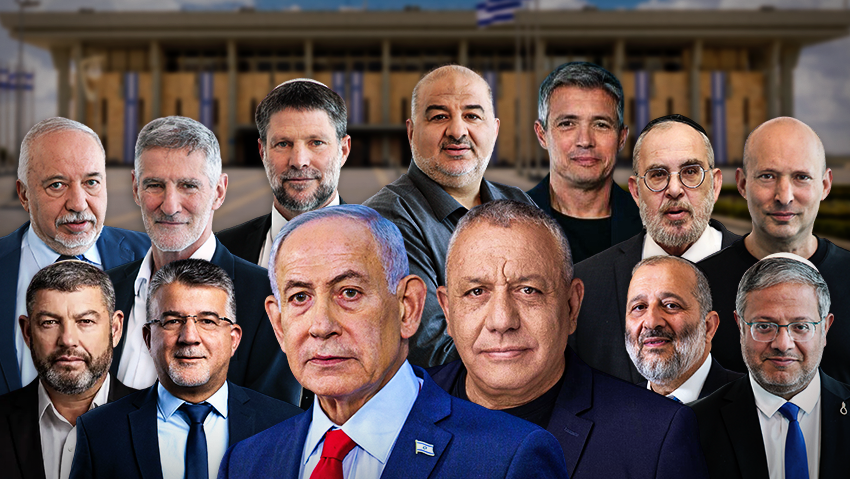
We asked AI to help us decide who to vote for
(Photos: Shutterstock, Shalev Shalom, Elad Malka, Joint List, Ryan Frois, Alex Kolomoisky)
At first glance, the models' performance is impressive. When presented with the profile of a voter seeking to combine a tough security policy with a regional diplomatic agreement, a free-market economy, separation of religion and state, a constitution and a broad-based government, most were able to navigate the 38 electoral lists competing in the election and identify the relevant parties.
Claude, Gemini and ChatGPT all identified the same three parties: Gadi Eisenkot's Yashar!, Naftali Bennett and Yair Lapid's Beyachad and Avigdor Liberman's Yisrael Beytenu. The models were even able to distinguish subtle differences between campaign promises and actual records in office, while identifying specific areas of disagreement with the voter's preferences.
AI is not a neutral adviser
A closer look at the results, however, reveals some significant cracks. The exact same questionnaire led Claude and ChatGPT to rank Eisenkot first, Gemini to give Bennett and Lapid a decisive compatibility score of 92%, and Grok to place Yair Golan's Democrats at the top of its list, pushing Liberman out of the top three altogether.
Such differences, despite nearly identical starting information, illustrate that language models are not entirely objective advisers. Rather, they are probabilistic systems that assign different weights to individual words and phrases in a prompt.

(Photo: Getty Images)
These findings are consistent with research and commentary published internationally. An October 2026 survey by the Pew Research Center found that approximately 8% of Americans, including 11% of those age 50 and younger, already use chatbots to gather information ahead of elections. Of those users, 40% ask the systems for actual voting recommendations.
Meanwhile, a study published in the journal PNAS Nexus in October 2026, examining elections in Britain, concluded that chatbot use can improve voters' factual political knowledge to a degree comparable to independent Google searches, without compromising factual accuracy.
Political analysts and regulatory researchers, however, present a more complicated picture. A report published by The Guardian in July 2026, which examined voting advice provided by chatbots during Hungary's elections, found that the models produced unstable and inconsistent responses to identical prompts.
Meanwhile, policy researcher Marie Erickson, writing in TechPolicy.Press, noted that Brazil's Superior Electoral Court (TSE) had prohibited chatbots from providing direct voting recommendations because of concerns about hidden biases, incorrect classification of users' political views and commercial influence.
It is important to explain how we conducted our own comparison. We initially tried a simple prompt asking, "Who should I vote for in the upcoming election?" without providing any context or preferences. All four chatbots refused to name a party. Instead, every platform suggested that we describe our policy preferences and political priorities.
Rather than immediately listing everything we would like to see happen, such as free air conditioning whenever temperatures exceed 27°C or world peace, we decided to let the chatbots guide the process.
Who will AI choose?
(Photo: Image generated by ChatGPT)
Each platform generated a questionnaire, and the resulting formats were remarkably similar.
In terms of usability, Gemini offered the most efficient interface, with a form that allowed users to select their preferences. The other platforms relied on a conventional question-and-answer format. All four settled on six main questions, each offering five or six possible answers.
So who should you vote for? It depends whom you ask
For the first round, we supplied the chatbots with a profile built around six guiding preferences: a tough approach to security combined with support for a regional diplomatic agreement; a free-market economy with a social safety net; separation of religion and state; adoption of a constitution; a broad government excluding ultra-Orthodox and extremist parties; and a preference for managerial and security-oriented pragmatism.
Claude: Methodological caution and close attention to the text
Claude ranked Eisenkot's Yashar! first, followed by Liberman's Yisrael Beytenu and Bennett and Lapid's Beyachad in third place.
It interpreted our preferences as pointing toward a security-oriented political figure who supports adopting a constitution, which it viewed as a direct match for Eisenkot. Claude described his position on the judiciary as corresponding "almost word for word" to our answer.
Its analysis stood out for its attempts to maintain objectivity and transparency. Claude explicitly acknowledged that it had not read the full platform of every party, qualified information drawn from media reports, including references to the religious-Zionist news site Srugim and an ultra-Orthodox website, and recommended that we independently verify Bennett's figures on the budget deficit.
Google Gemini: Political labeling and percentage-based rankings
Gemini ranked Bennett and Lapid's Beyachad first, with a compatibility score of 92%, followed by Yisrael Beytenu at 88% and Eisenkot's Yashar! at 84%.
Unlike Claude's more cautious approach, Gemini assigned us a clear political identity, describing our profile as belonging to the "heart of the Zionist-liberal camp." It also concluded unequivocally that we would rule out joining a government led by Netanyahu.
Gemini placed decisive weight on "practical effectiveness," or "what works," and therefore regarded the Bennett-Lapid alliance itself as the strongest match for our preferences. Its use of precise compatibility percentages created an impression of mathematical certainty, even though the rankings were based entirely on qualitative assessments.
ChatGPT: Balancing competing priorities and identifying internal tensions
ChatGPT ranked Yashar! first, Beyachad second and Yisrael Beytenu third. It correctly identified an inherent tension in our political profile: the desire for a tough security policy alongside a refusal to allow affiliation with any particular political camp to predetermine potential coalition partners.
The analysis maintained a high degree of objectivity, clarified that its ranking was not a scientific score, distinguished between a candidate's personal experience and a party's actual record, and concluded with three guiding questions that returned the ultimate decision about values and priorities to the voter.
Grok: A shift to the left driven by the coalition question
Grok produced an unusual result, placing Yair Golan's Democrats first, Eisenkot's Yashar! second and Bennett and Lapid's Beyachad third, while excluding Yisrael Beytenu.
The difference stemmed from the way Grok interpreted our answers. It understood our economic position as demanding a "strong safety net" and our coalition preference as reflecting a "center-left" position open to relying on Arab parties.
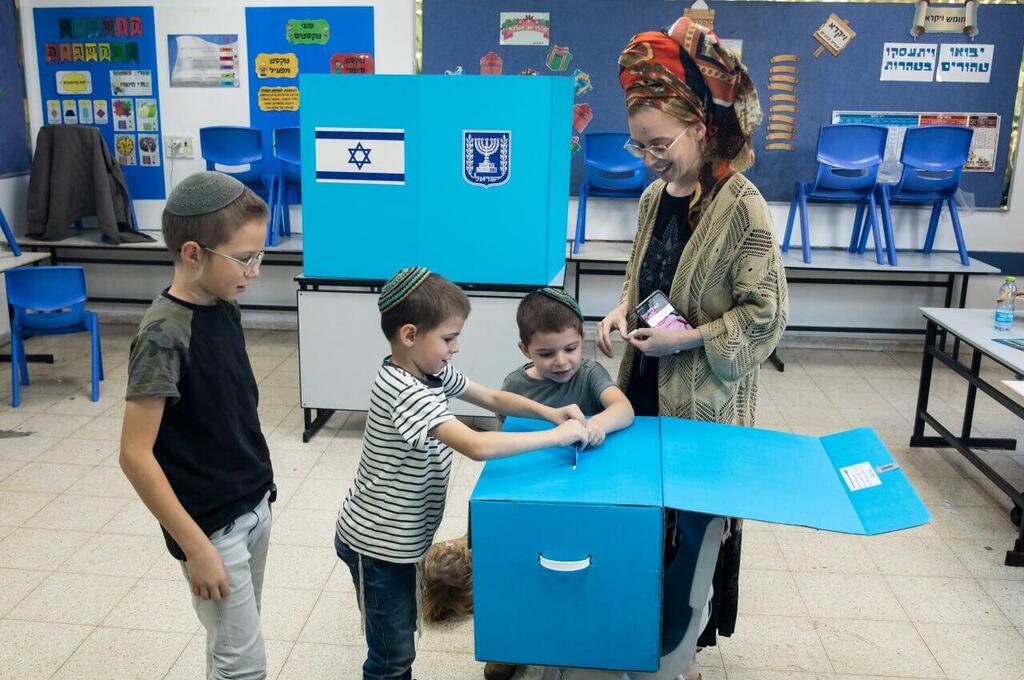
At the ballot box
(Photo: Amir Levi\GettyImages)
That interpretation pushed the algorithm toward Golan, even though Grok itself acknowledged that the Democrats might be too far to the left for our security preferences.
How the models responded to a right-wing voter
We then presented the systems with distinctly right-wing political positions: a tough security policy and the dismantling of Hamas, support for free markets, preservation of the religious status quo or strengthening Jewish identity under a "Torah and military service" approach, and judicial reform intended to strengthen government authority.
The platforms identified and emphasized the principal positions of right-wing and religious parties, but differed in how they balanced ideology against coalition pragmatism.
ChatGPT and Grok: Clear alignment with the religious-right bloc
Both ChatGPT and Grok interpreted the profile as favoring a right-wing coalition with religious parties.
The two systems selected exactly the same three parties: Likud in first place, followed by the Religious Zionist Party and Otzma Yehudit. ChatGPT ranked the Religious Zionist Party second and Otzma Yehudit third, while Grok reversed their order and noted the alliance between the Religious Zionist Party and Moshe Feiglin's Zehut party. Both models identified Likud as a relatively liberal governing party on the right, combining free-market economics, preservation of the religious status quo and support for stronger governance.
ChatGPT's analysis was particularly notable for distinguishing among three different versions of the Israeli right: establishment-oriented, religious-ideological and security-focused radicalism. It also carefully distinguished between passing legislation, such as the March 2026 law allowing the death penalty for terrorists, and achieving actual deterrence.
Gemini and Claude: A unity government becomes the deciding factor
When a preference for a broad unity government without extremists was included, Gemini and Claude broke away from the conventional political-bloc framework.
Gemini still ranked Likud first, with 82% compatibility, and the Religious Zionist Party-Zehut alliance second, at 78%. However, it excluded Itamar Ben-Gvir's party from its top three and instead ranked Bennett and Lapid's Beyachad third, with 74%. Its reasoning drew on Bennett's background in the economic right and his association with the "Torah and military service" approach.
(Photo: Amir Levi\GettyImages)
Claude took this interpretation even further. It assigned such overwhelming importance to the preference for national unity that it ranked Eisenkot's Yashar! first for a distinctly right-wing voter, Bennett and Lapid's Beyachad second and Likud only third. That result came after Claude corrected a factual error in which it initially recommended Blue and White, a party that had withdrawn from the race on October 19.
Comparing the center-left and right-wing results
The full comparison of the four platforms across both rounds reveals an interesting pattern.
In the center-left round, the results were relatively stable. Claude, Gemini and ChatGPT agreed completely on the same three parties representing the liberal center: Yashar!, Beyachad and Yisrael Beytenu. Only Grok shifted further left, toward Yair Golan's Democrats.
In the right-wing round, by contrast, the models diverged sharply depending on how they weighted the coalition question. ChatGPT and Grok maintained a consistent right-wing and religious-ideological interpretation, identifying Likud, Bezalel Smotrich's Religious Zionist Party and Ben-Gvir's Otzma Yehudit. Gemini created a bridge between the right and the center, ranking Likud, Smotrich and Bennett. Claude went further, steering even the right-wing voter toward centrist parties led by Eisenkot and Bennett.
When we supplied the systems with a clearly right-wing profile, including opposition to a Palestinian state, support for free markets, preservation of the religious status quo or strengthening Jewish identity, and judicial reform to reinforce government authority, the results demonstrated just how sensitive the models are to wording.
ChatGPT and Grok delivered a consistent right-wing and religious-oriented set of recommendations, both ranking Likud first alongside the Religious Zionist Party and Otzma Yehudit. ChatGPT's analysis was especially strong in explaining that the voter was effectively choosing among three versions of the right: establishment-oriented and economically liberal, religious and ideological, or more radical on security. It also distinguished between the passage of legislation, including the March 2026 law allowing the death penalty for terrorists, and demonstrable deterrence on the ground.
Gemini, meanwhile, factored in the desire for a unity government without extremists. Alongside Likud at 82% and Religious Zionist Party-Zehut at 78%, it placed Bennett and Lapid third, at 74%.
Claude took the desire for unity to the extreme, almost entirely disregarding the voter's right-wing positions on judicial and religious issues. It ranked Eisenkot first, Bennett second and Likud third, and only after correcting an embarrassing mistake in which it had initially recommended Blue and White, which had withdrawn from the election a week earlier.
So is there political bias?
The conclusion for Israeli voters is clear: AI tools can be extremely useful for an initial mapping of the political landscape, comparing party platforms with past performance and identifying contradictions within our own political positions.
They can save hours of research and highlight substantive areas of disagreement, such as the gap between a desire to separate religion and state and the compromises centrist parties may have to make when forming a coalition. But fluent textual analysis should not be confused with objective truth.
When Gemini assigns precise compatibility percentages or Grok shifts the political map because of its interpretation of a coalition preference, the ultimate responsibility must remain with the human user.
Artificial intelligence can help us organize our thoughts before entering the voting booth, but no algorithm can determine our values and priorities for us.