


As hospitals and healthcare providers increasingly turn to artificial intelligence to improve patient access and reduce operational pressure, Hyro is positioning itself as one of the leading players in the emerging healthcare AI agent market.
The company, founded by CEO Israel Krush and COO Rom Cohen, develops AI-powered voice and chat systems that automate patient interactions across call centers, websites, SMS, mobile apps and other communication channels. According to Hyro, its mission is to help health systems improve patient access to care while driving operational efficiency through responsible AI deployment.
Hyro


Aaron Bours, Hyro’s chief marketing officer and founding go-to-market executive, said the healthcare industry is facing a growing mismatch between patient expectations and system capacity. “Patients expect retail-like experiences and instant gratification, while healthcare systems are struggling to deliver on that promise,” he said during the interview.
Hyro says its AI agents now support more than 50 enterprise health systems across the United States, handling workflows such as scheduling, prescription refills, billing inquiries, routing and FAQs. The company estimates its systems automate between 60% and 85% of repetitive inbound and outbound patient interactions, helping reduce wait times and relieve pressure on understaffed support teams.
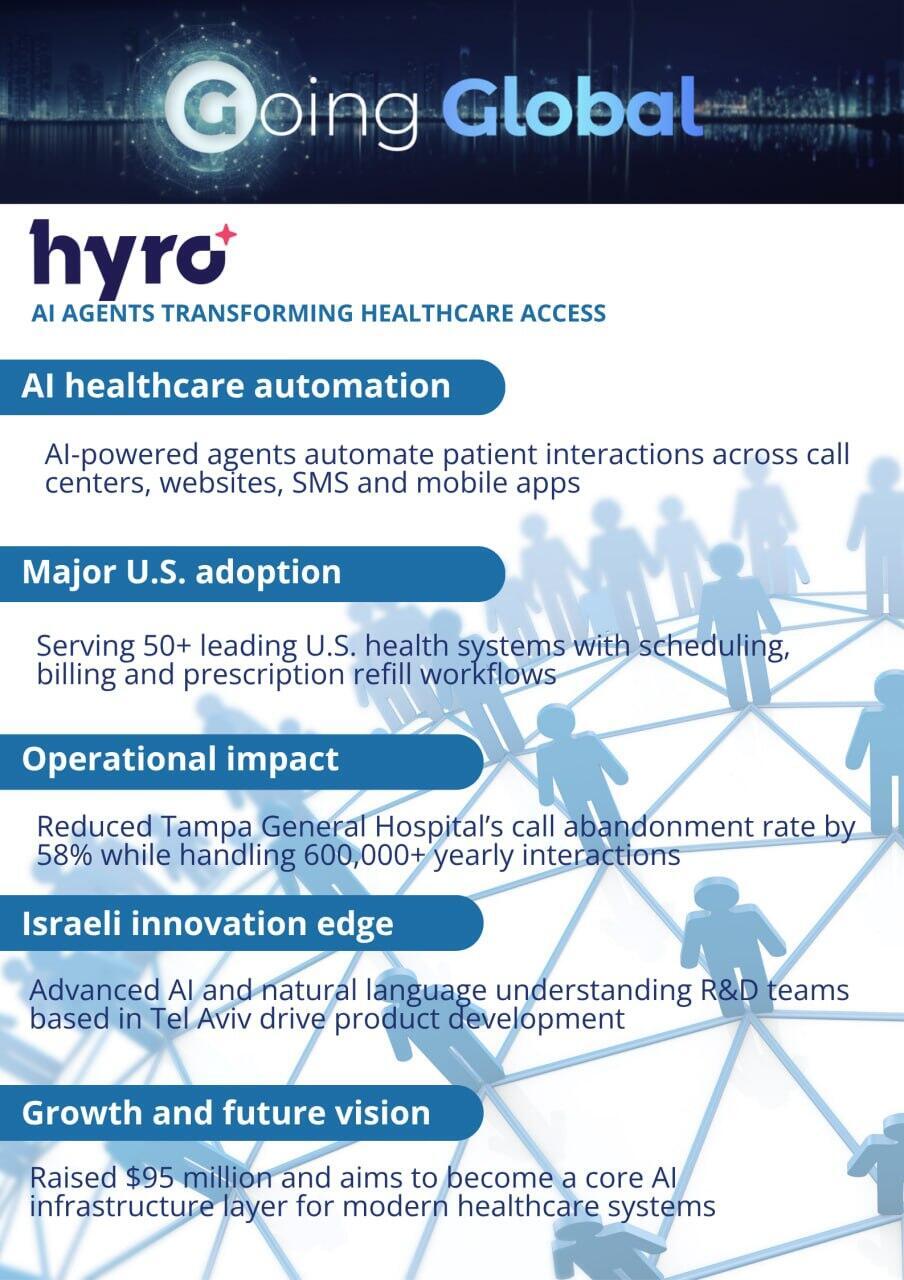
Going global, Hyro
(Photo:Illustration)
One example highlighted by the company involved Tampa General Hospital, which deployed Hyro across multiple systems, including Epic electronic health records and telephony infrastructure, in under 70 days. According to the company, the deployment reduced call abandonment rates by 58% while managing roughly 600,000 patient interactions annually.
Hyro said the hospital had originally planned to hire 48 new full-time employees to support a growing contact center operation before implementing the platform. The company attributes its scalability to a healthcare-specific AI architecture that combines proprietary small language models, large language models and dynamic knowledge graphs designed specifically for medical workflows.
With roughly 180 employees split between Israel and the United States, Hyro says its Israeli research and development operation remains a major competitive advantage. “Some of the best AI engineers and natural language understanding specialists are here in Tel Aviv,” Bours said.
The company, which has raised $95 million to date and recently doubled both its valuation and annual recurring revenue, plans to continue expanding its American footprint while deepening integrations across healthcare technology systems. Looking ahead, Hyro aims to become what Bours describes as “an integral part of the tech stack” for healthcare organizations navigating the transition toward agentic AI and automated patient engagement.
In cooperation with Team8, Discount Tech and Deloitte Catalyst
First published: 09:10, 06.15.26