

The market for intelligent agents is heating up and Google has no intention of falling behind. At its annual developer conference, Google I/O 2026, held last week at the company’s headquarters in Mountain View, California, the tech giant unveiled a series of announcements that signal a dramatic shift: a move away from the chatbot era of the past three years toward a new era of AI agents that work independently around the clock and complete end-to-end tasks.
Google CEO Sundar Pichai and senior executives spoke extensively about AI agents during the event, but three announcements stood out above the rest. These were not incremental upgrades but a turning point marking the next phase of artificial intelligence.
From “asking” to “doing”
Three years after ChatGPT triggered a revolution by proving that machines can hold fluent conversations, the entire industry is already in the midst of the next leap. If in the previous era we spoke to chatbots and received answers, in the new era we assign a task and the agent carries it out on its own.
The practical meaning is clear: instead of asking “write me an email to my boss,” users can say “find three cleaning service providers in Tel Aviv, compare them and schedule a meeting with the cheapest one.” The agent will do it independently, even while users sleep. This was the recurring mantra throughout the conference and the key context for understanding the announcements that followed.
The agent that works even when the computer is off
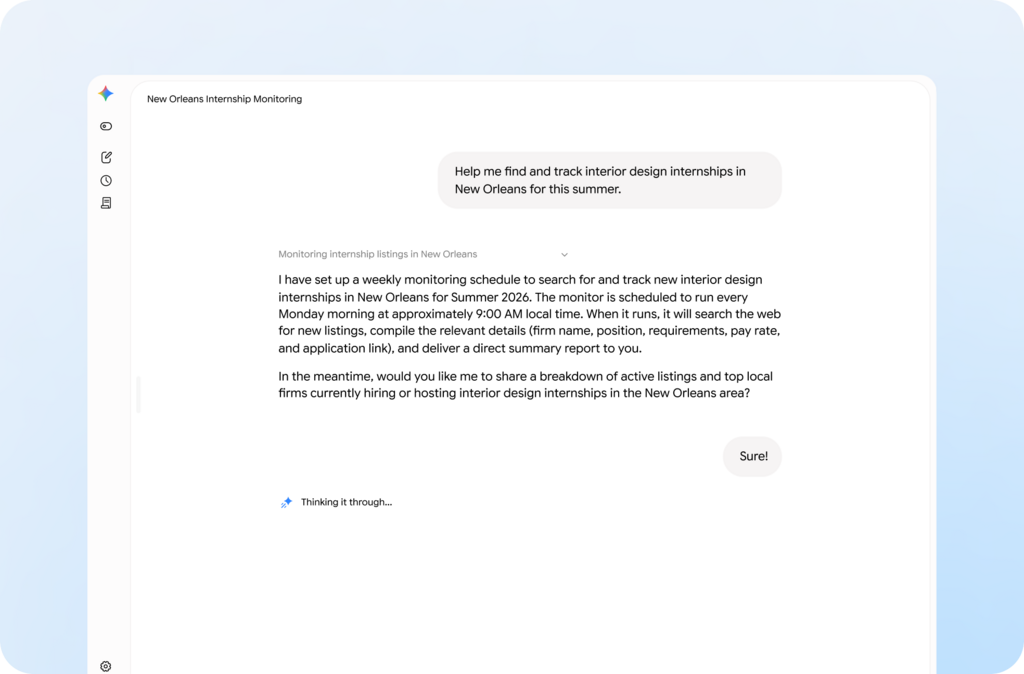
The main announcement of the conference was Gemini Spark, a personal AI agent running on Google’s servers and operating 24/7, even when the user’s phone and computer are turned off. Users assign it a task and it executes it end-to-end: researching, comparing options, browsing websites, connecting to external tools such as Gmail and Calendar, and even completing bookings on the user’s behalf.
What makes it different?
Until now, conversations with Gemini were continuous. Every request required waiting for a response on screen, replying again and repeating the cycle. Spark breaks this loop. Users give instructions once, close their device and return later to a completed result.
What happens to personal data?
On data security, Google was clear at the conference: personal data from apps such as emails, documents and calendar events is not used to train models and is not read by humans. The agent only accesses apps that users explicitly authorize and follows narrowly defined instructions rather than scanning broadly. Any sensitive action such as payments, sending emails or deleting files requires separate confirmation.
The first video editor that is actually an agent
The second major announcement was Gemini Omni. What sets Omni apart is not only its ability to generate video but its architecture. It is not just another video model but what can be described as a “meta model,” a system that can orchestrate Google’s other AI models and combine them in real time.
When Omni needs a still image of a character, object or background, it calls Nano Banana, Google’s image generation model. When it needs to understand what should happen next in a scene, or how physical reality should behave, or what historical, scientific or cultural context is relevant, it turns to Gemini.
By combining different models, Omni ensures consistency: characters remain the same across scenes, physical laws are respected and each edit builds on the previous one without losing context.
Google's new Gemini Omni
(Video: Google)


This is effectively the first time a video generation model operates as a full AI agent. Instead of producing a generic clip and stopping there, Omni functions as a digital video editor: it understands the request, researches what is needed, generates missing elements and assembles a coherent final video.
Omni may represent a broader shift from using tools to using agents, or “workers,” that complete tasks independently from start to finish.
Because such capability requires strong safeguards, Google emphasized security mechanisms built into Omni. Every generated or edited video receives a hidden watermark (SynthID) and a content authentication certificate (C2PA), allowing AI-generated content to be identified. The system blocks content involving minors or public figures, is limited to users aged 18 and over and prevents misuse for copyright violations, fraud or harassment. Avatar creation is also restricted so users can only generate their own likeness.
After 25 years, search is about to change
Google’s familiar search box has remained largely unchanged since the company’s founding in 1998. The simple rectangle with its blue button became part of the internet itself. At the conference, Google announced that search is about to undergo one of its most significant transformations.
The new search experience becomes a hybrid system combining traditional search with ongoing conversation powered by Gemini. Users can upload files, videos or even open Chrome tabs and ask questions about them in natural language.
In simple terms, instead of searching “how to fix a leaking faucet,” users will be able to film the faucet, upload the video and receive precise instructions based on what Gemini identifies.
Beyond that, Google introduced a new capability it calls Generative UI. A request like “plan me a fitness routine” will no longer return a list of links but will instead generate a mini application with an interactive calculator, a personalized weekly plan and visual graphics.
The new search also includes a safety layer. Features that connect personal data such as Gmail or Google Photos, what Google calls Personal Intelligence, are turned off by default and require explicit user permission, with the ability to choose which apps to connect or disconnect at any time.
Google's new AI-powered search
(Video: Google)
Google’s content detection tools will be integrated directly into search, allowing users to check whether an image was AI-generated while deepfake and misleading content will be demoted automatically in rankings.
The announcement is also strategically significant. Google is effectively undermining its own revenue model: fewer clicks on links means fewer advertising impressions. The company has chosen to take the risk, recognizing that if it does not move first, competitors like OpenAI and Perplexity will.
Availability is immediate. The features are already accessible for free to users through AI Mode in Google, including in Israel. Generative UI features will arrive in the summer, also for free.
It is worth noting that behind one of the conference’s key announcements was an Israeli researcher, Professor Yossi Matias, Vice President and Head of Google Research. Matias led the announcement of Gemini for Science, a suite of tools designed to accelerate scientific research from hypothesis generation to running experiments.
What does it all mean in practice?
First, the obvious conclusion is that the era of “just searching” is over and search is becoming an action layer. Instead of a list of links, users receive finished results and sometimes even automated services.
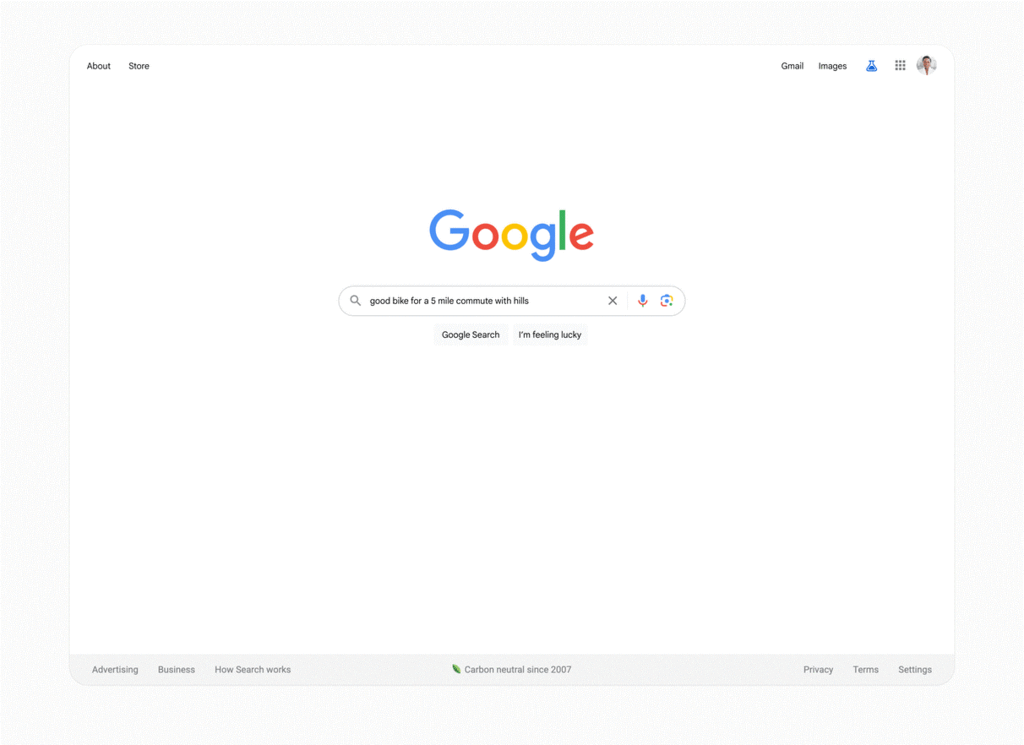
Google's new visuals for search
(Photo: Google)
Second, the bottleneck is shifting from machines to humans. In other words, agents can execute tasks, but the challenge is what people can actually ask for. The ability to clearly formulate tasks is becoming a professional skill in its own right.
Pichai described the moment by saying: “As we enter this agentic era, Search will be more helpful and powerful than ever.” And perhaps that is the most important point of all: after three years of promises and demonstrations, the entire industry, including Google, now understands it has to deliver.