


The Israeli company Mentee Robotics, developer of humanoid robots, on Wednesday published a series of videos to demonstrate the maturity of its technology. No, the company’s robot MenteeBot V3.0 isn’t about to arrive in our homes tomorrow to replace the robot vacuum or the dishwasher; that will still take a little while.
But Mentee’s current capabilities may soon allow it to enter the industrial world, for example, in logistics tasks (as seen in the videos) or even directly on a production line.
Rise of the robots
Mentee Robotics was established in 2022 by three AI experts: Professor Amnon Shashua, chairman of the company and CEO of Mobileye; Professor Lior Wolf, CEO of the Company; and Professor Shai Shalev-Shwartz. The company keeps a low profile and rarely exposes itself publicly. According to PitchBook, it has raised $41 million across three funding rounds. The firm reportedly employs 70 staff — 45 of them AI specialists — and continues to grow.
The unveiling of MenteeBot’s progress is significant against the backdrop of a surge of activity in the humanoid‑robot industry. For instance, the company 1X recently opened to the public the possibility of ordering its Neo robot, a furry, soft robot designed to perform household chores.
Tech billionaire Elon Musk has again declared his intention to produce millions of Optimus robots from Tesla as soon as next year (although his demonstration at Tesla’s October conference revealed the robots were remotely operated by humans). Meanwhile, dozens of Chinese firms announce humanoid‑robot models every month, some already on the market. It seems Mentee wants to distinguish itself in this crowded field.
What sets Mentee apart
The big difference is that many robots currently on the market or soon to be, like Neo, do not operate independently; they are remotely controlled by a human operator. Early customers must agree that a human will remotely operate the robot in their home, effectively serving as a training operator.
Musk’s demonstrations have often been similar — remote controls, not autonomous action. Until now the industry has focused on improving robots’ mechanical capabilities; only now is it turning to the much harder task of building powerful AI. Mentee claims to be at the forefront of both fronts — and shows it in its videos.
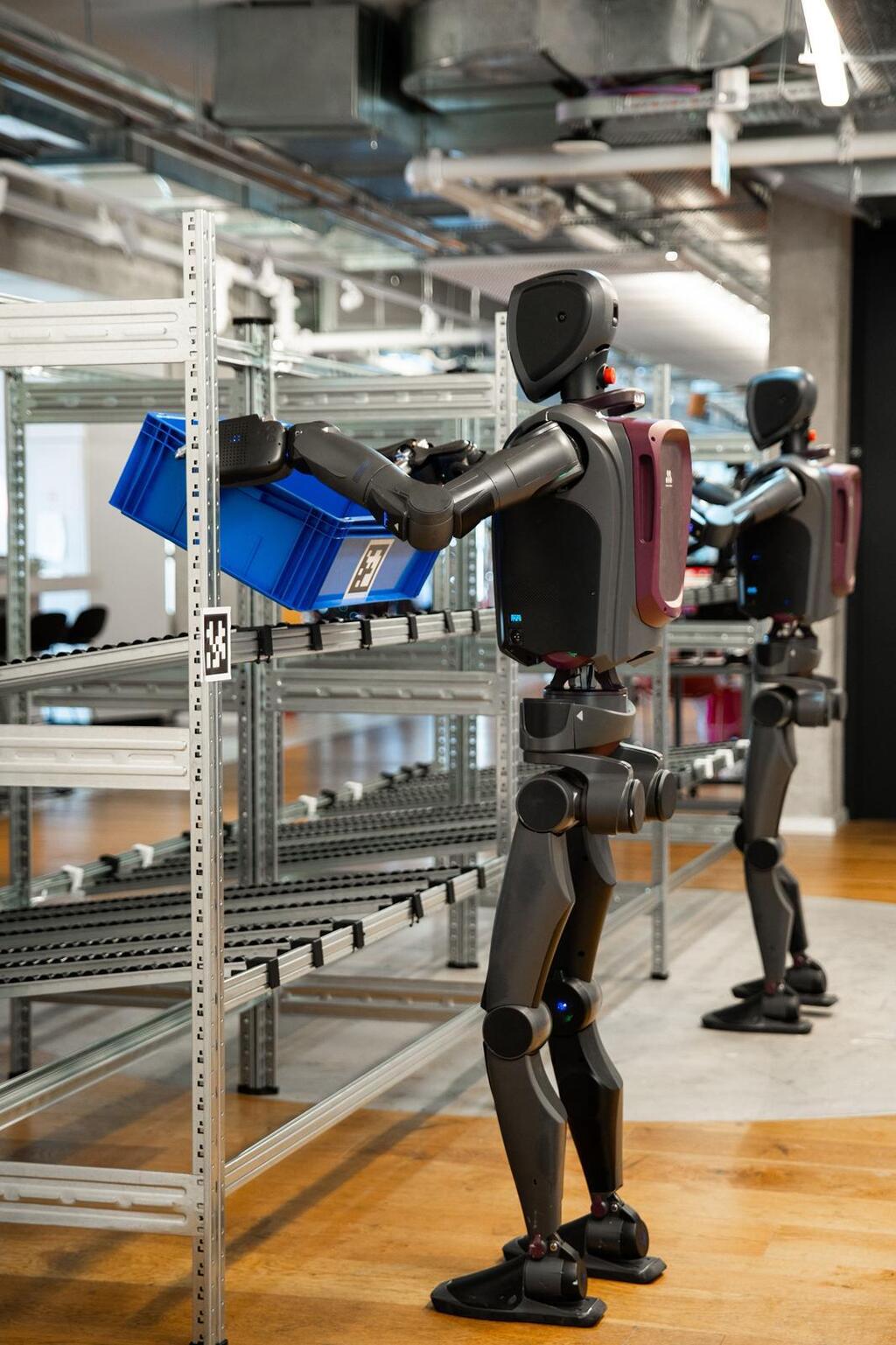
MenteeBot at work in a factory
(Photo: Mentee Robotics)
The MenteeBot V3, unveiled earlier this year, is a powerful robot capable of carrying a weight of 25 kilograms. It stands 1.75 meters tall and weighs 70 kilograms. Its head is equipped with five cameras that provide 360-degree vision, and its four limbs contain 31 joints powered by high-torque motors developed in-house by Mentee. It features a hot-swappable battery that can be replaced while the robot is in operation, allowing it to run continuously 24 hours a day. And, by the way, it doesn’t complain.
Since its debut earlier this year, Mentee has improved the robot’s mechanics: the hand was enhanced for a stronger grip and durability under ongoing work, and the walking gait has been slowed and steadied to match a factory‑floor environment.
That stands in stark contrast to many other robots from rival firms that showcase running, jumping, dancing or even playing basketball — visually impressive, but much less useful for repetitive industrial labor or factory‑line work.
The AI side matters
Beyond mechanical structure, the strength of the robot lies in its data‑processing systems. MenteeBot runs two NVIDIA Jetson Orin AGX AI processors. Its multiple cameras deliver computer-vision data, which the AI analyses.
The robot can follow voice commands, navigate autonomously, and learn from human operators. It uses a “simulation‑to‑reality” (sim2real) pipeline — learning first in virtual environment, then transferring to real‑world action.
One video shows two robots working in parallel and coordinated: they identify boxes, sort them and move them to designated locations. They perform the entire task autonomously, using advanced machine vision and smoothly handling heavy objects at various heights.
2026: The year of humanoid robots
Many industrial firms are said to be waiting for robots they can integrate into production lines to save on human labor. 2026 may become the breakthrough year — and Mentee may be among the first to offer commercial products.
In fact, American company Figure AI already deployed several of its Figure 02 robots at BMW factories, though that program was recently discontinued. Investors in Figure AI include some of Silicon Valley’s biggest names: Jeff Bezos and Amazon, Microsoft and OpenAI.
Other players: Apptronik (backed by Google) developed the Apollo robot; Agility Robotics already operates robots, but its Digit is more kangaroo‑like than humanoid.
Market potential is huge
The appeal of replacing human labor with robots is enormous for many industries — especially where labor shortages exist. A study by Goldman Sachs estimates there are currently 700,000 unfilled jobs in the U.S., and by 2030, there could be a global shortage of 2 million workers.
Mentee projects its robots could be leased for under $10 per hour, working 24 hours a day — that’s over 700 hours per month, compared with roughly 180 hours for a human worker, with no sick days or vacations.
Early on, Mentee had declared its robots were intended for the home market, for tasks like folding laundry and loading dishwashers. Over time, it has become clear that deploying robots in private homes is much more complex than anticipated, and that the industrial market is more ready to pay the price required for this technology today.