

Unlike the past traditional rounds of fighting, the latest confrontation with Iran exposed a deep crack within Iranian society. One that does not run along military frontlines, but through the social media feed of every citizen in the country.
The overwhelming majority of the Iranian people are trapped in an impossible situation: They long for normalcy and freedom, yet are forced to navigate their lives behind a mask of silence.
Viral coffee shop video: he uses his personal hardship to paint a picture of existential despair
(Video: Social media)


This dynamic has given rise to fascinating forms of resistance that use taarof — the art of indirect speech and exaggerated politeness — to convey sharp criticism of the regime without risking execution.
A complex social dance
Taarof is a key concept in Iranian culture, a kind of complex social dance in which people never say a direct "no," but instead wrap their message in layers of politeness and respect, even when intense opposition simmers beneath the surface.
In the digital age, Iranians have elevated this skill to an art form. The harsher reality becomes, the sharper and more sophisticated taarof grows, spilling from living-room conversations to TikTok and Instagram.
Take, for example, the viral "coffee shop" video. A young man is speaking on the phone and tells a friend that he does not even have enough money to buy a flower for his girlfriend. He does not shout that "the regime destroyed the economy." Instead, he uses his personal hardship to paint a picture of existential despair.
The waitress standing beside him and listening in silence completes the scene. They understand each other without words, in a quiet dance of acceptance of an unbearable reality. It is a deep and resonant despair conveyed through whispers, colliding with the cognitive dissonance the regime seeks to impose.
When the authorities realize their public is searching for the truth, they deploy their most accessible tool of repression: cutting people off from the world. This is where the satirical video about the digital "switch" comes in, taking taarof one step further toward open ridicule.
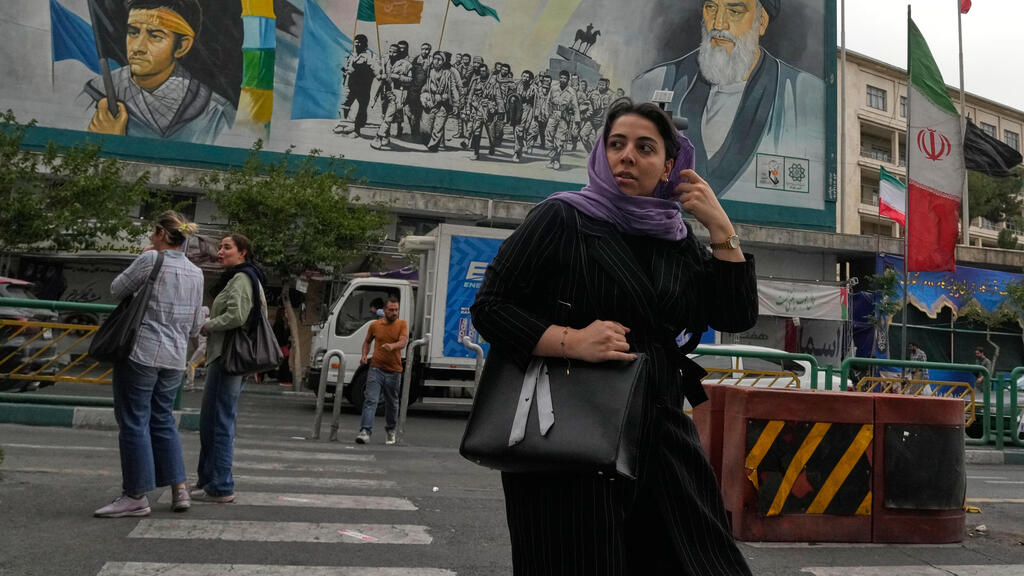
Tehran
(Photo: Vahid Salemi/AP)
In the sketch, the establishment is represented by an "official" who simply disconnects and reconnects plugs labeled "national internet" and "global internet." It is not just a funny video; it exposes the complete arbitrariness with which the regime decides what citizens can see and what is hidden from them.
The use of satire is a brilliant way of saying: "We see you, we understand your games, and we know you're afraid of the truth."
The climax comes when the regime attempts to create a PR victory through pro-government demonstrations, only to face a humiliating exposé from members of the Iranian diaspora. Operating from the relative safety of the West, they do not need to be on the ground to win the battle for public opinion.
They take the regime's official propaganda videos and pick them apart piece by piece. They analyze accents, dialects and responses to simple questions asked in the footage, then mercilessly reveal: "This protester isn't even Iranian."
Every propaganda video uploaded by the regime quickly becomes a target of ridicule, as evidence that the support on display is an "imported product" spreads across social media networks inside Iran.
The latest confrontation is not just another security event; it is a catalyst that highlights the fracture. While the regime clings to imagined "victories" and planted demonstrators, the Iranian people are focused on the daily struggle for survival.
The silence of Iran's citizens, even after the latest exchange of blows, is not consent. The public no longer believes the victories the regime is selling, and the authorities must bring in supporters from outside to fill public squares.
In other words, the Iranian regime has become far more fragile internally, with cracks that can no longer be repaired. This is the true voice of the Iranian street, even when it is spoken in whispers.
- Efi Benay is a lecturer and researcher of social media networks in Iran