

A team of engineering students from Afeka Academic College of Engineering became the first Israeli team to compete in Belgium’s iLumen European Solar Challenge this month, completing nearly 800 kilometers (490 miles) in a solar-powered race car they designed and built.
Competing as AFEKA Racing, the students completed 197 laps during the 24-hour endurance race, finishing 14th overall. The team placed first among the six teams making their debut in the competition.
Gallery
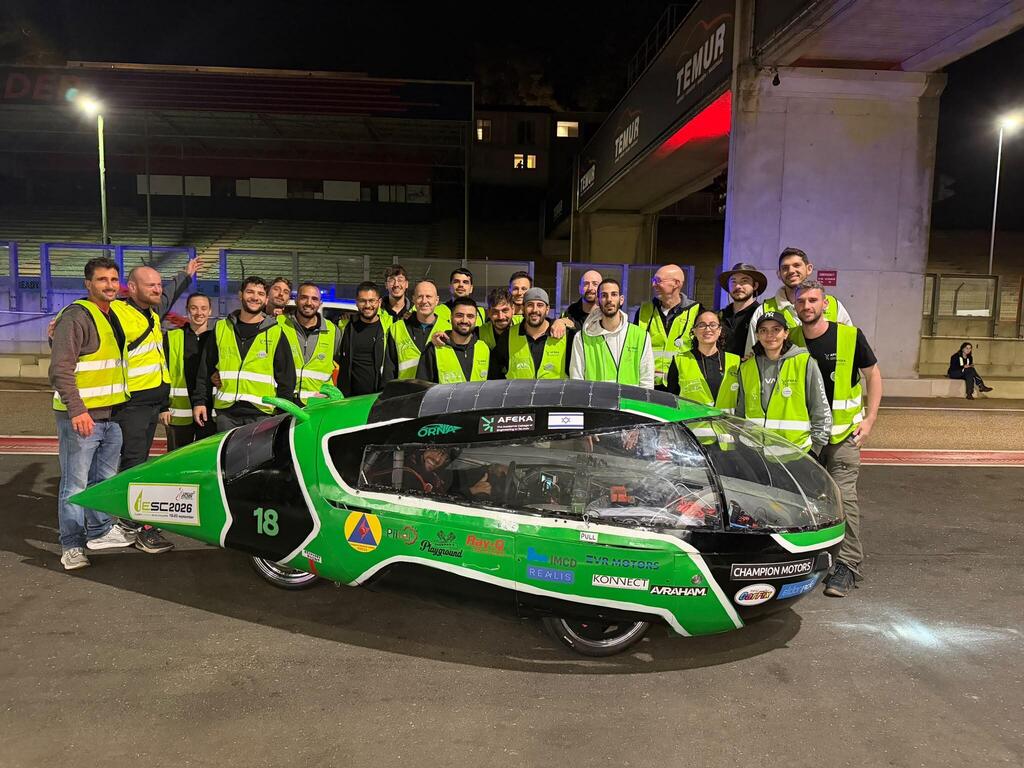
AFEKA Racing team members pose with their student-designed solar-powered car during the 24-hour iLumen European Solar Challenge in Belgium
(Photo: Afeka College of Engineering)
The project brought together students studying mechanical, electrical, software and industrial engineering, who worked across disciplines to design and build a solar-powered vehicle capable of competing in an international endurance race.
The 24-hour competition tested both the car and the students’ ability to address engineering problems under race conditions. The team encountered communications problems with the vehicle’s computer system and greater-than-expected tire wear. Students also performed a wheel alignment during the race to keep the car running.
“What made me most proud was seeing how the team grew throughout the project,” said Dr. Dan Herman, who heads Afeka’s Auto Club. “At the beginning, I was deeply involved in managing the project and making decisions. Over time, the students took ownership, managed themselves and learned to make those decisions together.”
Herman said the students continued working through technical problems as they arose.
“Even when we faced challenges during the race, they worked as a team, solved every problem and kept the car moving,” he said.
Afeka says it is the only academic institution in Israel to offer an automotive specialization as part of an undergraduate mechanical engineering program. The solar car project was developed as an extension of that program, giving students hands-on experience designing and constructing a complex vehicle while working with students from other engineering disciplines.
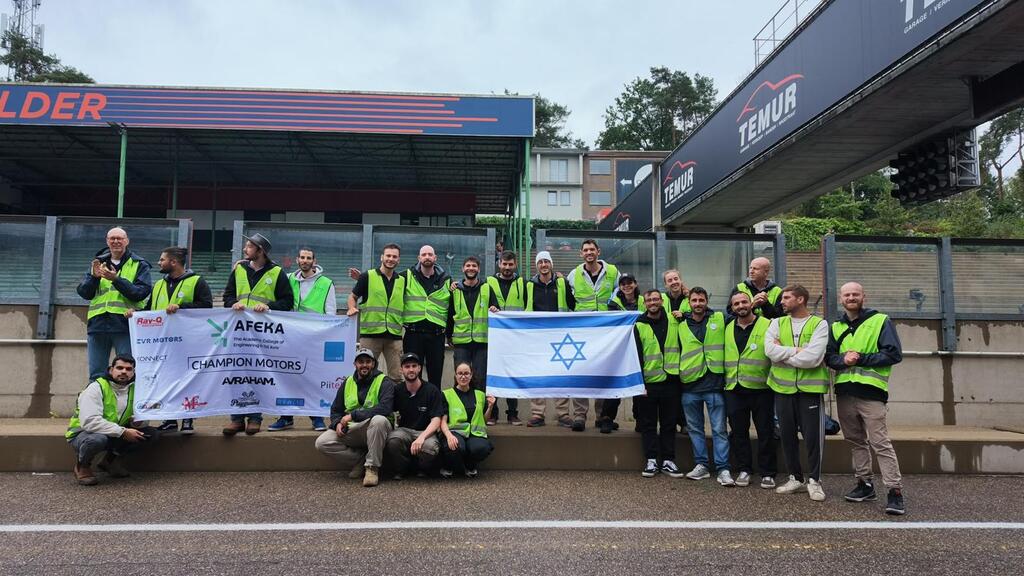
AFEKA Racing team members pose with an Israeli flag at the iLumen European Solar Challenge in Belgium
(Photo: Afeka College of Engineering)
The college operates several student engineering clubs aimed at giving participants practical experience applying classroom knowledge to real-world engineering projects.
Afeka plans to use its first appearance in the Belgian competition as a foundation for a continuing solar racing program, with future groups of students building on the knowledge and experience of previous teams. Graduates of the Auto Club are also expected to remain involved and share their experience with future participants.
“Engineering education is at its best when students have the opportunity to take what they learn in the classroom and apply it to complex, real-world challenges,” Afeka President Prof. Yossi Rosenwaks said.
Rosenwaks said the team’s performance demonstrated the “creativity, determination and interdisciplinary collaboration” the college seeks to develop among its students.
“More importantly, it reflects the kind of engineers we seek to educate — engineers who can turn knowledge into action, take on ambitious challenges and help shape Israel’s technological future,” he said. “We are incredibly proud of the way they represented Afeka and Israel on the international stage, and we look forward to seeing how they build on this achievement in the years ahead.”
The team is now setting its sights on the Bridgestone World Solar Challenge in Australia, one of the world’s leading competitions for solar-powered vehicles.
AFEKA Racing hopes to use the experience gained in Belgium to develop an Afeka-built vehicle for the August 2027 competition, which is set to take teams on a roughly 3,000-kilometer (1,860-mile) journey from Darwin to Adelaide.