

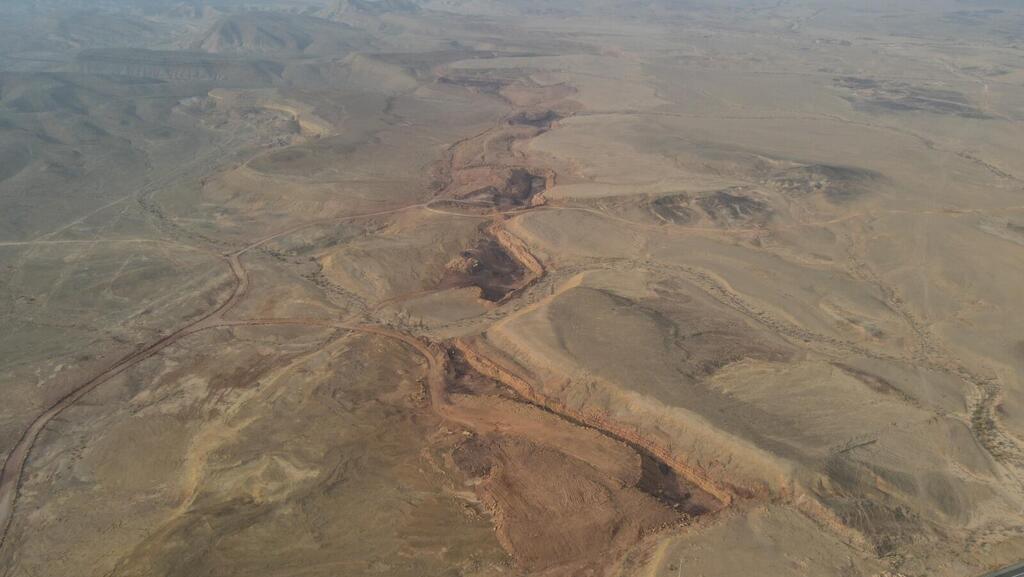
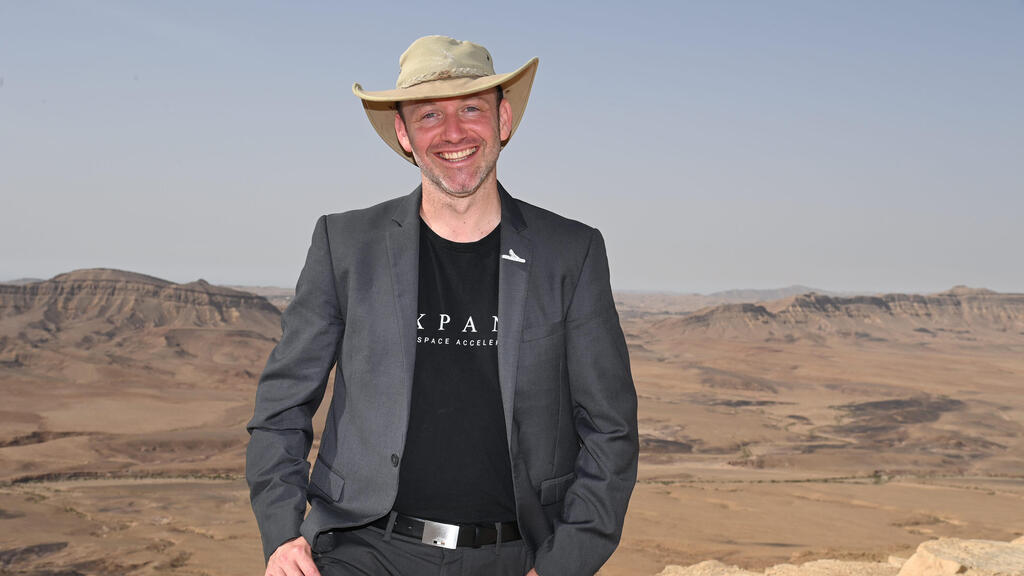
Dr. Roy Naor, CEO of Creation Space, has used the same gimmick dozens of times. Thousands of people have already seen it at lectures, conferences and investor meetings: He pulls out two large, rigid photos of a dry, rocky desert landscape, places them side by side and asks the audience: Which one was taken on Mars, and which one was taken in Ramon Crater, a few hundred meters from my home?
“They always get it wrong,” he says. “Everyone. NASA researchers and nature experts from Mitzpe Ramon. You simply can’t tell the difference.”
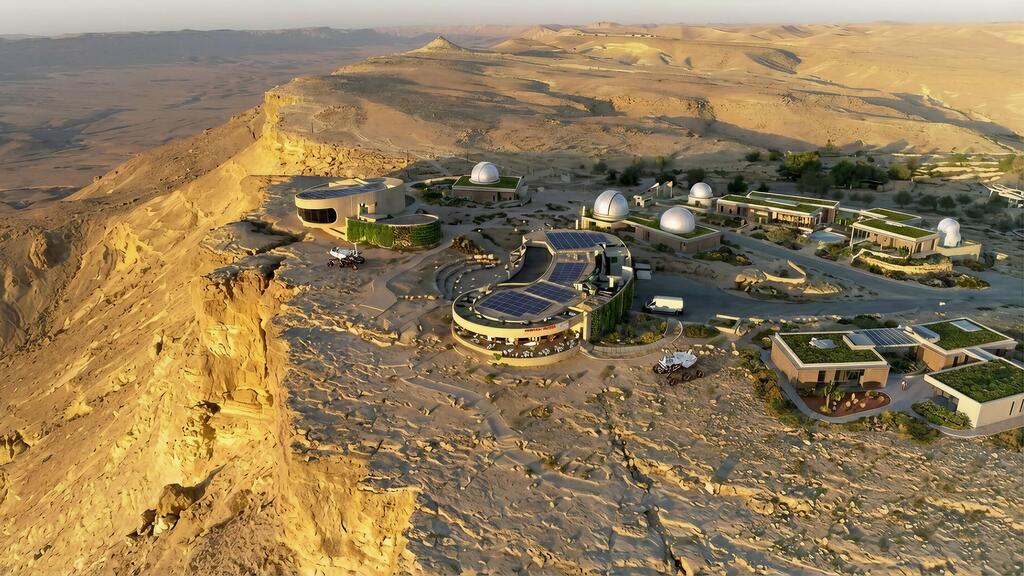
So what connects this energetic planetary scientist from the Weizmann Institute, a native of Kibbutz Na’an and a self-declared space geek, to Mitzpe Ramon, a small and sleepy town in the central Negev, isolated and remote, with no hospital, no port, no airport, scorching heat during the day and freezing cold at night?
“First of all, my wife,” Naor says. “She is the granddaughter of the legendary Hagai Avriel, one of Mitzpe Ramon’s founders in the 1950s and a former head of the Ramat Negev Regional Council. And second, and of course most importantly, the incredible connection between Mitzpe Ramon and space.”
What incredible connection?
“Mitzpe Ramon is the best place in the world to develop and accelerate technological solutions that have dual use, both for space and for a changing Earth,” he says. “It was already Israel’s space city before we got here.
“It is a small town, but for all of us it is associated with astronomy, space and the stars. It has more space-related institutions per capita than anywhere else: the largest university observatory in the Middle East, and a visitors’ center named after Israel’s first astronaut, Ilan Ramon, and his son Asaf. Everyone also knows that when there is a meteor shower, you go down to the crater to watch it.
“The environmental conditions here are phenomenally valuable for everything connected to planetary science research and technological development. I have led NASA delegations inside Ramon Crater. What do planetary scientists do? They go to environments on Earth that resemble the conditions they are studying in space, and compare them.”
‘Ramon Crater is one of the best analogs’
Naor says the idea began in 2014, while he was studying at the Weizmann Institute and attended the International Space University in France, which runs a unique executive program in different locations around the world every year.
“I took part in the program in the United States, in Ohio, at NASA’s Glenn Research Center,” he says. “To my right sat the person who had just landed a spacecraft on Mars, and not far away was the person training astronauts for the moon.
(Photo: Creation-Space)
“At NASA, I researched the geology of Mars. That kind of research requires comparison with similar environments on Earth. And my discovery was that Ramon Crater is one of the more suitable ways to do that.
“Want an example? On Mars, there is an interesting phenomenon: layers of sulfates, minerals such as gypsum, and above them layers of clay. Usually, you learn about this phenomenon only from images, but in the crater you can see it with your own eyes.
“There aren’t many places like that in the world. NASA itself now officially sees the crater as having potential for planetary analog research. From the place where we are sitting right now, you can simply walk into the crater, conduct an experiment and then propose how to test it on Mars.”
When he returned from the United States in 2015, Naor says, his life changed.
“I discovered that while the world was busy breaking boundaries into space, Israel was staying outside the race. I understood that in this developing market, there was money to be made, because the global space industry is undergoing a revolution.
“The field, which was once controlled only by government agencies, is becoming commercial and profitable. And what is needed is not just more spacecraft launches, but new technologies that make it possible to function and thrive in extreme conditions.
“There is one country in the world that is really good at that, and that is Israel. We have the ability here to contribute to this global effort and benefit from it. So I returned to Israel, only to see, sadly, that for everyone here, ‘space’ still meant only spy satellites over Iran.”
Mitzpe Ramon
(Photo: Oded Sahar)
Wireless electricity and a desert campus
Naor, 40, a father of three, is the force behind the ambitious idea of turning Mitzpe Ramon into an innovative international technology center that will draw thousands of researchers, businesspeople and tourists each year. Israel’s space city.
Six months ago, ten years after he began promoting the idea and knocking on every possible door, he moved with his family to Mitzpe Ramon. At the same time, Creation Space, which he founded four years ago with Gal Yaffe, Alon Shikar, Leon David, Chen Dudai, Doron Landau and Dr. Israel Biran of the M2M fund, is already handling tens of millions of shekels.
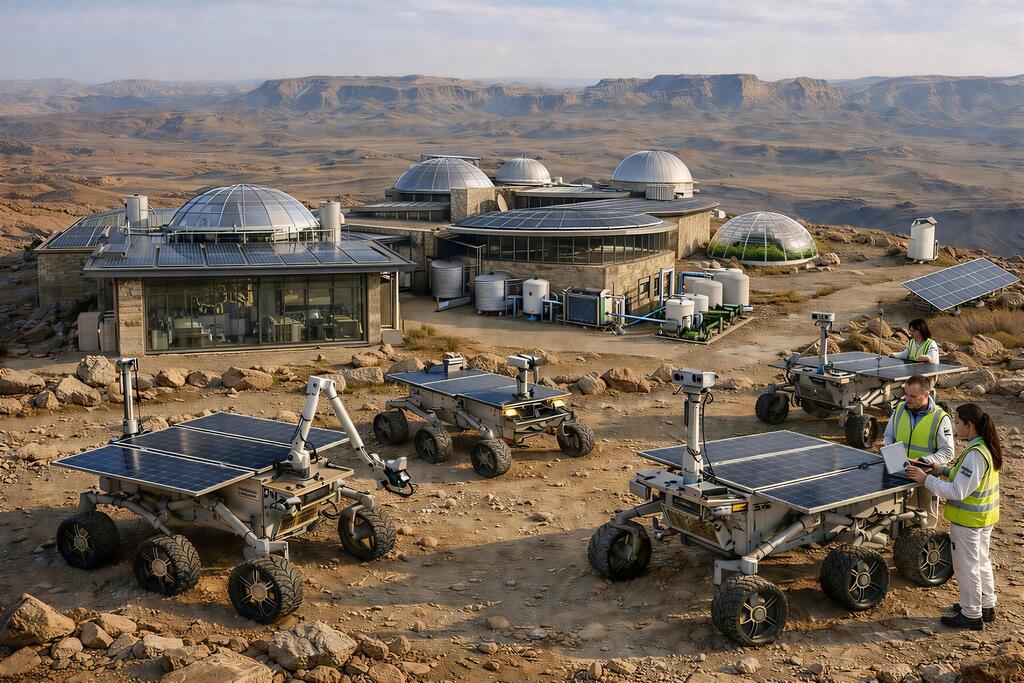
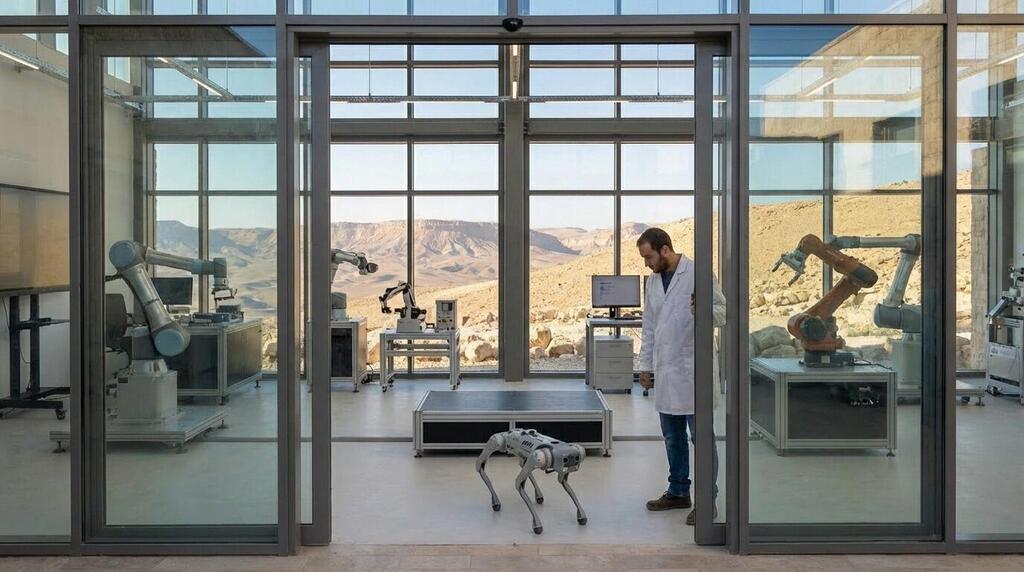
The company grows, supports and promotes startups developing technologies for space. It is now building a campus in Mitzpe Ramon that will include advanced laboratories, an international conference center and a control room, and it has a technological partnership with Nvidia, including the construction of a simulation and robotics lab.
Until a decade or two ago, space was mainly about prestige contests between superpowers or pure academic research. In 2026, space has become “New Space,” a hot business arena. Companies such as Elon Musk’s SpaceX have cracked the ability to return costly launch rockets to Earth and cut costs dramatically. Satellites the size of a shoebox now allow small companies to send equipment into space. Companies such as Starlink have shown that satellite internet can generate billions.
There are also commercial tourism ventures. Companies such as Axiom are already building modules in space that will serve as hotels for the wealthy and laboratories for rent. And the enormous land and energy demands of server farms on Earth are creating a race to develop ways to move them into space.
Dr. Roy Naor
(Photo: Herzl Yosef)
The technologies being developed by startups adopted by Creation Space sound as if they came out of science fiction books from the 1960s and 1970s. A partial list includes a thin robotic “snake” developed by Beyond Reach that can be inserted into hard-to-access spaces; a revolutionary method by Mishley for transmitting electricity wirelessly to devices; wireless charging for electric vehicles in space, developed by Elssway; an independent navigation system for robots in space by NaVision; and, if you ever find yourself stranded on Mars with a dead phone battery, NWPT is building a portable lithium-refining device for independent battery production.
In January, the Israeli government also joined the project. Against all expectations, Creation Space was chosen to lead the national laboratory for making space technology development more accessible. Four major established companies competed against it, including Israel Aerospace Industries. But the Israel Innovation Authority and the Israel Space Agency at the Ministry of Science and Technology, which led the tender, decided to bet on the young company from Mitzpe Ramon.
“We were impressed,” says Israel Innovation Authority CEO Dror Bin, “by Creation Space’s ability to offer a complete framework, from guiding entrepreneurs and companies to building technological infrastructure and managing actual space activity.”
The new project also includes the Technion, Ben-Gurion University, satellite company ImageSat International and the Rakia venture capital fund. The new national lab will help startups and academic institutions turn their knowledge into products that can break into the international market.
They will receive consulting, help building work plans, subsidies and access to infrastructure that until now was almost impossible for them to reach. The overall investment, estimated at about 100 million shekels, will be covered by a long list of government bodies, including the Innovation Authority and the Space Agency, the Growth Administration and Investment Authority at the Economy Ministry, the Mitzpe Ramon Local Council and numerous philanthropic and private organizations.
A playground for robots
So what does Creation Space actually do?
“We build startups that create technological solutions for the space market,” Naor says. “The message is this: Space is the challenge, the engine, and confronting it accelerates the real goal, which is technological development for Earth, for our needs here and now. We deal only with technologies intended for dual use, technologies that provide future value but also immediate value.
“The reason we insist on the dual purpose is simple. Establishing server farms on the moon, for example, is already a realistic forecast, but only for another decade from now. For a venture capital investor, that is too far away. If the investor is not convinced they will get a return within a few years, they won’t enter. But from their perspective, solutions that can make server farms cheaper and more efficient right now are a good investment.”
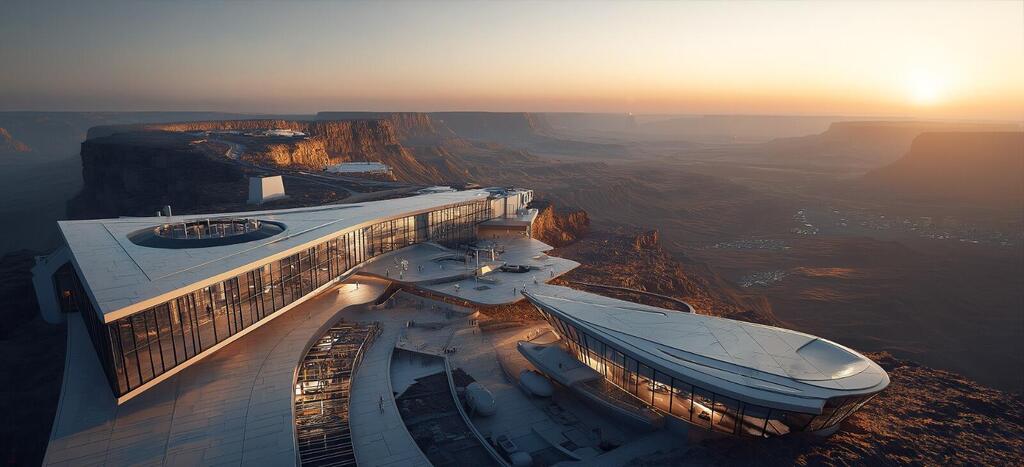
The Robotics and development lab complex
(Photo: Shika & Nisha architecture)
NASA originally developed many technologies we know today, he adds, and humanity ultimately benefited from them.
“Today, even at NASA, when they issue a grant to develop technology for building a device on the moon, the condition is that it must have dual use. Otherwise, economically, it is not worth dealing with.
“Startups that aim their development at a future space need expand their opportunities. If they manage, with our help, to win NASA funding, the money will also help them develop for the regular market. In the lab we are building with Nvidia, the idea is that you develop and build a robot in a digital environment inside the lab, then simply open the door and go straight out to the playground, to the testing area.”
And what does Nvidia gain from the match?
“I believe they understand the potential here,” Naor says. “When you see what happens when Iran hits server farms in Dubai, you suddenly understand why a server farm in space matters. Suddenly, the space market looks more realistic than ever, with justification not only economically, but politically and defensively. Besides, Mitzpe Ramon is the most remote town in Israel. That is a major advantage.”
An advantage?
“Correct. Because when you want to work on technological development that will function in disconnected places such as the moon and Mars, a pilot in Tel Aviv has no real value. My son injured his leg. If I lived in Tel Aviv, I would jump over to Ichilov, right? On the moon, do you jump over to Ichilov? Here, too, you don’t. So you have to find an alternative solution.
“Elon Musk, who plans to settle people on Mars, will one day buy telemedicine technology. Whoever develops it today will need to run trials in relevant places. So we are offering a living laboratory for such pilots. And not just medicine. Because of its isolation, Mitzpe Ramon is the most expensive community in Israel to supply with water and remove waste from.
“So if you are developing, say, water recycling technology for the moon, this is the place to test it. And if you need to run a pilot for some system, they don’t need you for that in Tel Aviv. But in Mitzpe Ramon, you could lower the cost of water by 10%. Here, they will help you run the pilot.”
Building toilets in space
With all due respect to Zionism and love of space, Creation Space was formally established in 2022 as a for-profit company. By coincidence, construction had just been completed in Mitzpe Ramon on an innovation center built by the Jewish philanthropic organization USA JNF, led by the American Braverman family.
(Photo: Ariel Gabay)
The meeting between the enthusiastic entrepreneurs and the donors produced not only a close relationship, but also an investment. Later, the Mirage Israel fund joined as well.
“From that moment,” Naor says, “we married this place. We were the first office tenants here. And this is where our startups come. Today, we are backed by 10 additional American entities, most of them private investors.”
Alon Shikar, 45, a co-founder of the company and an architect by profession, holds a degree from the Technion and another in urban planning from Bezalel. He is responsible for planning the unique series of buildings Creation Space is building in Mitzpe Ramon.
“As far as I’m concerned,” he says, “planning a good spaceship is like planning a good villa. To create quality spaces both for space researchers and astronauts, you need to take into account the same mental, social, physical and technical aspects.”
By the end of 2016, he already had his own office and studio, he says, when he received a call from Hillel Rubinstein, who would later become a partner and was then a physics PhD.
“He was interested in designing a building that would simulate a structure on Mars,” Shikar recalls. “He told me, ‘They said you are an architect who knows how to do special things.’
“It was challenging. I told myself: If I can develop a system for handling sewage from toilets in space, I will certainly know how to do it in towers, neighborhoods and buildings. I already knew Roy Naor. I was lecturing at the Technion, and Roy was at Weizmann. Space was our fantasy. Then, for the first time, we launched a course at the Technion with architects, doctors and engineers from all fields to design a structure suitable for life on Mars.”
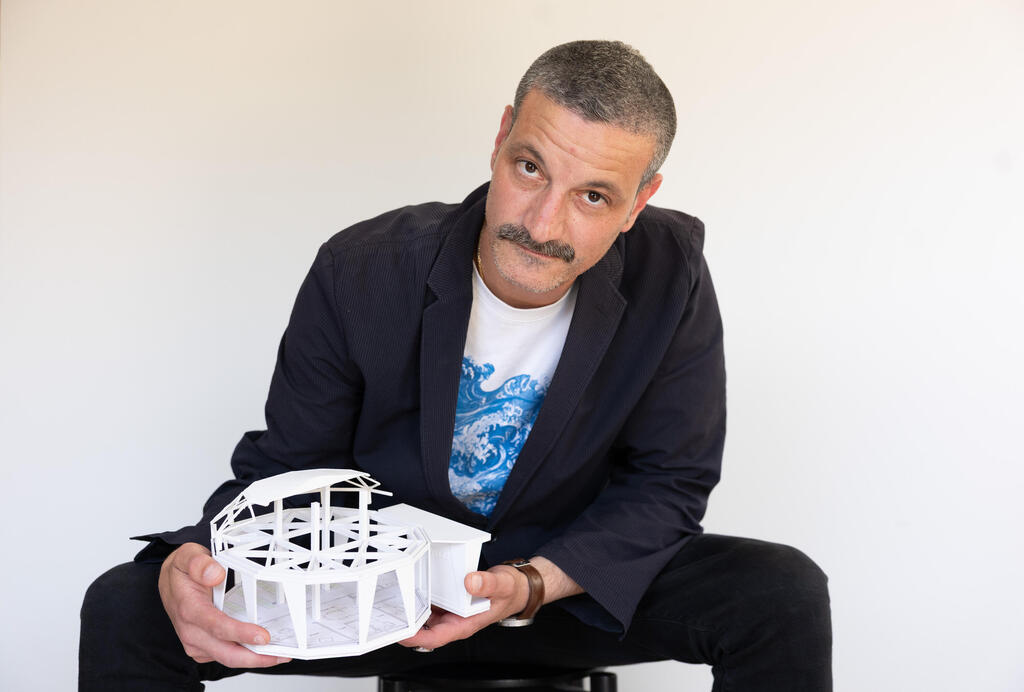
Alon Shikar
(Photo: Oz Mualem)
But there is an elephant in the room. Do they really believe they can draw startup founders away from Tel Aviv and Herzliya and turn Mitzpe Ramon into the center of their lives?
“I am not here to sell a dream of moving all of Tel Aviv to Mitzpe Ramon,” Naor says. “It is not for everyone. I do not expect CEOs to move here, but I do see companies carrying out the activities here that give them value. If that means hiring local workers to run experiments here, all the better.
“More than 50 years ago, Phoenix, Arizona, was also a hole in the middle of nowhere. Today, thanks to high-tech and innovation, it is the fifth-largest city in the United States and one of its important economic centers.
“People have a certain perception of the periphery, and at least in Mitzpe Ramon, it is not correct. I live here and I have everything. The education here is better than what we had on the kibbutz. In my daughter’s class, she is in second grade, there are only 17 children, and she is the oldest in the school. My younger son is in a forest kindergarten.
“I leave the house, and within walking distance I can choose between 10 cafés. On the kibbutz I had one. There is no hospital here, but there is a larger clinic than the one in Na’an. Demand for apartments here is insane. The place is developing, there are new neighborhoods where they are already building large apartments, semi-detached homes and terraced housing. The population here is diverse, and Mitzpe is also a tourist destination in its own right.”
One person reaping the benefits of Creation Space’s enthusiasm is Mitzpe Ramon Mayor Elia Winter. Winter, 41, a father of seven, arrived in the town at 18 as a student at the local hesder yeshiva, fell under its spell and stayed.
 Mitzpe Ramon Mayor Elia Winter Photo: Nir Slakman
Standing at the edge of the spectacular observation balcony overlooking the breathtaking landscape of Ramon Crater, Winter points to the work being done just meters behind us. The council, together with JNF, the Economy Ministry and others, is building the large conference center that will become the living heart of the space campus.
Lectures, workshops and conferences will be held there.
“The promenade along the edge of the crater will be expanded,” Winter says. “The old buildings you see below it will be demolished very soon. A huge shopping complex will be built here, and above it an ultra-luxury residential area with apartments looking directly onto the crater.”
Did the Creation Space people fall from the sky into your lap, literally?
“Like a glove fits a hand,” he says. “This place is entirely a laboratory, and there is no reason not to take it one step further. We constantly ask ourselves how to get people with high-quality jobs to come to Mitzpe Ramon, and here is the opportunity. When the space lab operates here, every startup dealing with the field, certainly from Israel, but we hope also from Asia and Europe, will need to pass through Mitzpe Ramon.”
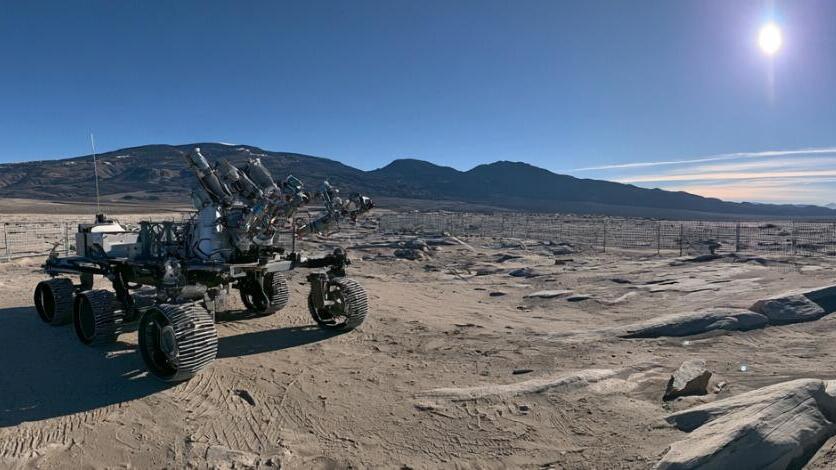
Space robotics experiment in Ramon Crater. Why Morocco, if it can be done in Israel?
(Photo: Alon Shikar)
How do you get those people to actually live here?
“For 95% of the world, it may not be suitable, but we are aiming for the 5% for whom it is. We found that four main things bring a population to Mitzpe Ramon: housing, culture, education and employment. In all of them, we have managed to create a transformation.
“In employment, there are two channels we are investing in. The first is tourism, the second is technology. True, this is not Silicon Valley. But our uniqueness is that we are isolated and remote, and located in extreme weather. That is a product we can market, to be a testing laboratory.
“You would be surprised, people want to live in Mitzpe Ramon. Right now, everything is full. There is not one room available. We need to build more workspaces for people who will work remotely from here for companies in the center. There are many who want to come, but I do not have workspaces for them.”
Grapes from Mars
The peak of Creation Space’s marketing creativity is a new winery at the entrance to Mitzpe Ramon, whose construction is expected to be completed by the end of the year.
What does a winery have to do with the space industry? The answer has to do with food. There is currently no technology that makes it possible, for example, to grow fruit in space, certainly not grapes.
Astronauts on shuttles and the space station, as is well known, mainly eat concentrated powders or pastes. NASA has been trying for years to achieve a breakthrough in this area, and the challenge is high on the list of topics that receive generous research grants.
“We identified the potential,” Naor says. “That is why one of the labs included in the space campus will be an agritech lab, combining agriculture and advanced technology, and it will be adjacent to the tourist winery Ramon Winery being built here.
“This is not a nursery or greenhouse for growing food. It is an actual laboratory for technological developments that will enable agricultural growth in extreme conditions, a field that is also very important for an Earth that is becoming drier. Mitzpe Ramon is surrounded by one main crop: vines. So we said, let’s turn this into a flagship project and try to develop vine growing in space.
“Then we saw that a new winery, one of the most impressive in the Negev, was being built at the entrance to the town by entrepreneur Haim Danon, owner of Comasco. We proposed integrating the lab we had planned into the winery. It will have glass walls, so tourists who come here will be able, beyond the tourist experience, to see scientists, engineers and entrepreneurs up close as they work on developments that may one day reach Mars.
“At the same time, we signed an agreement with SpaceX, Elon Musk’s space company, reserving space for our samples on a spacecraft that will be launched to Mars in 2030. The contract states that the first demonstration of vine growing outside Earth will come from technology developed here, at the winery in Mitzpe Ramon.”
Is that even feasible?
“Today, on the International Space Station, for example, they conduct experiments in hydroponics, growing lettuce and so on, but not at the level of growing a tree. Israeli astronaut Eytan Stibbe conducted an experiment in space involving chickpea sprouting.
“I’ll give you an example of a startup called Mana that will operate here and is still in very early stages. In space, the soil is toxic, and plants cannot be grown in it. But it turns out you can feed a plant like a person, by injection. You can give it an infusion. Many farmers use this technology when a plant is sick.
“In principle, you can actually grow it that way, with the pot serving only as a home for the roots while all the materials needed for growth come from outside. Our startup is trying to refine this: to build a kind of drip system connected constantly to the trunk, feeding it the right and changing dose of water, nutrients and more.”
Why start with grapes? Wouldn’t wheat make more sense?
“You’re right,” Naor says. “When people hear about the idea of a lab in a winery, they are genuinely surprised. Why wine? To survive on Mars, you need potatoes, like in the movie The Martian. So I remind them: When Noah emerged from the ark into the destroyed world after the flood, he did not plant potatoes. He planted a vineyard.
“Why a vineyard? There are all kinds of answers, but I like the one given by Rabbi Moses ben Nachman, the Ramban, one of the great sages of Spain: A vineyard is a message of culture. Noah knew that wine was a central element in rituals and social life, even to this day, and he wanted to preserve the culture he knew in order to restore a sense of normalcy to the world.
“As human beings, we did not come into the world only to survive. We came to thrive. When the Jewish people reach Mars, they will not come to grow potatoes. They will come with their culture.”