

“You are entering the world at an extraordinary moment,” Nvidia founder and CEO Jensen Huang told Carnegie Mellon graduates on Sunday, casting the Class of 2026 as the first generation to begin its working life at the dawn of the AI industrial era
“A new industry is being born. A new era of science and discovery is beginning,” Huang said in his commencement address, telling thousands gathered at the university’s rain-soaked Pittsburgh campus that they are standing at what he called a rare technological starting line
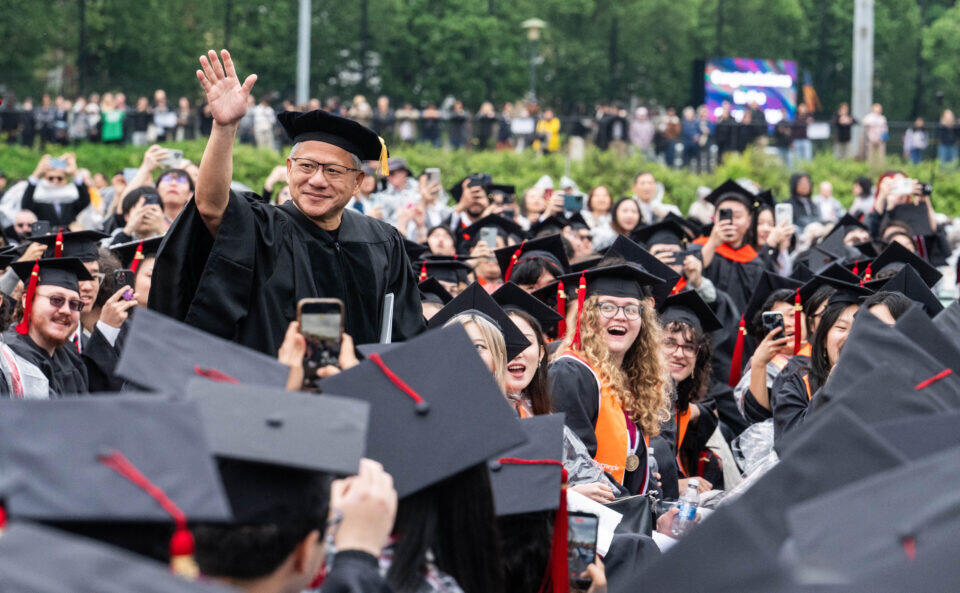
Nvidia founder and CEO Jensen Huang
(Photo: Nvidia)
“No generation has entered the world with more powerful tools — or greater opportunities — than you,” he said. “We are all standing at the same starting line. This is your moment to help shape what comes next.”
Before turning fully to AI, Huang asked graduates to turn to their mothers and wish them a happy Mother’s Day, drawing cheers from the crowd.
He then placed AI in the broader arc of computing history, saying every major platform shift — PCs, the internet, mobile and cloud — had brought society to the current moment.
“But what is about to happen now is bigger than anything before,” he said. “Because intelligence is foundational to every industry, every industry will change.”
‘AI gives America the chance to build again’
Huang described AI as driving what he called the largest technology infrastructure buildout in human history — and said the shift gives the United States a rare opportunity to rebuild its industrial capacity.
AI, he argued, is not only creating a new computing market but also a broader industrial era that could reshape work far beyond software and engineering.
“This is your time,” Huang said. “AI is not just creating a new computing industry. It is creating a new industrial era.”
He said the opportunity extends to electricians, plumbers, ironworkers, technicians and builders of all kinds, not only to computer scientists or AI researchers.
“For the first time, the power of computing and intelligence can truly reach everyone and close the technology divide,” Huang said. “Now it’s your time to realize your dreams — and the timing could not be more perfect.”
Huang also acknowledged the anxiety that comes with such a sweeping shift.
“Every major technological revolution in history created fear alongside opportunity,” Huang said. “When society engages technology openly, responsibly and optimistically, we expand human potential far more than we diminish it.”
He argued that AI will automate tasks, but does not erase the deeper purpose of many professions. Radiologists, he said, do not merely read scans — they care for patients. AI may help automate the reading of scans, but it can also elevate the radiologist’s broader role.
His message to the graduates was direct: do not retreat from AI, engage with it deeply.
‘Advance AI wisely’
Huang said the scale of the AI revolution demands a clear-eyed approach to both its promise and its risks.
“The responsibility of our generation is not only to advance AI — but to advance it wisely,” he said.
The remark drew applause, especially as Huang stressed that “scientists and engineers have a profound responsibility to advance AI capabilities and AI safety together.”
He also said responsibility does not fall only on technical experts.
“Policymakers have a responsibility to create thoughtful guardrails that protect society while still allowing innovation, discovery and progress to move forward,” he said.
Huang summarized the challenge as four simultaneous tasks: advancing AI safely, creating thoughtful policies, making AI broadly accessible and encouraging people to engage with the technology rather than fear it.
“History shows that societies that retreat from technology do not stop progress — they only surrender the opportunity to shape it and to benefit from it,” he said. “So, the answer is not to fear the future. The answer is to guide it wisely, build it responsibly and ensure that its benefits reach as many people as possible.”
‘Carnegie Mellon’s place in AI history’
Huang also used the address to connect the AI boom to Carnegie Mellon’s own history.
He called the university “one of the true birthplaces of artificial intelligence and robotics,” pointing to work by CMU researchers in the 1950s on the Logic Theorist, widely regarded as the first AI computer program, and to the creation of the Robotics Institute in 1979, the first academic institute devoted entirely to robotics.
“AI started right here at Carnegie Mellon,” Huang said.
Huang received an Honorary Doctor of Science and Technology, one of Carnegie Mellon’s highest distinctions, from university president Farnam Jahanian.
Ahead of the ceremony, he visited Carnegie Mellon’s Robotics Institute and met with students, including members of the robotics club, to learn about their work and the real-world problems they are trying to solve.
Huang also spoke personally about his own path in the United States, saying he saw part of himself in the graduates and their families.
“Like many in this audience, I am a first-generation immigrant,” Huang said, describing the America he saw growing up as “not easy, but full of opportunities. Not a guarantee, but a chance.”
“My parents came here because they believed America could give their children a chance,” he said. “How can we not be romantic about America?”
He ended by returning to Carnegie Mellon’s motto and telling graduates to match the scale of the moment with work that matters.
“Carnegie Mellon has a motto I love: ‘My heart is in the work.’ So put your heart in the work,” Huang said. “Build something worthy of your education, your potential and the people who believed in you long before the world did.”