

Sometimes it seems smartphone manufacturers are competing to see who can cram the most outrageous numbers into a specifications sheet. For years, the formula was straightforward: one high-resolution main camera accompanied by two secondary lenses that often felt like afterthoughts.
Now Oppo has decided to take things considerably further. Its new Find X10 Pro Max comes with three rear cameras, each packing a 200-megapixel sensor. Add a next-generation 2-nanometer processor, an enormous battery and a premium price tag, and the Chinese manufacturer has a flagship designed to challenge Apple and Samsung head-on.
We were among the first to get our hands on the device at its global launch in Mallorca, Spain, on Wednesday. Our initial impressions were impressive, particularly when it came to photography, although a closer look revealed some surprising compromises.
First, some background. Oppo is one of China's major smartphone manufacturers, operating alongside brands such as Vivo, iQOO and OnePlus within a closely connected corporate ecosystem. OnePlus, long popular among Android enthusiasts for offering flagship-level performance at more accessible prices, has been retreating from Western markets.
The Find X10 family also includes the standard X10, which is not expected to arrive in Israel, and the X10 E, which recalls some of OnePlus' design choices. But the main attraction is the Find X10 Pro Max, Oppo's most ambitious attempt yet to compete with the industry's premium heavyweights.
Gallery
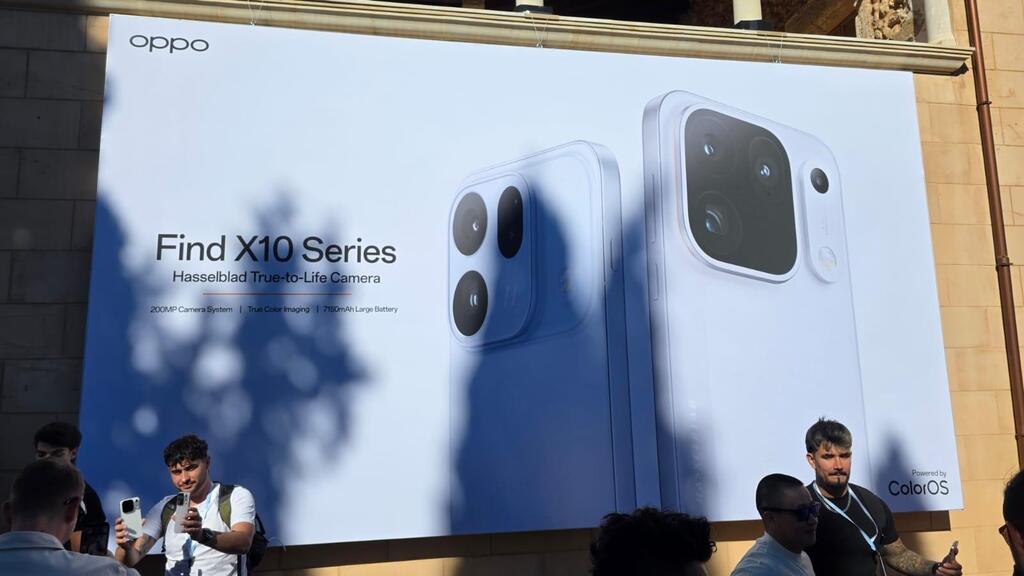
Oppo's Find X10 Pro Max unveiled at its global launch event in Mallorca, Spain
(Photo: Raphael Kahan)
Its central selling point is photography. Working with prestigious Swedish camera manufacturer Hasselblad, Oppo has developed a system designed to prioritize natural colors, realistic lighting and accurate detail over the heavily processed appearance that has become common in smartphone photography.
During our brief hands-on session, the results were striking. Colors looked unusually faithful to the original scene, with an accuracy more commonly associated with dedicated cameras than smartphones. Of course, a complete verdict will have to wait until we can test the phone extensively.
A heavyweight flagship, in every sense
The first thing you notice when picking up the Find X10 Pro Max is its weight. At approximately 235 grams and 8.4mm thick, this is not a compact phone that disappears into your jeans pocket.
It feels substantial, partly because of its large battery and the considerable amount of camera hardware on the back. A prominent square camera island dominates the rear panel, pushing the LED flash into a separate corner.
The two-tone finish, available in Luna White and Titanium Grey, gives the device a polished, expensive appearance. It certainly looks like a flagship.
Oppo also deserves credit for what comes in the box. While Apple, Samsung and Google generally require customers to purchase a charging adapter separately, Oppo includes an 80W fast charger, a compatible cable and a soft protective case matching the phone's color.
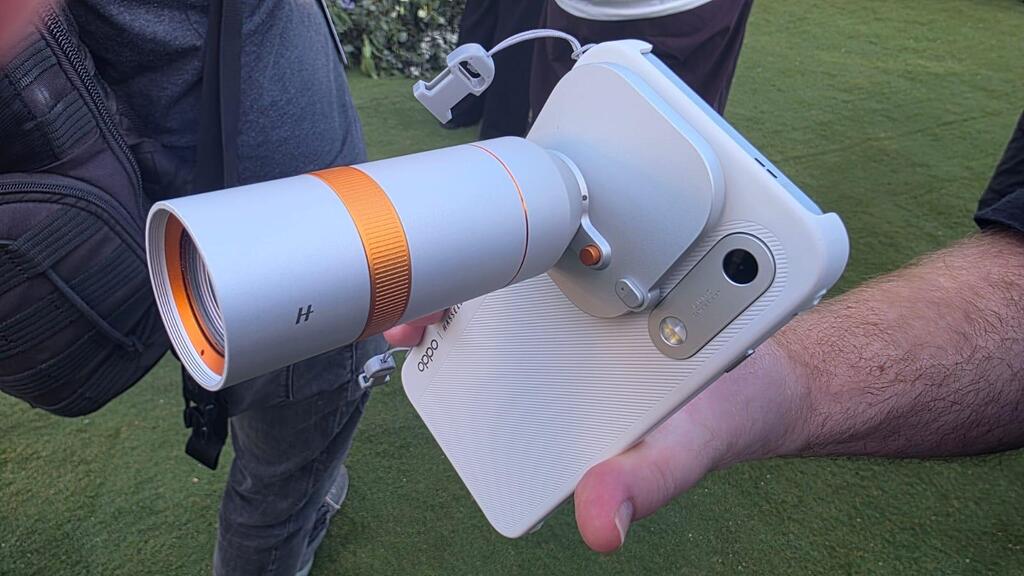
The Oppo Find X10 Pro Max fitted with its optional external telephoto lens
(Photo: Raphael Kahan)
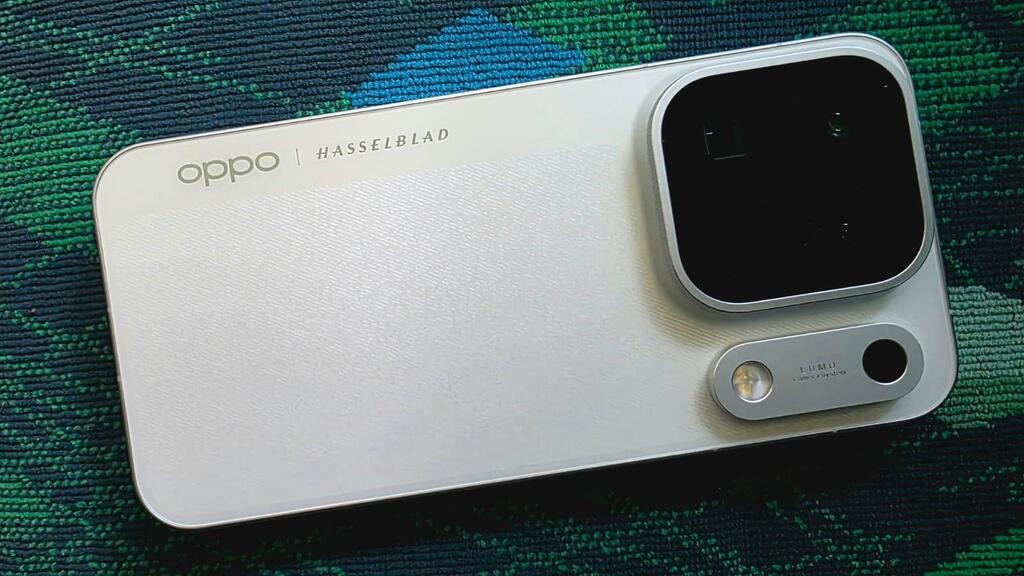
A closer look at the Find X10 Pro Max during Oppo's launch event
(Photo: Raphael Kahan)
There is, however, one frustrating omission. The dedicated physical camera button found on the previous Find X9 Pro has disappeared. For a device so heavily focused on photography, that seems an especially strange decision.
On the front is a 6.78-inch AMOLED display protected by Gorilla Glass Victus 2. Its refresh rate adjusts from 1Hz to 120Hz during ordinary use, climbing as high as 144Hz in supported games, although relatively few titles currently take advantage of that capability.
Brightness reaches 2,000 nits in bright conditions, with localized peaks of up to 3,600 nits when displaying HDR content. In practical terms, the screen should remain easily readable even under strong sunlight.
But the resolution reveals another compromise. At 2772 x 1272 pixels, commonly described as 1.5K, the display falls short of the QHD+ panels found in devices such as Oppo's Find X9 Ultra and Samsung's Galaxy S26 Ultra.
In everyday use, the difference is unlikely to be noticeable. The screen looks exceptionally sharp and its colors are rich. Still, it is odd to see a device carrying the Pro Max name and commanding this price settle for a lower resolution than some competing flagships.
Under the hood, Oppo has installed MediaTek's Dimensity 9600 Pro, one of the first smartphone processors manufactured using TSMC's advanced 2nm technology.
Put simply, smaller manufacturing processes allow chipmakers to fit more transistors into a given space, improving the potential for greater processing power and better energy efficiency. The promise is faster performance without a corresponding increase in heat generation or battery consumption.
Three 200MP cameras, but the zoom tells another story
The cameras are where the Find X10 Pro Max makes its strongest argument.
Its Hasselblad-developed system includes a 200-megapixel main camera with an f/1.5 aperture, a 200-megapixel telephoto camera offering 3x optical zoom and macro photography from as close as 10 centimeters, and a 200-megapixel ultrawide camera with a 124-degree field of view.
There is also a 50-megapixel front camera with autofocus.
The combined 600-megapixel figure makes for an impressive headline, although it is important to understand that the phone does not produce a single 600-megapixel photograph. Instead, each of its three rear cameras has its own 200-megapixel sensor.

(Photo: Oppo)
Nor does the device normally produce enormous 200-megapixel image files. By default, it combines information from neighboring pixels to generate photographs of approximately 26 megapixels. Users can switch to 50- or 200-megapixel modes when they want additional detail for cropping or large prints.
Oppo's broader ambition is to move away from the artificial appearance that characterizes some smartphone photography. The company has criticized competitors for oversaturated colors, excessively bright faces and aggressive sharpening that can make photographs look impressive but unnatural.
Its new LUMO image-processing engine, combined with a dedicated 24-channel color sensor, is intended to reproduce scenes with greater fidelity. The goal is to make photographs look the way people remember seeing them, rather than the way software thinks they should look.
Video capabilities are similarly ambitious. All three rear cameras support recording at 8K resolution and 30 frames per second, as well as 4K at up to 120 frames per second.
The phone also supports professional formats such as Log, which provides greater flexibility when color grading footage, and Open Gate recording, which captures a larger area of the sensor so video can later be cropped for different formats, including YouTube and Instagram.
These are particularly useful tools for content creators who need to produce both horizontal and vertical footage from the same shoot.
So where is the catch? Despite its three 200-megapixel cameras, the phone's native optical zoom stops at 3x, equivalent to approximately 70mm.
Oppo can use the sensors' high resolution to digitally crop images and simulate longer focal lengths with relatively little loss of detail. But that is not the same as having a dedicated long-range optical lens.
Consider Oppo's own Find X9 Ultra, which offers a physically larger main sensor and an additional periscope camera providing genuine 10x optical zoom. In that respect, the new Pro Max does not necessarily represent an upgrade.
For photographers seeking extreme magnification at concerts, sporting events or wildlife shoots, Oppo offers a separately sold external telephoto lens kit. It extends the phone's capabilities, but adds cost and complexity to a device that is already expensive.
Ultimately, the accessory is a reminder that even a smartphone with three 200-megapixel cameras cannot entirely replace the flexibility of dedicated photographic equipment.
An enormous battery and an equally high price
According to Oppo's specifications, the Find X10 Pro Max features an 8,000mAh silicon-carbon battery, considerably larger than the roughly 5,000mAh batteries commonly found in competing flagship phones.
The company says the capacity is sufficient for up to two days of typical use, although that claim will need to be tested under real-world conditions.
There is an important regional distinction, however. While the global and Chinese configurations carry the full 8,000mAh battery, the European version has a smaller 7,150mAh unit.
That difference matters for Israeli consumers, particularly anyone considering importing the device independently from Europe.
Oppo's official Israeli importer, Ronlight, lists the full 8,000mAh capacity for the local version. Buyers should nevertheless check the specifications on the retail packaging, especially when purchasing from parallel importers, to ensure they are receiving the configuration they expect.
The phone is expected to reach Israeli stores in November, with a projected price of 6,499 shekels. That places it firmly in the most expensive segment of the smartphone market, competing directly with Apple's iPhone 18 Pro Max and Samsung's Galaxy S26 Ultra.
In Europe, the price is around 1,799 euros, representing a substantial increase over the previous generation.
So is it worth the money? Based on our initial experience, the Find X10 Pro Max is among the most intriguing smartphones heading to Israel this year. Its camera system is genuinely ambitious, its processor promises considerable performance and its battery capacity is exceptional.
For photographers, videographers and serious content creators, the combination could be compelling. For everyone else, it is a beautifully engineered luxury device with compromises that become harder to ignore at this price.
And given its substantial dimensions, the old expression about needing deep pockets has rarely been more appropriate.
We will put the phone through a more extensive evaluation before delivering a full review.
Disclosure: The reporter attended Oppo's launch event in Mallorca, Spain, as a guest of the company.