

A U.S. data engineer has built a massive, searchable database of documents related to convicted sex offender Jeffrey Epstein, drawing widespread attention online and raising questions about public access to federal records.
The man, who uses the pseudonym “Eric Keller” to protect his identity and family, is an American in his 30s who works as a data engineer and has children. He said he devoted himself to the project after the U.S. Justice Department began releasing large troves of Epstein-related documents to the public in late 2025.
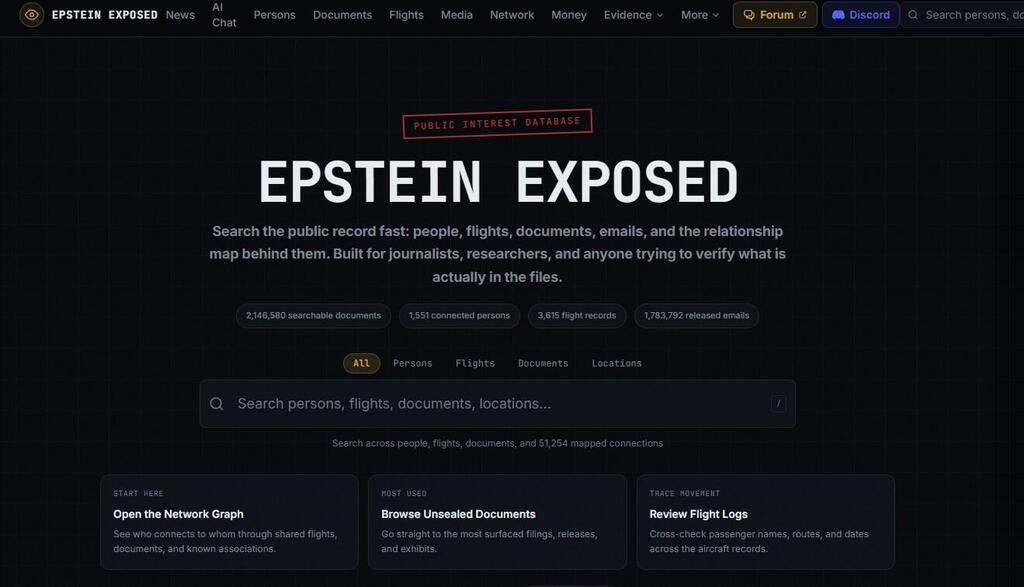
Keller created a website called “Epstein Exposed,” which he describes as a comprehensive, searchable database of Epstein case materials. The site includes more than 1.5 million files, has indexed more than 2 million documents, cataloged about 1,500 individuals and mapped tens of thousands of connections among them.
The database allows users to search names, documents, flights and relationships, and includes emails, letters, images, videos and flight records. It also uses artificial intelligence tools to analyze and summarize content and visualize links between people connected to Epstein.
The technology magazine Wired first reported Keller’s story this week, noting that the site gained traction after he shared it in a Reddit post more than a month ago. The post drew about 5.5 million views, and hundreds of thousands of users visited the site in the following days.
Keller told Wired that his motivation is partly rooted in his own experience as a victim of sexual abuse as a child, saying it led him to closely engage with the material and identify with victims described in the documents.
“When the first documents started coming in, I couldn’t look away,” he said. “I understood from the inside what was being described.”
The Justice Department’s document releases include millions of pages, many of them unstructured, partially redacted or difficult to search. Keller said that after spending hours manually searching through files, he began building a tool to automate the process.
Within hours, he had developed a basic prototype search engine. He then expanded the system to extract and organize key details such as names, dates, organizations and locations, linking them across documents.
In January, the Justice Department released a larger batch of more than 3 million files. By then, Keller’s database had surpassed 1 million documents and included an interactive network map showing connections among prominent figures linked to Epstein, including business leaders, politicians and academics.
According to the database, former Prime Minister Ehud Barak appears in thousands of documents and flight records, while Prime Minister Benjamin Netanyahu is referenced primarily in media citations and correspondence.

The site has struggled at times to handle heavy traffic and has drawn interest from journalists, law enforcement officials and researchers, Keller said.
He said he believes the Justice Department did not make the documents easily searchable and that “the public deserves more.”
Twelve days after launching the site, Keller quit his job to focus on the project full time. He said the effort costs about $8,900 per month to maintain and is funded without ads or a paywall. Donations have not covered expenses, and he said he is using his personal savings.
Keller also said he has received legal warning letters from attorneys representing individuals named in the database.
He said he hopes the platform will help sustain public attention on the case, encourage further investigations and support victims seeking documentation.
“I think about them all the time,” he said. “If they can come to the site and find documents confirming what happened to them, there are no words for how important that is.”
Despite fluctuations in traffic, Keller said even a small number of daily users could make a difference, including journalists, researchers or survivors searching for records.
He added that significant work remains, including reviewing more than 130,000 documents that have yet to be fully processed and expanding tools to analyze financial connections tied to Epstein.