

A humanoid robot developed by Chinese smartphone maker Honor ran 100 meters in 9.32 seconds, faster than Usain Bolt’s longstanding human world record, Chinese state broadcaster CCTV reported Saturday.
The robot, dubbed “Lightning,” reached a peak speed of 14.5 meters per second during a preparatory test ahead of the second World Humanoid Robot Games, which opened Saturday in Beijing.
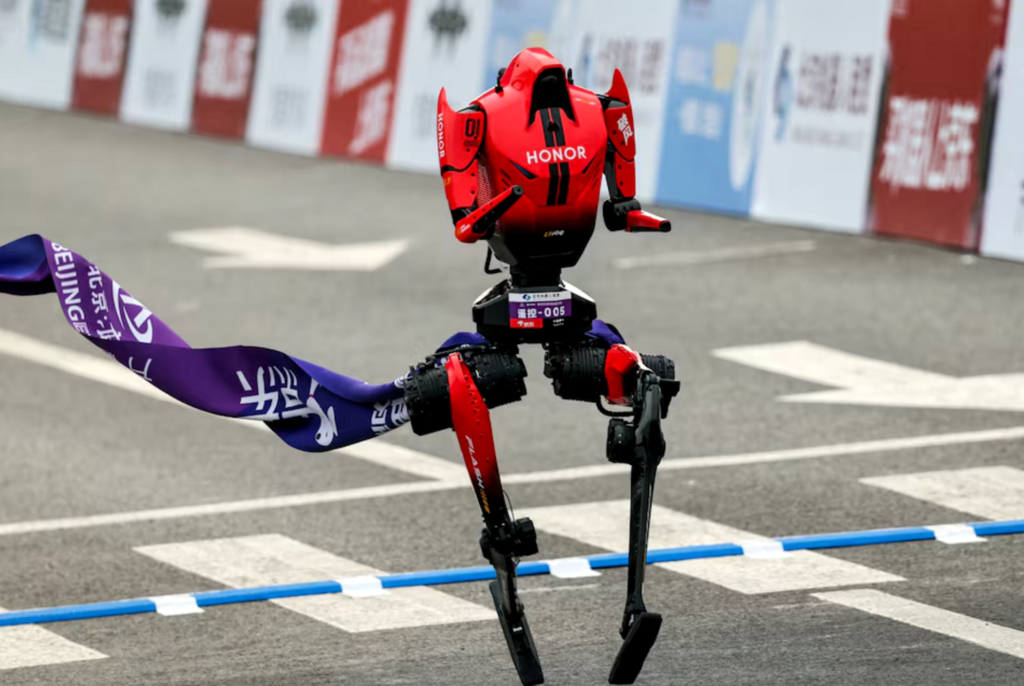
A Lightning humanoid robot by Honor crosses the finish line of the second Beijing E-Town Half Marathon and Humanoid Robot Half Marathon in Beijing
(Photo: Reuters)
Its reported time was faster than the men’s 100-meter world record of 9.58 seconds set by Jamaican sprint legend Bolt at the 2009 World Athletics Championships in Berlin.
The feat comes as China increasingly promotes humanoid robotics as a strategic emerging industry, with policymakers and technology companies betting that advances in artificial intelligence and hardware will accelerate the use of robots in manufacturing, logistics and consumer applications.
Lightning has already demonstrated its endurance as well as its speed. In April, the robot won the 21-kilometer Beijing half marathon in 50 minutes and 26 seconds, a pace faster than the elite men’s human world record.
At the time of the half marathon, Lightning stood 169 centimeters, or about 5 feet 7 inches, tall and had 95-centimeter legs. Researchers have since extended its legs by 10 centimeters to 1.05 meters ahead of the World Humanoid Robot Games, CCTV reported.
The latest sprint adds another striking benchmark to China’s rapidly developing humanoid robotics sector, where companies are increasingly testing machines not only in laboratories and factories but also in public sporting competitions designed to showcase advances in mobility, balance and speed.