


The Education Ministry announced Thursday that beginning February 2, on Tu Bishvat, a new policy prohibiting the use of mobile phones on elementary school grounds will take effect. Under the guidelines, presented under the direction of Education Minister Yoav Kisch, students will not be allowed to use their devices during the school day except in designated lessons where staff approve supervised use for learning purposes.
The policy was developed following an extensive review led by Education Ministry Director General Meir Shimoni, which examined research and global trends regarding the impact of smartphone use on student wellbeing, school climate, learning environments and the emotional and social skills needed in a changing world. The move is part of a broader system-wide policy aimed at reducing distractions, strengthening social bonds and ensuring optimal learning conditions.
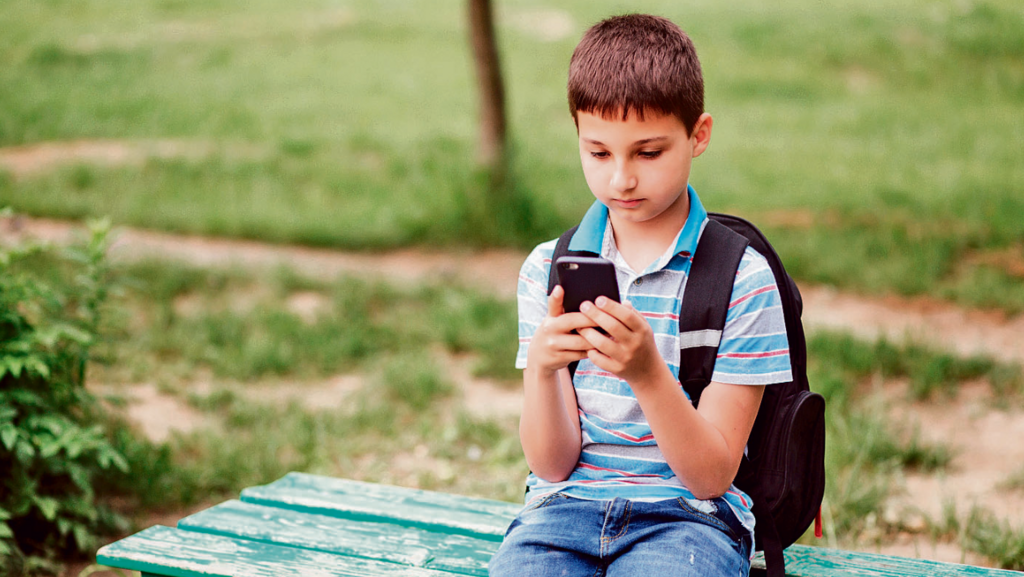
Implementation will include educational programming in classrooms and dialogue with parents to encourage balanced use of mobile devices, prevent misuse of social networks and reduce exposure to inappropriate content. The emphasis is on cultivating social and emotional skills and encouraging face-to-face interaction among students.
The ministry will support schools in implementing the policy together with local authorities, school principals, the national parents committee and the student council to ensure the rollout is adapted to each school’s needs for the benefit of all students and the broader community. The move will be coordinated through roundtable discussions and has gained the support of key stakeholders, including the national parents union, the student council, local government bodies, the Teachers Union and others.
(Photo: Shutterstock)
In parallel, the ministry is preparing a new Director General’s Circular that will formalize the policy. The circular, expected to be published by February, will outline a range of enforcement tools from warnings to confiscating the phone to the principal’s office and even requiring a parent to collect the device in cases of repeated violations. The circular will clearly define the options available to schools.
Education Minister Yoav Kisch said, “We are allowing children to meet one another again in a real way, to reduce external distractions and to deepen natural human connections among students without screens. The policy is based on extensive research in Israel and abroad and on a commitment to a healthy and safe educational climate designed to reduce the negative effects of student smartphone use. Creating a school environment that supports children’s social and emotional growth is our responsibility.”
Australia’s headline-making law
The ministry’s announcement came after reports that millions of children and teenagers in Australia have lost access to their social media accounts following a first-of-its-kind law that restricts the use of such platforms to those aged 16 and older.
The law is intended to protect minors from addictive social media features, online bullying and sexual predators who use the platforms to target victims. Australia is the first country to implement such restrictions. Platforms affected include Instagram, Facebook, Threads, Snapchat, YouTube, TikTok, X, Reddit and others.
Australia’s Communications Minister, Anika Wells, told the National Press Club that the government will show zero tolerance. “If on December 10 a child still has an active account, the platform is breaking the law.” Penalties for companies that fail to enforce the law could reach roughly 49.5 million Australian dollars, about 32 million U.S. dollars.
Still, “raising the minimum age is not a magic solution but a treatment plan,” Wells said, stressing that technology will continue to evolve and regulation must remain dynamic.