

The Jülich Supercomputing Centre (JSC) in Germany, home to Europe’s fastest supercomputer, has become the first high-performance computing (HPC) center in the world to deploy an NVIDIA DGX Quantum system, a move aimed at advancing hybrid quantum-classical computing.
The deployment, developed in collaboration with Quantum Machines and Arque Systems, integrates quantum computing into one of the world’s most powerful HPC infrastructures, giving researchers access to quantum and classical resources within the same system. JSC operates JUPITER, Europe’s first exascale supercomputer, currently ranked fourth globally.
The DGX Quantum system combines NVIDIA’s Grace Hopper Superchip with Quantum Machines’ OPX1000 hybrid quantum-classical controller, enabling round-trip data transfer with latency under four microseconds — roughly 1,000 times faster than previous implementations.
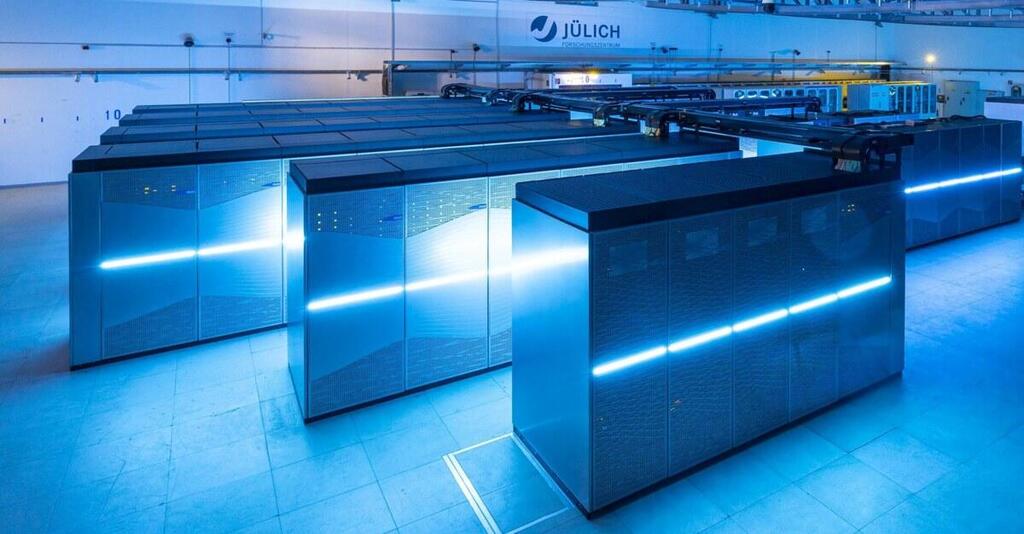
Germany's supercomputer JUWELS at Jülich
(Photo: Forschungszentrum Jülich / Sascha Kreklau)
“This deployment marks a transition from laboratory environments to practical HPC integration,” said Professor Dr. Kristel Michielsen, JSC director. “By merging quantum and classical computing at Europe’s leading supercomputing facility, we open new opportunities to explore hybrid quantum-classical algorithms at scale.”
The system includes a 5-qubit quantum processor from Arque Systems, which uses electron shuttling to couple qubits, a method designed to support quantum error correction (QEC). Microsecond-scale analog feedback ensures classical processing stays within qubit coherence times, supporting fast and reliable quantum operations.
The collaboration focuses on accelerating qubit calibration, benchmarking quantum error correction performance and testing hybrid quantum-classical algorithms. Researchers can run neural networks and machine learning models on classical GPUs while maintaining low-latency communication with the quantum controller, enabling adaptive calibration and decoder optimization in real time.
“Deploying our quantum system at JSC is a major milestone in making quantum computing accessible within existing HPC infrastructure,” said Dr. Markus Beckers, CEO of Arque Systems.
Dr. Itamar Sivan, CEO of Quantum Machines, added: “We’re witnessing the convergence of AI and quantum computing in the world’s most advanced computing facilities. This deployment is more than a technical achievement — it’s a step toward a future where quantum acceleration is as accessible as GPU acceleration today.”
Sam Stanwyck, NVIDIA’s quantum product lead, emphasized the importance of integration for practical applications. “Tight integration of quantum and classical systems is critical for quantum error correction. DGX Quantum allows researchers to use AI supercomputing to implement the control processes needed to turn today’s qubits into tomorrow’s accelerated quantum supercomputers,” he said.
The JSC deployment marks a key milestone in Europe’s efforts to lead globally in hybrid quantum-classical computing and positions the facility as a hub for scientific and industrial breakthroughs..