

The technological race to develop drones and unmanned aircraft has long moved beyond speed and flight range. Increasingly, it is focused on the art of remaining unseen.
While defense companies worldwide invest heavily in complex systems intended to conceal aircraft from radar or thermal sensors, researchers at Northwestern University in the United States have approached the problem from a much simpler direction: the limitations of human vision.
Their experimental drone, called Phantom Twist, uses motion blur rather than expensive coatings or sophisticated optical systems to reduce its visibility. The concept relies on the same visual effect that makes the blades of a rapidly spinning fan or propeller appear transparent.
Most drones, from consumer photography models to more specialized aircraft, use a quadcopter configuration: a rigid central body surrounded by four or more rotating propellers. Although the propellers spin quickly enough to become difficult to see, the central body remains stationary and clearly visible. Phantom Twist changes that basic engineering structure.
It has one motor and one propeller, but no stationary central body. As the propeller rotates in one direction, the rest of the drone, including its batteries, circuit board, sensors and structural components, spins rapidly in the opposite direction.
The drone can rotate as many as 25 times per second, too quickly for the human eye to process its individual components clearly. Instead, the entire aircraft appears as a faint, semi-transparent blur that blends into the background.
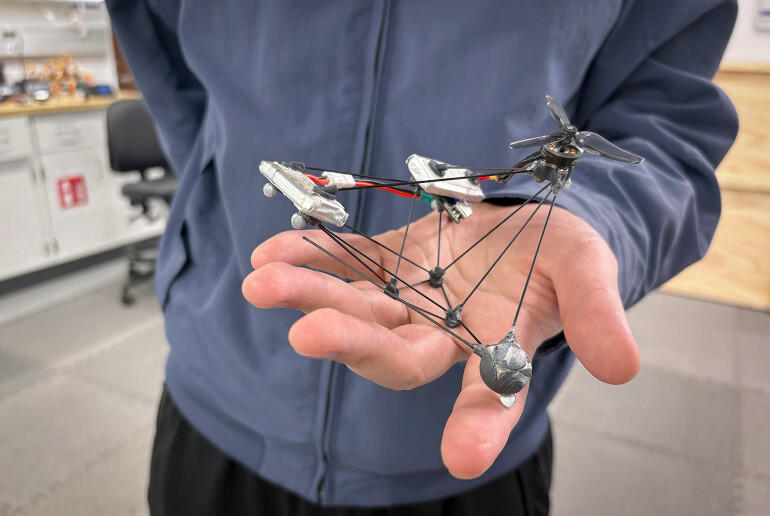
“For a typical quadrotor drone, the propellers are spinning, but the robot is stationary,” said Michael Rubenstein, an associate professor of computer science and mechanical engineering at Northwestern University who led the research. “So, you still see its body. For our drone, the whole thing is rotating, so there are no stationary parts.”
To develop the unusual structure, the researchers used a computational model to generate roughly 20,000 drone configurations capable of stable flight. Artificial intelligence and optimization algorithms then repeatedly rearranged the aircraft’s major components, including its motor, propeller, circuit board, batteries and counterweight.
The aim was to position the parts at different heights and angles so they would not visually overlap and form a dark silhouette while rotating. The researchers simulated the designs in flight and placed their images over 100 real-world backgrounds.
A perception model designed to approximate human vision then measured how noticeable each configuration appeared. The 500 designs with the lowest visibility scores underwent further optimization before the researchers selected the most promising version and built it. “The design process was fully automated,” Rubenstein said. “Then, when we were confident that a drone met all our criteria, we built it.”
According to the researchers’ visibility metric, the optimized drone is about 10 times less visually perceptible than a conventional quadcopter. “The human eye takes time to accumulate signals, roughly analogous to the exposure time of a camera,” said Emma Alexander, an assistant professor of computer science and an expert in computer vision. “When an object spins quickly, we perceive it as blurring out and losing distinct features.”
Because the drone’s structure contains large gaps between its relatively few opaque components, those parts are visually averaged with the background as they rotate, she explained. The result resembles a slight haze rather than a recognizable aircraft.
Attempts to visually conceal aircraft are not new. During the two world wars, military forces experimented with painting the undersides of aircraft in colors that matched the sky and using transparent materials to reduce their visibility. Such approaches were effective only under particular lighting and viewing conditions.
With the emergence of U.S. stealth aircraft such as the B-2 bomber, the focus shifted toward geometric shapes and radiation-absorbing materials designed primarily to reduce detection by radar.
More recently, researchers have explored optical “invisibility cloaks” based on engineered materials capable of bending light around an object. Despite laboratory advances, such systems can be expensive, heavy and sensitive to environmental conditions, limiting their practicality for small drones.

The drone demonstrates highly advanced camouflage capabilities
(Photo: Northwestern Now)
Phantom Twist avoids those obstacles by using a relatively straightforward mechanical principle rather than attempting to manipulate light around the aircraft.
The current prototype remains far from true invisibility or commercial production. Its propeller produces significant mechanical noise, while its wires and supporting rods remain somewhat visible. The researchers said future versions could incorporate more transparent materials and quieter propulsion systems to make the drone less noticeable.
For now, the technology is intended to demonstrate a new approach to low-visibility flight rather than provide a finished product.
The researchers highlighted potential civilian applications, including monitoring nesting birds and other wildlife without changing their behavior, surveying natural environments and inspecting aging infrastructure with less visual disruption.
Drones used for such work can affect the behavior of animals and people simply because they are noticed. A less visible aircraft could collect information while causing less disturbance.
Although the technology could eventually attract broader interest, the researchers have not presented Phantom Twist as an operational surveillance or military system. Its most important achievement is more fundamental: Instead of disguising a drone to resemble its surroundings, its designers changed the way the human eye perceives the aircraft itself.