

Russia's prolonged war against Ukraine is making Russian society increasingly militaristic. Over the past two years, amid the propaganda battle between the two countries, Russians have turned to a new weapon to boost morale at home: patriotic war songs generated by artificial intelligence.
The Soviet Union had a long tradition of using music to promote patriotism, particularly during and after World War II. Those songs reflected the real experiences of soldiers fighting an existential war that affected almost every Soviet family. Now, artificial intelligence is allowing that tradition to be repurposed for Russia's modern propaganda campaigns.
Gallery
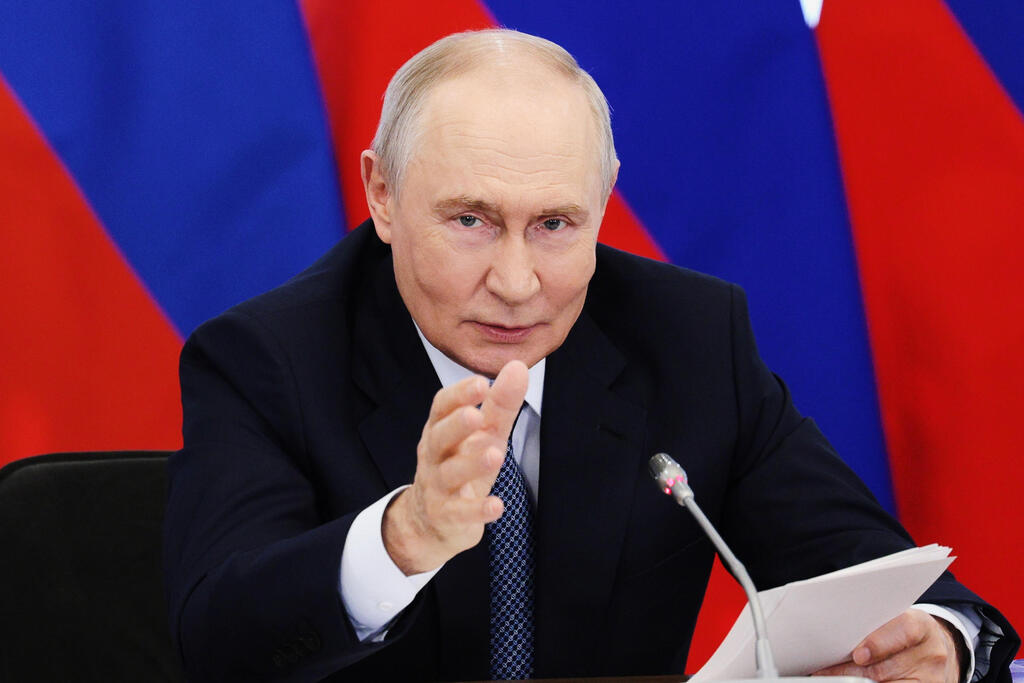
Russian President Vladimir Putin
(Photo: Gavriil Grigorov, Sputnik, Kremlin Pool Photo via AP, File)
Many of these AI-generated "compositions" resemble old Soviet war songs, some of which became classics of Hebrew music through translation. One, titled "A Soldier's Daughter," is a lament for a soldier killed in battle and the daughter he leaves behind: "Forgive me, my daughter, I couldn't become a wall / And you couldn't hide behind me / I hope you get to live in a different time / When they stop taking pride in war", the song's translated lyrics say.
Another popular track, "Power of Artillery," takes an entirely different approach. The pounding Russian-language rock song glorifies long-range artillery:
"It will catch you off guard, day and night / Goddess of war, and God won't help you / You can't escape her wrath / You'd better remember your prayers quickly," the translated lyrics declare.
Millions of streams
According to reporting by The New York Times, AI tools have been used to produce hundreds of Russian-language songs promoting the war, ranging from nostalgic ballads and mainstream pop to heavy rock and thrash metal.
The songs glorify Russian soldiers, portray them as heroes and frequently disparage Ukrainians, sometimes using ethnic slurs. Russia's full-scale invasion of Ukraine in February 2022 is presented as a necessary defensive operation rather than an act of aggression.
The music is produced using a rapidly expanding range of AI applications, many developed in the United States, capable of generating complete songs from written instructions.
According to research by Terrecon, a Ukrainian nonprofit research organization, these patriotic songs have been streamed millions of times across major platforms, including Spotify, Apple Music, YouTube and Deezer. Yet only some of these services require uploaders to label AI-generated content.
Spotify, for example, only introduced measures last September to label AI-generated songs and prevent them from being recommended to users, without necessarily removing them. Other platforms have policies prohibiting hateful or violent content, but few impose meaningful restrictions on songs. Some also struggle to detect offensive language or ethnic slurs in foreign languages.
Automated moderation systems on YouTube and SoundCloud, for instance, failed to flag songs whose titles and descriptions explicitly identified them as Russian war propaganda. The algorithms did not block the tracks, allowing them to remain online for weeks.
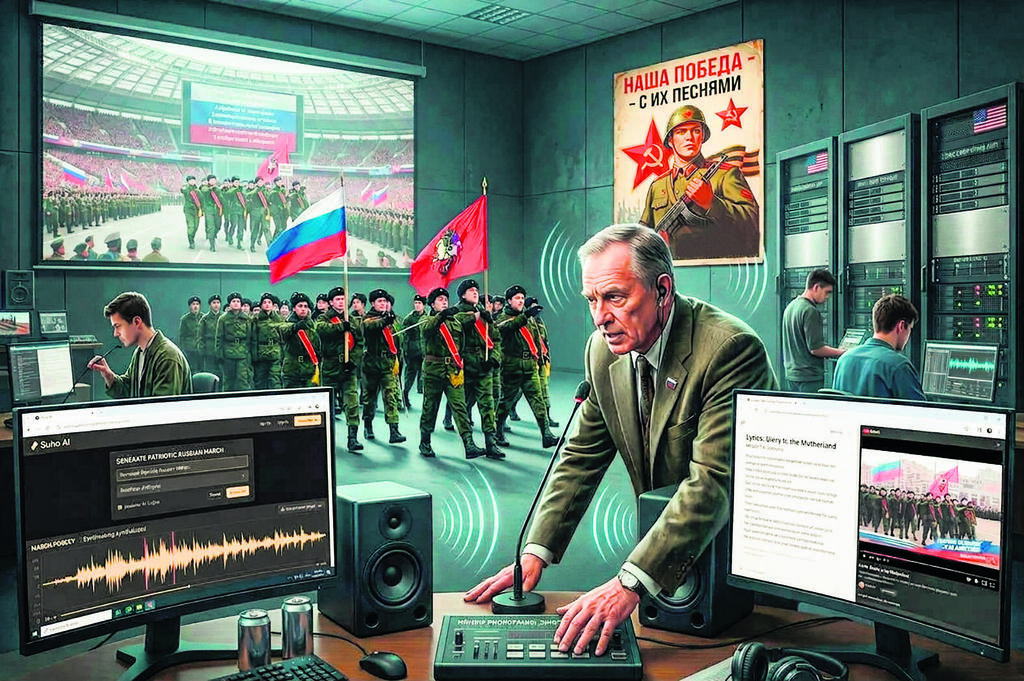
AI-generated songs
(Photo: AI)
According to Terrecon researchers, the extent of the Russian government's involvement in distributing the songs remains unclear. However, the Kremlin is known to devote substantial resources to building public and cultural support for the war. Russian media reported that just last week, the head of the Internet Development Institute, a Moscow-based organization that works closely with the Russian government to "promote patriotic values," revealed during a lecture that his institute had supported more than 350 war-related "artistic" projects.
"Creating a real song," the researchers write, "requires considerable resources, including songwriters, production and musicians. Creating a song using an AI application is much easier, faster and cheaper." Terrecon compiled a list of 981 such AI-generated propaganda songs. The vast majority appeared after 2024, when AI music-generation applications such as Suno, Google Flow Music, Mureka and Udio entered the market.
Provocative videos, too
But are the songs actually popular? One tribute to artillery, for example, was uploaded to YouTube with accompanying video footage and has attracted more than 2 million views over two years. The song, created using the Suno app, was posted by a user named Sergei Vaseykin, whose biography on a Russian poetry website says he was born in a Siberian village near Tyumen.
The content removal policies of major streaming platforms reveal a significant gap between their stated rules and actual enforcement. Researchers tested AI music generators by submitting general prompts in Russian and English, instructing them to create songs promoting Russian propaganda, including calls for violence.
Although the applications rejected some of the prompts, others successfully generated the requested songs, which the researchers were even able to upload to YouTube Music and SoundCloud. The filtering systems responded primarily to prohibited words rather than the broader context.
Beyond audio, the technology is also being used to create provocative videos. Kremlin-aligned Russian pop singer Shaman (Yaroslav Dronov) released an AI-generated music video for his song "Mother Russia," featuring digital likenesses of exiled Russian opposition leaders appearing to join him in singing in support of Russia. Following the report, YouTube said its teams were reviewing the findings. SoundCloud did not respond.