

Humanoid robots that can tidy rooms, load laundry and serve coffee are making their way into Israel’s consumer electronics market, with the first home-use model set to be sold by Mahsanei Hashmal starting at NIS 150,000.
The electronics chain will begin distributing the personal robotics line of Chinese tech giant UNIX AI in June. The company’s robots compete in a growing market that includes Tesla’s Optimus and Unitree’s humanoid robots.
Humanoid robot
(Video: PR)


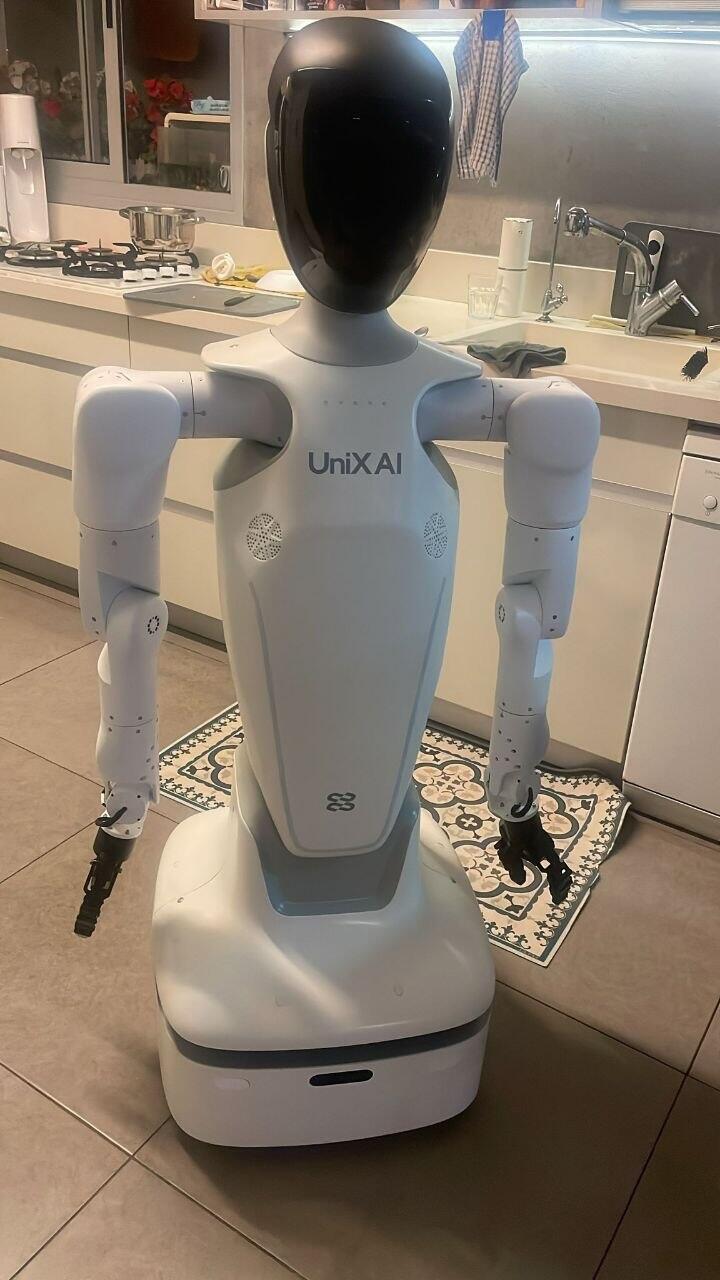
The first model to be sold in Israel is WANDA, an AI-powered robot with human-like arms but no legs, making it a semi-humanoid robot. It is designed to operate in human environments, performing gentle, repetitive actions and complex multi-step household tasks.
According to the company, WANDA can tidy rooms, clear a dining table, make a bed by spreading a blanket and arranging pillows, collect clothes and move them into a laundry basket or washing machine, organize objects and even serve coffee in the living room. Its arms are designed to handle delicate actions such as holding a cup and plate.
Mahsanei Hashmal plans to bring in the PANTHER model, which was launched globally last month and is better suited for home use. WANDA, by contrast, is more tailored to the hospitality industry and medical laboratories.
In about two weeks, the chain will also begin selling Lilymylo, a social robot shaped like a puppy and designed for emotional companionship. The robot, made by Ecovacs, will sell in Israel for NIS 2,800. In the United States, it sells for $799.99.
The retailer will also distribute robotic exoskeleton suits made by Chinese robotics manufacturer TAIXI. Its flagship product, the Climbing Assistive Exoskeleton, is already used commercially at tourist sites across China.
The AI-powered lower-body exoskeleton, worn mainly around the waist and thighs, is designed to reduce physical effort while hiking, climbing stairs, walking long distances and carrying weight. In Israel, it will sell for about NIS 6,000. In the United States, it sells for $1,200.
The robots will be sold online only and not in physical stores. Purchases of WANDA, however, will be handled through a callback from the company’s phone center. WANDA does not currently speak Hebrew. It can sync with the user’s ChatGPT account and hold conversations, for now in English. Hebrew is expected to be added next month, and the robot will receive ongoing software updates.
The robot learning process is not always simple
Behind the launch is Electra Consumer Products, which operates 70 Mahsanei Hashmal, Shekem Electric and Shekem Duty Free branches, as well as the Mahsanei Hashmal website. The company says it wants to bring the personal robotics revolution into Israel’s private consumer market, after similar products began gaining traction in major electronics chains in China, Japan, the Gulf states and the U.S.
The category also drew increased attention at CES 2026, where a record number of exhibitors presented products in the robotics field.
But teaching the robots to perform tasks is not always straightforward. Training can take several hours and requires users to film videos of the action they want the robot to learn. The robots sold in Israel are not connected to the Internet of Things (IOT), meaning they may struggle to operate washing machines, dishwashers and coffee machines, tasks they can perform more easily in other markets.
They also need to learn how to move inside a typical Israeli home, which is often more crowded and cluttered than the homes used in laboratory training in China or the U.S. As with any learning process, mistakes can happen, including scraping doorframes, bumping into objects or learning how to carry plates of different weights.
There are also privacy questions, since the robot maps the home using cameras and laser sensors.
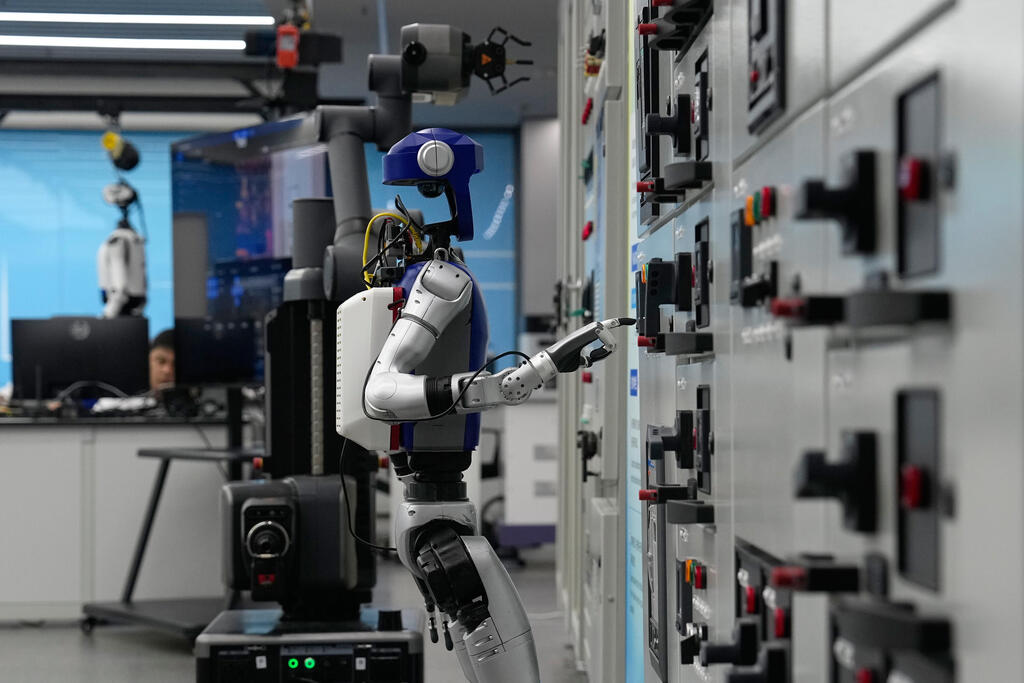
UNIX AI robot
(Photo: Andy Wong/AP)
How WANDA works
WANDA, which is already used in the hospitality industry, stands 1.4 meters tall and weighs about 80 kilograms. It can operate for between eight and 16 hours on a single charge. The robot learns tasks through demonstration. Users must film videos of the action they want the robot to perform, after which the robot studies the task for several hours before carrying it out.
WANDA comes with two bionic arms containing 34 joints with high degrees of freedom. At the end of the arms are adaptive smart grippers that allow it to hold objects and lift up to 12 kilograms. Instead of legs, the robot has a four-wheel chassis with full steering and propulsion, allowing it to move quickly in enclosed spaces and pass through doors 75 centimeters wide.
According to Mahsanei Hashmal, UNIX AI said the decision to use wheels rather than the more common leg-like structure was intended to improve efficiency, practicality and deployment in real-world service environments, particularly when combined with general AI models.
Users communicate with the robot through smart voice interaction using an AI-based conversational interface tailored to the user through their personal GPT account. Mahsanei Hashmal said certified Electra Consumer Products technicians, trained in UNIX AI laboratories, will come to customers’ homes, sync the system, provide guidance and make sure WANDA is ready to fit into the household routine.
A robotic puppy with body heat and emotion
Lilymylo, the robotic puppy made by Ecovacs (a company familiar to many Israelis for its robotic vacuum and floor-washing devices), uses digital eyes, advanced language models, facial and voice recognition and user-habit learning to identify people. The robot remembers preferences, develops changing response patterns and creates a dynamic interaction that evolves over time.
It responds immediately to touch and uses dog-like body language, including head tilts, tail wagging and changes in posture. It has soft fur, touch sensors across its body and emits body heat of 38 degrees Celsius to resemble a real pet.
The company says Lilymylo can identify 21 emotional states, has 5 personality types and 7 core emotions, and changes and develops its character over time based on how members of the household treat and speak to it. Unlike WANDA, the puppy robot does not take photos or send data to external servers.
A suit for hikers, older adults and people with mobility difficulties
The Climbing Assistive Exoskeleton is a wearable smart system designed to strengthen the legs and make walking and climbing stairs easier. Weighing just 2.4 kilograms, it combines motorized support systems with an adaptive AI-based algorithm that analyzes walking patterns, slope and pace in real time. On inclines, it provides a "push" that reduces strain on the muscles. On descents, it provides braking support to protect the knees. According to the manufacturer, the device can reduce the user’s energy consumption by up to 30%.
The suit is equipped with sensors that learn the user’s walking pace and climbing angle in real time. Small motors provide torque at the exact moment the leg is lifted, synchronized with the body’s natural movement.
Users can choose between two modes: Gentle Mode for light daily activity and Sport Mode for more strenuous activity. Each mode offers up to eight support levels, with mode changes accompanied by voice prompts in English.
The exoskeleton comes in a dedicated carrying case, with two rechargeable batteries that each provide about four to five hours of activity, equivalent to roughly 14 kilometers of walking, as well as a charger and a Type-C fast-charging cable.
Liron Katz, VP of business development at Electra Consumer Products’ electronics division, said the arrival of personal robotics in Israel was a natural continuation of local consumers’ rapid adoption of breakthrough technologies.
“Our experience shows that Israelis do not settle for less than the best, as we saw with the mass adoption of robotic vacuum cleaners, the purchase of premium screens with breakthrough technologies, and the purchase of the most powerful and advanced gaming computers, smartphones and drones,” Katz said.
“We believe the Israeli public is now ready for the next step: integrating autonomous and wearable robotics as a daily aid at home. “This is no longer a science-fiction fantasy, but an accessible and practical consumer product that can improve quality of life and free up more time for ourselves.”