

Nvidia announced Monday a new safety system for robots and physical AI, saying the platform is designed to help developers build and deploy autonomous machines that can operate safely alongside people in factories, warehouses and logistics centers.
The company introduced Nvidia Halos for Robotics at the Automate conference in Chicago, calling it the first full-stack safety system for robots and physical AI. The system extends Nvidia’s Halos safety technology, previously used in autonomous vehicles, to robotics.
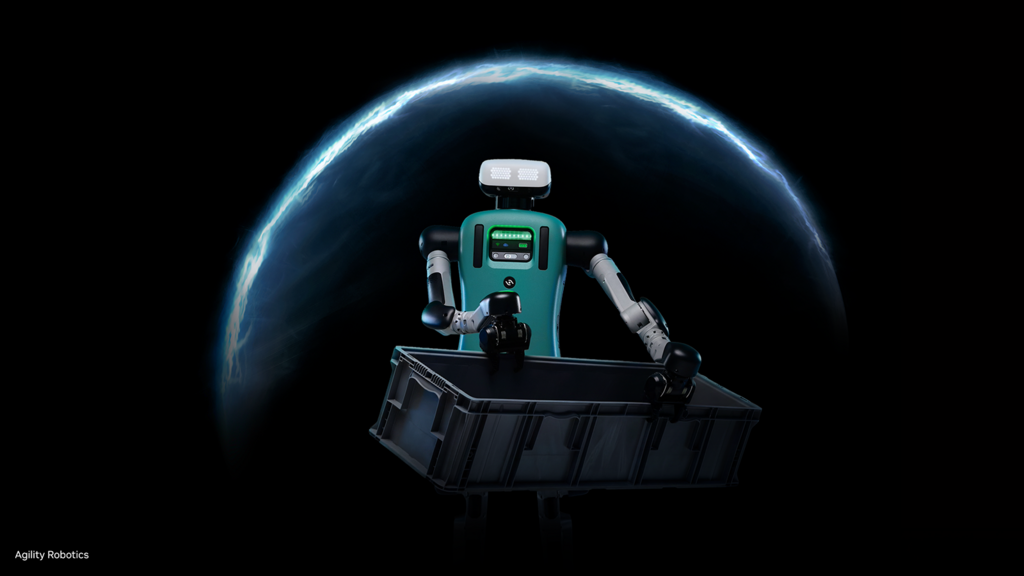
Halos for Robotics
(Illustration: Agility Robotics)
Nvidia said the platform provides a unified safety architecture for machines that can sense, decide and act in the physical world. It combines AI computing, system software, sensor data, safety applications and testing processes for robotic systems.
Agility, a company that develops humanoid robots and physical AI applications, is the first company to work with Nvidia to integrate parts of Halos for Robotics into its proprietary safety system. Nvidia said Agility’s Digit robot, designed for industrial work in logistics, manufacturing and warehouse operations, will use components of the system.
Agility’s robots are used by customers including Amazon, GXO, Schaeffler and Toyota Motor Manufacturing Canada.
“Physical AI is transforming how factories, warehouses and logistics operations work, and robotics teams need a unified safety architecture to scale autonomous systems into these environments,” said Deepu Talla, Nvidia’s vice president of robotics and edge AI.
The system includes Nvidia IGX Thor and Nvidia Holoscan Sensor Bridge for industrial-grade AI computing, built-in safety and sensor connectivity. It also includes Nvidia Halos OS, a software stack for robotic safety functions and applications that use external cameras and AI agents to help control robot behavior in industrial settings.
Nvidia said Halos for Robotics also includes its Halos AI Systems Inspection Lab, which it described as the world’s first ANSI-accredited program for functional safety and AI safety in physical AI applications. The program is meant to help partners prepare Halos integrations for certification by third-party standards organizations including TÜV Rheinland, UL Solutions, TÜV SÜD, exida, SGS and CertX.
Agility will participate in the inspection lab program. The companies said they will use it to assess Digit’s safety software, AI components and cybersecurity systems against standards including IEC 61508, ISO 13849 and ISO/IEC TR 5469 before final third-party certification.
“For humanoids to deliver value at scale, safety has to be built into the robot and validated across the entire system,” said Peggy Johnson, Agility’s CEO. “Partnering with NVIDIA to implement and optimize the Halos for Robotics system extends our leadership in responsible automation, which is a nonnegotiable requirement for bringing humanoids safely into industrial workflows. This collaboration unlocks true human-robot teamwork, driving the long-term returns that will power next-generation manufacturing and logistics operations.”