

"Well," I began my detailed explanation, "like every tiger cub knows, it is harder to catch an antelope when it is in a herd. Throughout history many have believed that it is impossible to hit on a girl when she's at a pub with a girlfriend. Luckily for you, young Martin, the algorithm was cracked here in Israel, and the 'technique' written in blood is being transmitted by word of mouth under a veil of secrecy. Are you ready?"
Martin nodded. "Well, the 'technique' has many names, though it is most known as 'laying on the fence.' In any case, one guy, let's call him ' A', approaches the girlfriend and begins chatting with her. After a couple of minutes, about the time it takes to boil an egg, the second guy approaches the girl he's interested in who is by that time bored and frustrated: Her ego is hurt because a guy expressed interest in someone else. She then, if history teaches us correctly, will gladly surrender herself."
I saw confusion taking over Martin's expression. Then he said: "Look, NB, no disrespect to 'the technique,' but why don't I just approach the girls and offer to buy them a beer? In Canada this usually works."
I chuckled. "Listen, boy, Canadian women might appreciate tall, handsome, rich men. Here, in Israel, they are looking for something else. Here we go..."
Urban jungle
I stood up, put on my self-confident expression and went to the girls. I turned to one of them in a horase voice and said: "Hey." Real poetic, I know. The girl looked at me as if I was a junky on a street corner asking her for spare change and said "I have a boyfriend, okay?"
Back at our table I explained to Martin that from up close they were really ugly and that I couldn't be bothered. Martin did not buy it and said he was going to try the Canadian method.
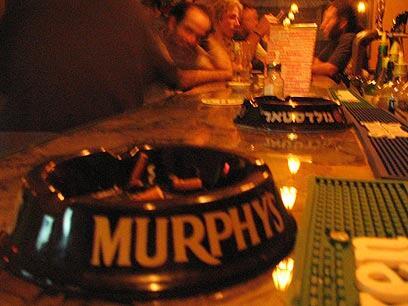
Tel Aviv style nature reserve (Photo: Amnon Picker)
You may have already guessed what happennd next. It seems that good looks, youth, money and a foreign passport, do work on Israeli women afer all. So much so that both girls end up drunk on my bed with Martin. Call me a snob but when someone is engaged in a ménage à trois on my bed, I rather spend the night elsewhere even if it means a mattress on the floor at a friend's house.
Martin called in the morning. He wants me to show him Tel Aviv's bauhaus buildings. Apparently he is interested in architecture and history and wants to see the White City. Luckily, the friend I stayed with likes pretending he's an architect like George from Seinfeld. So we end up on Nahmani Street listening to explanations about the history of rounded balconies.
The G-Spot
I wanted Martin to see the National Theater's building, Habima, but it is being renovated and looks like Mount Bofor following the retreat of the IDF, so we continued towards Rothschild Boulevard - also known as Tel Aviv's g-spot.
.
Martin watched the gallery of archetypes filling the boulevard: young, pretty mothers proudly carrying their soon-to-be-asthmatic babies, clean-cut analysts sharing a bench with guitar-playing Rastafarians, pale brokers sucking cappuccinos out of huge paper cups, waitresses wearing black serving tea to dreamy-eyed girls.
Martin liked what he saw but said it was not as pretty as it is in Montreal. His ungratefulness angered me: "Do you know the IDF can conquer Canada in three days and turn Montreal into a soccer field?" I barked. He was shocked. So was my friend. "Well," he apologized, "it is really beautiful here."
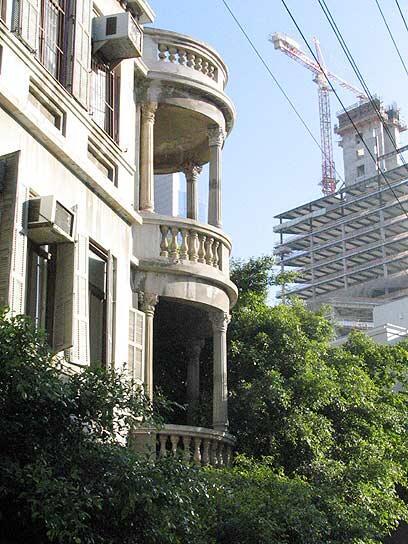
Tel Aviv. 'Not as pretty as Montreal'
Later, as the three of us were sitting on the beach watching the sunset: "I'm not sure you understand," Martin began, "what a beautiful city you live in. Sun, beach, history, beautiful people. It's all so special. It could have been…" He was brought to a sudden halt by a stray paddle ball that hit him in the eye.
My friend and I continued to suck on our beers, exhausted from the day's activities. Martin rubbed his eye and went on: "There are so many unique things here: Falafel for example, and... paddle ball, and like... kibbutz. Let's go to a kibbutz tomorrow, okay?"
Next week: Martin visits a kibbutz while NB confronts childhood traumas