


Thailand will shorten the visa-free stay granted to Israeli tourists from 60 days to 30 days, under new regulations officially published Monday and set to take effect on Sept. 15.
The change means Israelis entering Thailand under the visa exemption from that date onward will be allowed to remain in the country for up to 30 days, instead of the current 60.
Gallery

Thailand officially cuts visa-free stays for Israelis from 60 days to 30
(Photo: PinkBlue Studio / shutterstock)
Israel is included in the final list of 60 countries and territories whose citizens will continue to be eligible to enter Thailand without obtaining a visa in advance.
The new exemption is intended for tourism, unlike the broader current arrangement, which also covered short-term work or business activity.
Travelers already in Thailand will not be required to cut their trips short.
Authorities clarified that anyone who entered under the existing exemption, as well as travelers arriving through Sept. 14, will be allowed to remain for the period granted when they entered the country, meaning up to 60 days.
The new 30-day limit will apply only to entries beginning Sept. 15.
Even after the new regulations take effect, travelers will still be able to request an additional 30-day extension, subject to approval by Thai immigration authorities.
For those planning to stay in Thailand for more than a month, that means they will no longer receive 60 days automatically upon entry and will instead need to apply for an extension.
Another change affects travelers entering Thailand through land border crossings, including those arriving from neighboring countries during regional trips.
Under the new exemption, visa-free entry through land crossings will be limited to twice per calendar year.
The restriction does not apply to travelers arriving by air.
Four countries, Malaysia, Brunei, Indonesia and Singapore, are exempt from the land-entry limit. Israelis are not among those exceptions.
Thailand’s expanded 60-day visa exemption took effect in July 2024 and applied to citizens of 93 countries and territories.
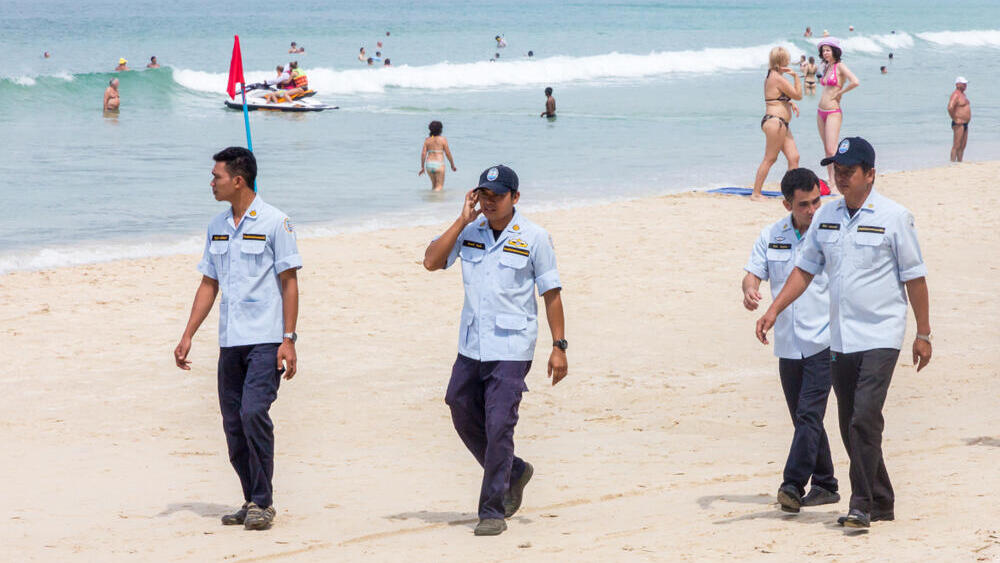
Local inspectors patrol Patong Beach in Phuket
(Photo: Kevin Hellon / shutterstock)
The policy was introduced to encourage tourism and make entry easier for visitors, but the Thai government later decided to review the arrangement.
In July, the government approved the final changes.
Officials said the longer permitted stay could be exploited for purposes inconsistent with the visa exemption, including criminal activity or work unrelated to tourism.
Authorities said the revised policy was intended to strike a balance between promoting tourism and addressing security, economic and immigration-control concerns.
Four relevant notices from Thailand’s Interior Ministry were published in the Royal Gazette on Aug. 31, with Israel explicitly listed among the countries eligible for the new exemption.
The change is not directed specifically at Israelis and applies to dozens of nationalities.
It nevertheless comes as Israeli tourists have faced growing scrutiny in Thailand.
Several incidents involving Israelis were reported in August, particularly in Phuket and Koh Samui.
Thailand’s tourism minister also warned that authorities would not hesitate to revoke visas and deport foreign tourists who break the law or cause public disturbances.
In the final days of August, the residency permit of an Israeli linked to a case involving a zoo on Koh Samui was revoked.
More recently, about 150 residents demonstrated in Patong, Phuket, calling on the government to limit Israelis’ stays in the country to 15 days.
That local demand is not part of the nationwide reform now approved, but it reflects the increased attention Israeli tourists have recently drawn in Thailand.