


A rare gold coin bearing the portrait of Egyptian Queen Berenice II was discovered during an Israel Antiquities Authority excavation at the Givati parking lot in the City of David archaeological excavation site, within Jerusalem Walls National Park.
The tiny coin, valued at a quarter drachma and crafted from 99.3% pure gold, dates to 246-221 BCE during the reign of her husband, Ptolemy III. The Israel Antiquities Authority and City of David hailed it as the first of its kind found in a clear archaeological context, one of only about 20 known worldwide.

The coin features Berenice’s Hellenistic image, adorned with a crown, veil and necklace, while its reverse displays a cornucopia symbolizing prosperity, flanked by stars and inscribed with “of Queen Berenice” in Greek. It was spotted by Rivka Laengeler, a local excavator, while sifting soil.
“I was sifting the excavation dirt and suddenly saw something shiny. I picked it up and realized it was a gold coin. At first, I couldn’t believe it, but within seconds, I was running excitedly around the site,” she recalled.
“I’ve been digging in the City of David for two years and this is my first gold find! I always watched others uncover special artifacts, waiting for my turn—and now it’s here,” she added.
Dr. Robert Kool, head of the Israel Antiquities Authority Numismatic Department, and Dr. Haim Gitler, chief curator of archaeology and numismatics at the Israel Museum, who examined the coin, noted it is “the only one of its kind found outside Egypt, the Ptolemaic power center.”

The gold coin featuring Queen Berenice II
(Photo: Eliyahu Yanai, City of David)
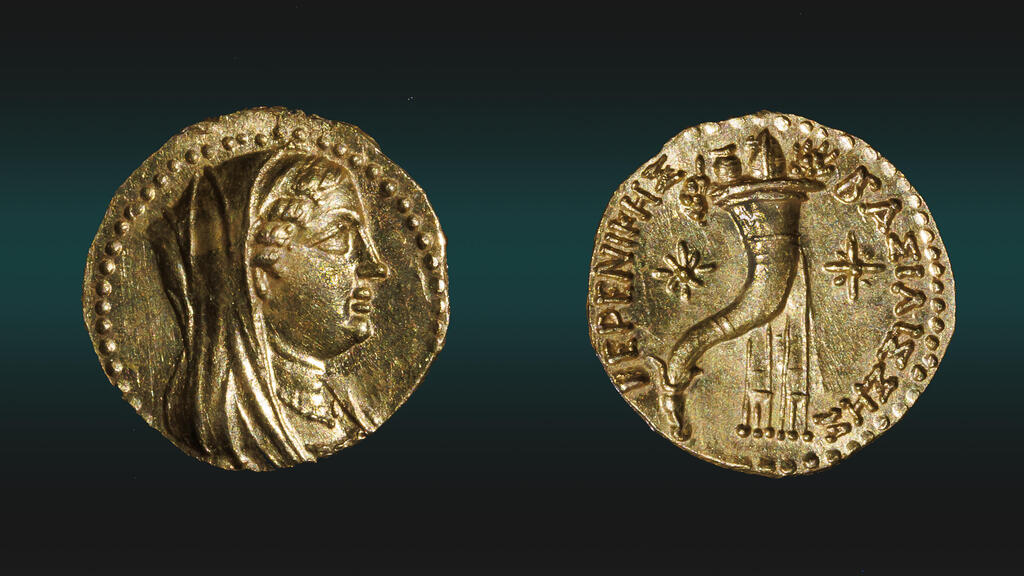
(Photo: Eliyahu Yanai, City of David)
The Greek inscription “ΒΑΣΙΛΙΣΣΗΣ” (of the Queen) is rare for the period, they said. “Berenice appears not as a consort but possibly as a ruler in her own right, a rare sign of political independence.
“Women featured intermittently on Ptolemaic coins over nearly 300 years (305-30 BCE), with Cleopatra as the most famous, but this is among the earliest cases of a Ptolemaic queen titled so during her lifetime.” They suggested it was likely minted in Alexandria, Egypt, perhaps as a reward for soldiers in the Third Syrian War against the Seleucid kingdom.
Excavation directors Dr. Yiftah Shalev of the Israel Antiquities Authority and Efrat Bocher of the Jerusalem Research Center added, “Finding such a rare gold coin in Jerusalem, under Ptolemaic rule, offers a fascinating glimpse into the city’s status and possible ties with the empire’s power center from Egypt.
“Discovered in the City of David, it carries broad significance for Jerusalem’s development after the First Temple’s destruction.” They noted, “Research once depicted post-586 BCE Jerusalem as a small, marginal, resource-poor city.
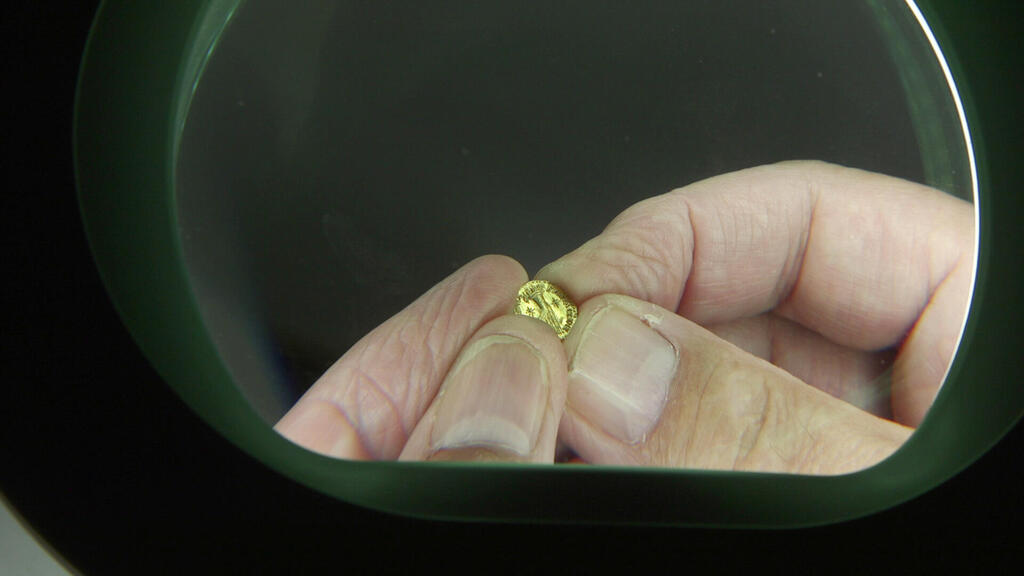
The small coin being inspected
(Photo: Emil Eljam, Israel Antiquities Authority)

(Photo: Eliyahu Yanai, City of David)
“This coin, alongside other mid-3rd century BCE finds, suggests otherwise: Jerusalem began recovering in the Persian period and grew stronger under Ptolemaic rule. It was not desolate or isolated but a city in revival, reconnecting with the era’s political, economic and cultural hubs.”
Heritage Minister Amichai Eliyahu congratulated the rare find. “Excavations in the City of David reveal entire chapters of Jerusalem’s history, from the city’s glory days under the Kingdom of Judah to the period after the First Temple’s destruction and the exile. After 2,000 years we have returned to our capital and we’re privileged to uncover its rich past.”