

A global shortage of air traffic controllers is fueling cross-border recruitment of experienced staff, exposing staffing gaps that are raising concerns about air safety and travel disruption, aviation officials say.
Countries from Australia to Canada and South Africa are competing for experienced controllers, with some turning to foreigners to fill vacancies even as their own staff are recruited elsewhere. Globally, 71,000 new air traffic controllers will be needed by 2034, according to a 2025 forecast, opens new tab from aviation training firm CAE.
Gallery

Behind every takeoff and landing lies extensive work passengers never see
(Photo: Macondofotografcisi / Shutterstock)
The competition highlights a broader problem for an industry struggling to replace an aging workforce and train controllers quickly enough to meet demand. Moving experienced staff between countries can offer short-term relief but does little to address the underlying global shortage, while training replacements can take years.
Australia, the United States and Canada are among countries where controller shortages have contributed to flight disruptions.
Controllers and union officials interviewed by Reuters said staff were leaving for higher pay, improved conditions and in some cases the opportunity to work beyond their home country's retirement age.
Two people with knowledge of the matter said some controllers employed by Airservices Australia were moving to Qatar, which has recently advertised for staff.
"We are aware of dozens of ATCs (air traffic controllers) across multiple locations in Australia, including some in Sydney, who have either resigned from Airservices to work overseas, or are exploring the opportunity to do so," said Scott Nugent, president of union Civil Air Australia.
Most departing controllers were searching for better conditions regarding fatigue, leave, overtime and staffing, one of the people said.
Airservices Australia said its national attrition rate for controllers was within expectations. Qatar's civil aviation authority did not respond to a request for comment.
Canada, which normally hires only citizens or permanent residents as controllers, has also looked overseas. NAV CANADA, the country's air navigation service provider, said it had recently used an external firm as part of "a limited, targeted measure" to recruit eight foreign controllers willing to immigrate to Canada.
Countries trying to reduce poaching
South Africa, meanwhile, is trying to avoid simply transferring shortages elsewhere. Its Air Traffic and Navigation Services agency limits the number of staff it seeks from individual countries after losing 28 controllers itself within eight months between 2024 and last year.
"We don't want to do that to any one specific country," said Josia Manyakoana, chief operating officer at Air Traffic and Navigation Services.

Air traffic controllers at work following a lengthy training proces
(Photo: Gorodenkoff / Shutterstock)
New Zealand's agency similarly said air navigation service providers should collectively tackle staffing shortages "rather than simply shifting" the problem from one organization to another.
Civil Air Navigation Services Organization (CANSO), a global trade group representing air traffic control providers, is examining ways to share training costs between controllers' current employers and the organizations that trained them.
"The (country) that trains a controller usually carries the full cost, even if that controller later moves on," a CANSO spokesperson said. "We're aware that several of our members have been concerned about losing controllers they trained at their own expense."
Still, some countries are also looking for new ways to expand the global pool. Indonesia, which has a surplus of controllers, has agreed to deploy five to Australia next year to work there until 2030.
"Australia needs more controllers and we have a surplus at the moment," AirNav Indonesia Director of Operations Setio Anggoro said. "We are ready to export our controllers."
Ultimately, aviation officials say recruitment alone cannot solve the imbalance: countries need to train more controllers while improving retention.
Nick von Schoenberg, president of the Canadian Air Traffic Control Association, said his union was not usually in favor of foreign hiring as a solution to longstanding staffing problems, but it was not objecting to NAV CANADA's recruitment plans.
"Given the severity of the current circumstances we are not going to get in the way of this," he said.
What about Israel?
Against the backdrop of the global crisis, ynet contacted the Israel Airports Authority to determine whether Israel is also facing a shortage of air traffic controllers and whether international competition for experienced personnel is affecting the local workforce.
The authority told ynet that, based on its current workforce planning and assessment of staffing needs, it does not anticipate a shortage of air traffic controllers in the coming years. According to the authority, staffing levels are planned years in advance, taking into account the time required for recruitment, screening and training.
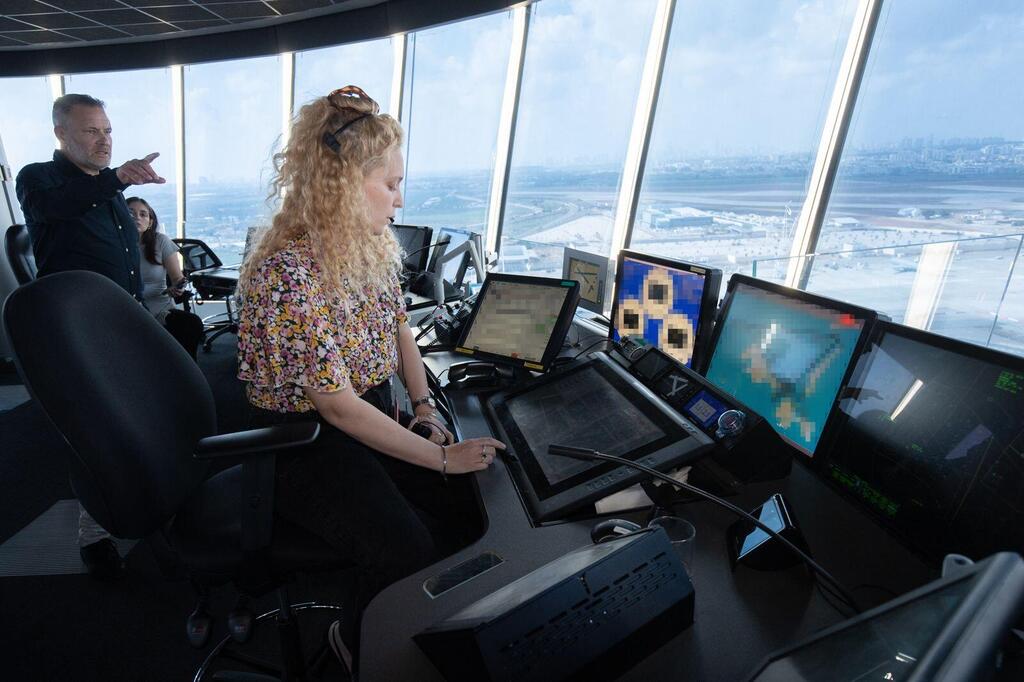
The air traffic control tower at Ben Gurion Airport
(Photo: Israel Airports Authority)
According to figures provided by the authority, it has 234 authorized air traffic controller positions. However, it did not disclose how many of those positions are currently filled.
The training process in Israel is lengthy. Once a decision is made to recruit new controllers, the screening process takes between six months and a year. This is followed by two to four years of training, including coursework, depending on the unit to which the controller is assigned. As a result, the period between the initial recruitment decision and completion of training can last up to five years.
The authority confirmed that workloads at air traffic control units increase primarily during the summer, when air traffic volumes rise, but stressed that work schedules are determined in accordance with Israel's Hours of Work and Rest Law and regulatory guidelines.
Although the authority does not expect a staffing shortage, it acknowledged that the number of air traffic controllers leaving their jobs has increased in recent years. However, it did not provide figures on the extent of the departures, explaining that employees leave for various reasons and that their departures are not necessarily linked to taking jobs abroad.
While countries around the world are attempting to address shortages of air traffic controllers by recruiting personnel from overseas, the Israel Airports Authority maintains that it does not anticipate a shortage in the coming years. Nevertheless, the rising number of controllers leaving the authority and the lengthy process required to train their replacements underscore the importance of advance workforce planning.