


An extraordinary archaeological discovery in central Israel has revealed a rare set of Roman-era bronze discs, shaped as lion heads and dating back around 1,900 years ago.
The ornate artifacts, likely once attached to coffin handles, offer a glimpse into ancient burial customs and the status of the deceased. The find was recently published for the first time in 'Atiqot, the Israel Antiquities Authority’s (IAA) archaeological journal.
Digital scan of the bronze disc
(Video: Dr. Elie Haddad, Israel Antiquities Authority)


The four bronze discs were unearthed in 2018 during a salvage excavation at Khirbat Ibreika, near the Eyal Interchange in central Israel. The excavation was carried out by the Israel Antiquities Authority and led by Dr. Elie Haddad and Elisheva Zwiebel.
“This is a unique and rare set of finds,” Dr. Haddad and Zwiebel said in a joint statement. “The carrying handle ring, which was attached — in most of the known examples from the Roman world — through the lion’s mouth, was joined in this case precisely to the disc’s vertex, at the top of the lion’s head.
“It seems this enabled freer and wider movement of the handles that served to lift the coffin and integrate it into a burial procession.”
Gallery

All four lion heads from the Eyal Interchange excavation
(Photo: Dafna Gazit, Israel Antiquities Authority)
The lion-head discs were found in a neat pile inside a grave, in what appears to have been the original location of a wooden coffin that has since decayed. Each disc is slightly different, with unique facial expressions and distinct designs for the mane, eyes and nose.
“Similar discs were discovered in several other places in Israel, such as in Netanya and Tel Dor — most of them found in a distinct burial context,” the researchers noted.
The identity and background of the deceased remain unknown, but the imagery points to symbolism associated with strength and nobility across many cultures. “Tracing the lion as a symbol in the ancient world reveals that in many cultures it represented strength, protection and nobility,” the couple added.
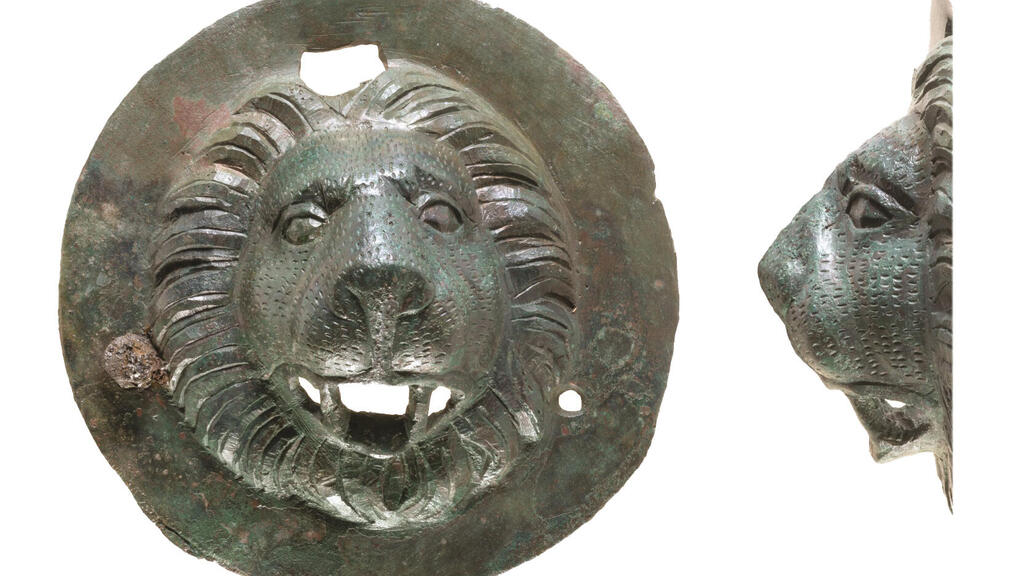
(Photo: Dafna Gazit, Israel Antiquities Authority)

Lion head with a ring handle attached to the top of the disc
(Photo: Dafna Gazit, Israel Antiquities Authority)
“At this stage we do not have enough evidence to associate the lions to a particular religion. However — the reasonable assumption is that here we have a pagan burial. In any case, these fancy, elaborate discs clearly reflect this individual’s high status.”
Israel Antiquities Authority Director Eli Escusido noted the lion’s enduring symbolism. “For thousands of years lions have symbolized bravery and courage. It is not by chance that the State of Israel‘s current campaign to neutralize the nuclear threat in Iran is called ‘A nation will arise like a lion’ — a phrase taken from the Bible (Numbers 23:24).”
Get the Ynetnews app on your smartphone: Google Play: https://bit.ly/4eJ37pE | Apple App Store: https://bit.ly/3ZL7iNv
Escusido also revealed that similar rare lion discs had previously been returned to the IAA. “A citizen who had such ancient lion objects just sitting in her living room contacted us and requested to hand them over to Israel’s National Treasures collection. Thanks to this action, the lovely decorated discs were put into special climate conditions, which will preserve them for future generations to enjoy.”

The finds piled at the edge of the tomb, next to glass vessels from the Roman period
(Photo: Assaf Peretz, Israel Antiquities Authority)

Graphic reconstruction: Carrying the coffin aided by the 'lion rings'
(Illustration: Yakov Shmidov, Israel Antiquities Authority)
Heritage Minister Amichai Eliyahu commented on the deeper historical significance of the find. “The discovery of the lion plaques offers us a compelling historical lesson. Although these are pagan artifacts, they reflect a recurring phenomenon throughout history — foreign cultures adopting ancient Jewish symbols.
“In the ancient world, the lion was not merely a decorative motif. It was, first and foremost, the emblem of the Tribe of Judah — ‘Judah is a lion’s whelp.’
“Pagan cultures that once inhabited this land recognized the power of Jewish symbolism and were influenced by it, even if they did not always acknowledge it,” he added.
“This is a phenomenon we observe throughout history: the world is shaped by Jewish values, symbols, and heritage — sometimes even unknowingly. Western civilization as a whole is founded upon values rooted in the Bible and Jewish tradition.”