

There are moments in nature that never repeat themselves. Sometimes they last only minutes, or even seconds, when the desert awakens, dry channels fill, and a silent waterfall turns into a roaring torrent.
That exact moment at the iconic Qumran waterfall near the Dead Sea was captured this week by Lt. Col. (res.) Haim Habshoosh, a well-known travel blogger and leader of the adventure travel group Hashavma, an acronym for ‘Friends Who Truly Hike the Land’, who broadcast the event live.
Qumran waterfall in full force
(Video: Haim Habshoosh)


"From the morning until now I have been in a state of euphoria", Habshoosh told Ynet after returning from the trip. "It is so emotional that it makes your heart pound."
The decision to head out was not accidental. It was based on a mix of weather forecasts, terrain analysis and a great deal of patience. "We initially wanted to see flows in other areas", he said, "but based on our early morning analysis we estimated that Qumran would flow. We checked rainfall radar data for the drainage basins and saw heavy rain in the Qumran basin. We decided to wait for it and went flood chasing."
As the group of flood chasers waited for the show to begin, drones were sent into the air to spot early signs of flowing water and alert photographers to be ready. "We waited about half an hour. At first we launched drones and saw nothing", he recalled. "Each time we had to bring them down because the batteries were about to run out."
Then he felt it coming. "I walked back to find an angle where I could see further upstream and warn the group about the first wave. Suddenly it started. I shouted that the wave was coming so they would have a few seconds to prepare for the shoot. I began to see something which looked like smoke, mist rising from the channel. 'Here it is', I shouted to them from afar, 'Get ready'. "The rest you can see in the video. It was overwhelming. We caught it live. It was incredible."
Habshoosh said seeing the first surge is the ultimate thrill. "There is a big difference between seeing a flowing stream and seeing a waterfall awaken," he said. "Flowing water is impressive, but a flood at a waterfall is truly heart-shaking. And seeing the first wave is the most intense moment. It is so close, you feel everything."
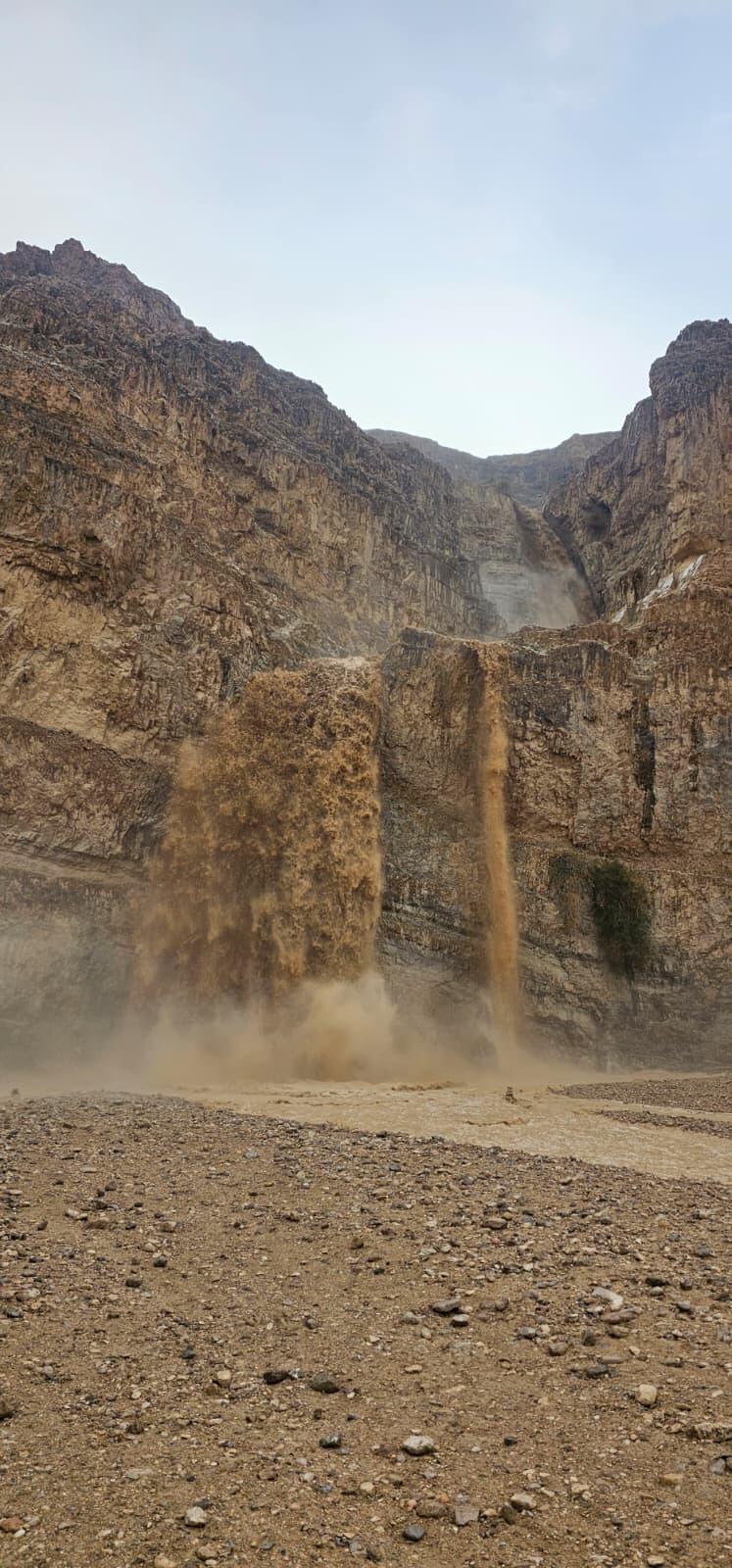
Qumran waterfall in a breathtaking view
(Photo: Haim Habshoosh)
Qumran itself is a relatively small stream, but one that reacts quickly. It is considered one of the most dramatic channels in the Judean Desert, small in scale yet unusually powerful during rain events. Its compact drainage basin means that when significant rainfall hits the area, the water converges rapidly, carves into the escarpment and spills over in a striking series of waterfalls.
"Its drainage basin is relatively small," Habshoosh explained. "It is located in the Hyrcania Valley, with several small channels feeding into it. From there it cuts into the escarpment in a series of waterfalls. It is a beautiful stream with stunning pools. There is also a marked trail that leaves Qumran National Park and climbs upstream, but during floods it is dangerous to hike there."
Strong flow in the Qumran stream
(Video: Megilot Search and Rescue Unit)
Who chases floods?
They are not an official group; they have no club and no fixed schedule, but they know when to get up. "They are nature lovers, hiking fanatics", Habshoosh said. "People whose priorities are such that if there is extreme weather with heavy rainfall, they go outside instead of going to the office. It is something fleeting that you have to catch in time, and it does not always work."
Patience, he stressed, is essential. "Sometimes we drive to places and wait two or three hours. It is not an exact science. It is a mix of forecasts and assessments. Sometimes we arrive and get disappointed, or we miss the first wave. Sometimes roads are blocked, or it is physically impossible to reach the site because water is flowing over the road."
Habshoosh also shared basic safety rules for flood chasers, emphasizing that excitement does not override responsibility. "First of all, do not enter channels or canyons," he said seriously. "Do not cross a flowing stream because you don't know the power of the flood. Don't get too close to a waterfall. Don't climb cliffs. Some people do that to get a shot, and it is very dangerous."
The road poses risks as well. "Stopping on the road must be done carefully", he warned. "Sometimes it happens without warning, and people stop in the middle of the road. Roads are usually slippery. Stopping and pulling over must be done in a safe place."
In the end, after the drones, the waiting and the first surge, what remains is a lasting memory. "It is something emotional", Habshoosh said. "It makes your heart pound. From the morning until now I have been in euphoria. Seeing a waterfall in flood, and seeing that first wave, is the climax. It's a crazy moment."