

One of Ibiza’s most picturesque and photographed beaches became the latest flashpoint in Europe’s growing backlash against overtourism over the weekend, as around 100 residents gathered at Cala Saladeta to demand fewer visitors to the island.
Protesters arrived Sunday carrying signs opposing mass tourism, including one declaring: “Everywhere you look, only tourists.”
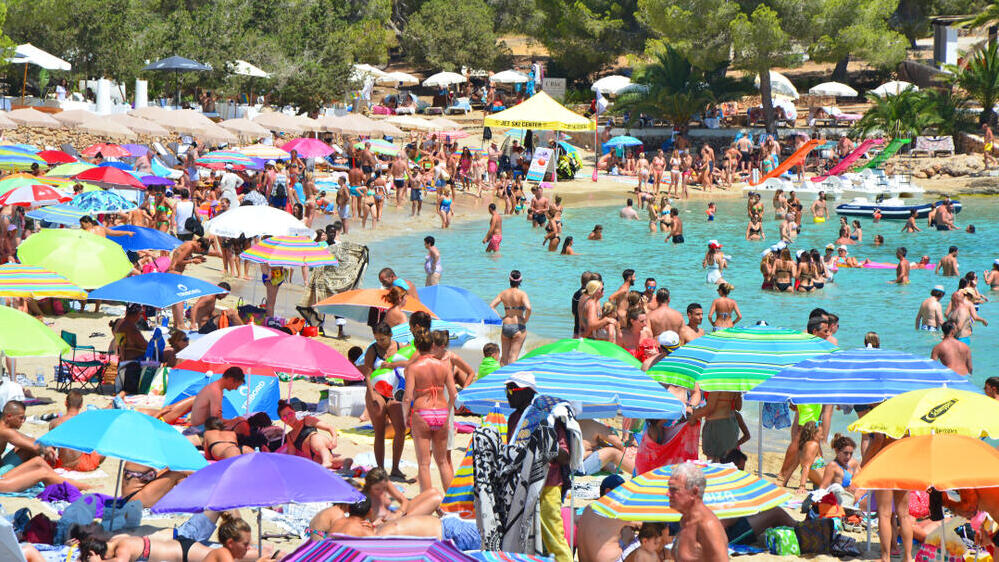
Crowded Ibiza beach. Locals are growing fed up
(Photo: Studio Barcelona / shutterstock)
The demonstration was organized by the Associació de Joves d’Eivissa, or Ibiza Youth Association, a group founded this year by young residents who say the relentless growth of tourism is damaging local culture, crowding public spaces and making the island increasingly difficult to live on.
For the group, the problem goes well beyond packed beaches.
It argues that much of Ibiza’s economy and cultural life has become geared primarily toward visitors. Young residents looking for work often find themselves pushed toward the tourism industry, while much of the island’s entertainment revolves around its famous party and electronic music scene.
Their message is blunt: young people may live on Ibiza, but increasingly, the island is no longer built for them.
Housing is among the protesters’ biggest concerns.
Simon Grenville, a luxury tourism expert who works in Ibiza and elsewhere in Spain, told the New York Post that the seasonal rental market is also driving up year-round housing costs.
He said even workers who keep Ibiza’s tourism industry running, including drivers, restaurant employees and villa managers, are increasingly struggling to afford housing on the island, with some reportedly forced to live in their vehicles.
Residents also point to mounting pressure on infrastructure.
According to Grenville, Ibiza’s roads, water systems and waste collection infrastructure were never designed to handle the number of visitors that descend on the island during the peak summer months of July and August.
Another source of frustration is competition from wealthy foreign buyers and investors.
Kevin Schrank, a tourism consultant in Valencia with family ties to Ibiza, said the prospect of returning to live on the island has become almost impossible for many locals earning average wages.
He said the resentment is not necessarily directed at individual tourists, but at a system residents feel prioritizes visitors and investors over people who live there year-round.
The backlash also has a cultural dimension.
Across the Balearic Islands, where a strong local Catalan identity remains, some residents fear mass tourism is displacing not only locals from housing and public spaces, but also the region’s language, traditions and way of life.
Tourist crowds in Santorini, Greece
(Video: Reuters)


Schrank described residents watching their birthplace gradually turn into a “theme park” while they become less able to afford living there themselves.
Ibiza is far from alone.
Spain has emerged as one of Europe’s most visible centers of anti-overtourism protests in recent years. Last summer, demonstrators in Barcelona were filmed spraying tourists with water pistols.
Similar protests have taken place across Europe as residents complain that surging visitor numbers are driving up housing costs, increasing the cost of living and overwhelming city centers.
In Italy, Venice and the Amalfi Coast have struggled with severe overcrowding, with viral footage showing streams of visitors creating pedestrian traffic jams in narrow streets and at popular viewpoints.
Saint-Tropez in southern France also faces a seasonal influx of tourists and social media influencers crowding the small resort town.
In Ibiza, however, protest organizers say they are demanding more than better behavior from tourists.
The youth association is calling for what it describes as “tourism reduction,” meaning an end to policies aimed at continually increasing visitor numbers.
The group has also announced plans to oppose an expansion of Ibiza Airport.
For the protesters, the question is no longer whether tourism is good for Ibiza, but how much tourism the island can sustain before local residents lose even more of the place they call home.