

At 14, Eitan Shalmon, now 24, from the community settlement of Karmei Katif, heard a rumor about a hidden lake tucked between the fields of the Lakhish region. This was long before TikTok videos and Waze recommendations for hidden springs. Eitan and his friends hitchhiked to the Yad Natan junction, walked across open land and suddenly found a huge reservoir that hardly anyone knew existed.
Ten years later, after military service, travels across Israel and earning a fresh tour guide certification, Eitan returned to the same spot. To his surprise, the mysterious lake was still there: full of clear water, quiet and almost as hidden as on the day he first discovered it.
Gallery
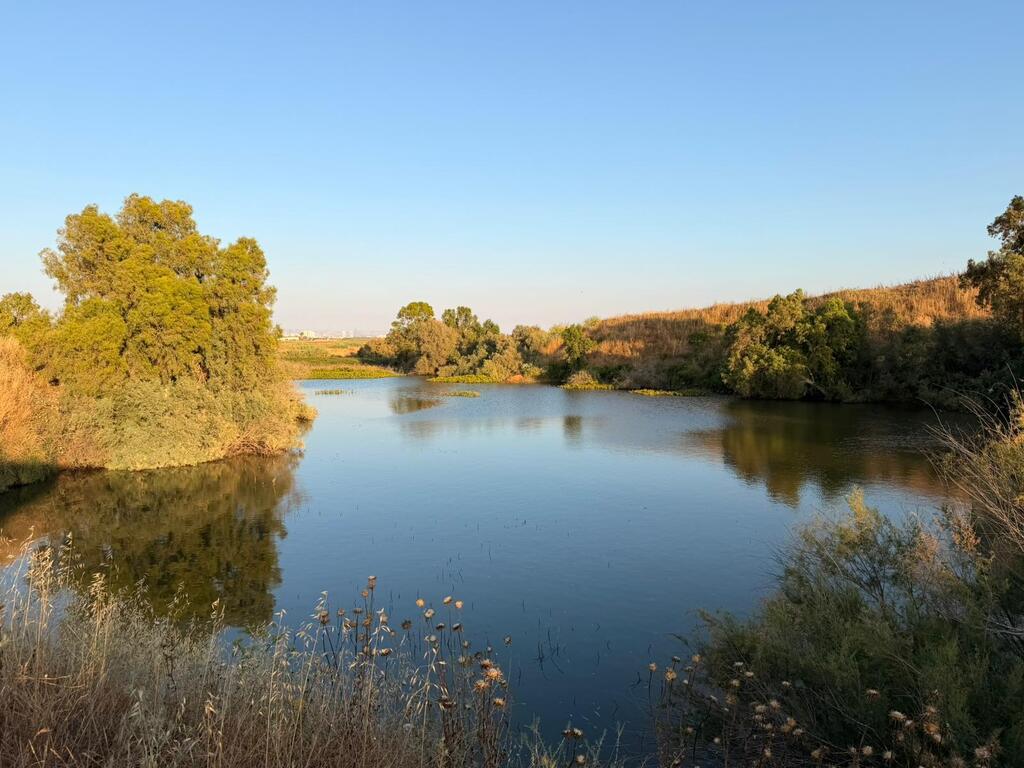
The mysterious lake was still there: full of clear water, quiet and almost as hidden as on the day he first discovered it
(Photo: Eitan Shalmon)
“People know the springs around Jerusalem, the streams in the north and the desert pools in the Negev,” Eitan told ynet. “But for most people, the entire area between Hadera and Be'er Sheva is almost a blank space. They don’t expect to find anything special there. It’s not an area people search for springs, and that’s exactly why the lake in the Lakhish region has remained unknown.”
The early summer destination Eitan recommends is known as “Otzem Lake” ("אגם עוצם") or “Yoav Lake” ("אגם יואב"), depending on whom you ask and on which day of the week. The confusing double name comes from the reservoir’s proximity to Moshav Otzem, while Yoav Stream feeds it with water.
The site is an abandoned quarry that filled with water. It is located in western Lakhish, not far from Yad Natan and Route 35, which connects Ashkelon and Kiryat Gat.
The story of Yoav Lake began with extensive mining work that scarred the land.
“There used to be an active quarry there,” Eitan said. “After excavation stopped, a very large pit remained. Over the years, water from Yoav Stream began collecting there. Eventually, the reservoir we see today was formed.”
Nahal Yoav itself is an intermittent stream, fed mainly by winter rainfall.
“In good winters, it flows for days or even weeks,” Eitan said. “The water reaches the old quarry, gathers there and remains for a long time. What formed is essentially a giant water pool in the heart of the Shfela region.”
For Eitan, the lake is much more than a wild swimming spot.
“There was this rumor among local teenagers about some place with water,” he recalled. “I don’t even remember who told me about it. One day we hitchhiked to Yad Natan junction and walked about 10 minutes. That’s just how we were. Always looking for adventures. Once, a friend joked that we should walk to the sea, and in the end we actually walked dozens of kilometers. That was the age. That was the time.”
His first encounter with the hidden lake left a strong impression.
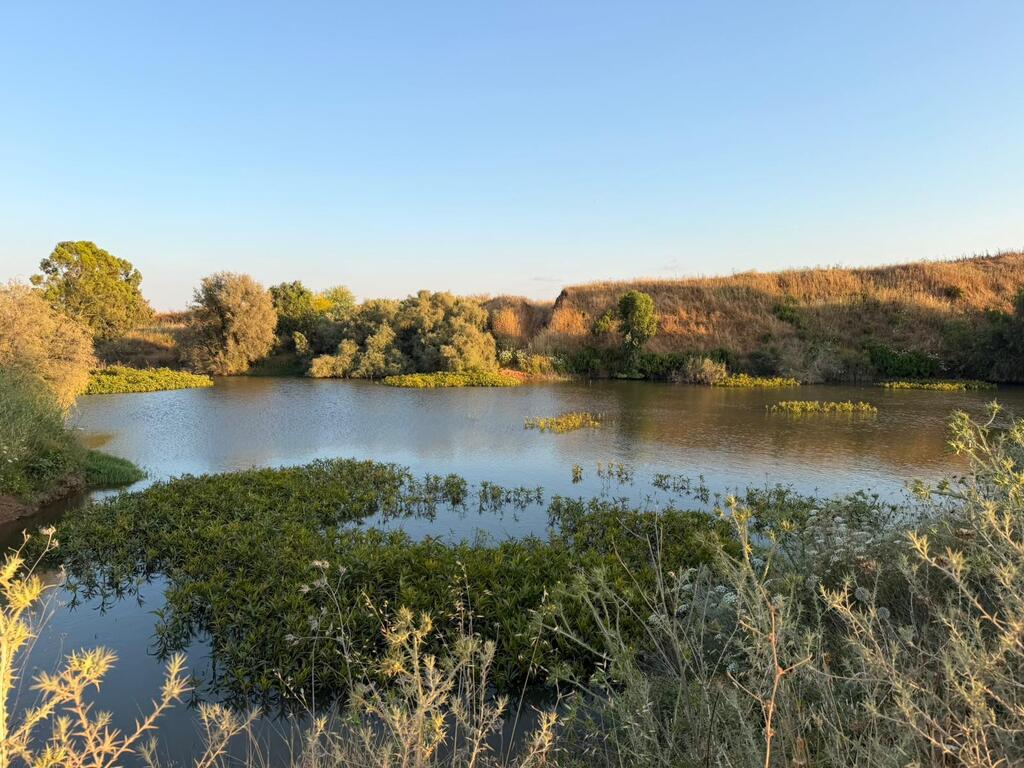
The site is an abandoned quarry that filled with water. It is located in western Lakhish, not far from Yad Natan and Route 35, which connects Ashkelon and Kiryat Gat
(Photo: Eitan Shalmon)
“There aren’t many water sources where we live. If you wanted to swim somewhere beautiful, you’d go north, to Jerusalem or the Negev. Suddenly, we found a place close to home, without crowds, without masses of people and without all the surrounding noise.”
He laughed as he described the feeling.
“It felt like discovering something. A place that was almost secret. No hundreds of people, no barbecues all around. You felt like you had found something special.”
Eitan kept returning to the hidden lake again and again.
“Even my friends from Dimona used to come with me,” he said with a laugh. “We would make special trips because the place really is worth it.”
Then life moved on. The military, studies, travels and journeys across Israel distanced him from the lake.
“For years, I didn’t visit it at all,” he said. “Then a friend mentioned that after the rainy winter this year, the place might have filled up again, so I went to check on it.”
What awaited him surprised him.
“It was emotional. Suddenly seeing the place full of water again. But beyond the water itself, the feelings returned too. I experienced that same sense of adventure I had slightly forgotten — going to a quiet, almost unknown place and feeling as if you had discovered something all over again.”
“The entrance into the water is a bit tricky,” he stressed. “The ground is muddy and you need to be careful. Some people like that feeling and some don’t, but it’s important to know what you’re getting into.”
According to Eitan, the reservoir is roughly 100 to 150 meters long and between 15 and 30 meters wide, surrounded by greenery and agricultural fields. The water starts relatively shallow but reaches depths of more than two meters farther in.
“You only need to swim a few meters and suddenly you’re in a large, cool and refreshing pool.”
In recent years, several additions have made access easier.
“There’s a small bridge that lets people cross the muddy area, and there are benches and a seating area. It’s still nature, but a bit more accessible.”
A memorial was recently added at the lake’s lookout point in honor of Chief Superintendent Avi Amar, described as an Israeli hero who was killed during the October 7 battles at kibbutz Be’eri. The surrounding landscape includes wide fields, seasonal wildflowers and open scenery that gives the site an almost northern-Israel atmosphere.
“If I had to describe it in one sentence, I’d say it’s a small piece of the Galilee or the Golan in the heart of the Shfela,” Eitan said with a laugh. “As if someone brought northern Israel to Kiryat Gat.”
As with any lesser-known water site, questions about water quality inevitably come up.
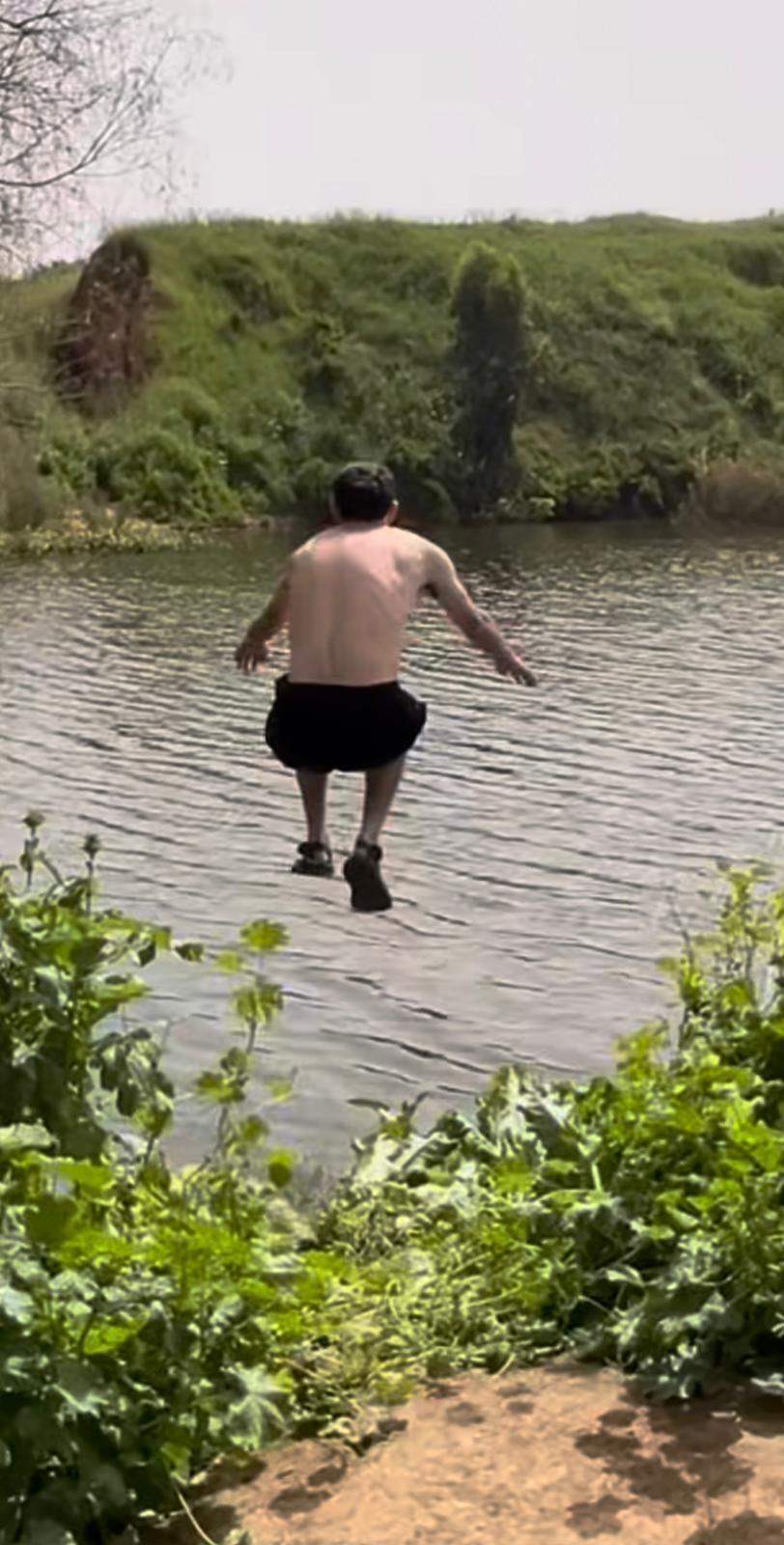
Eitan Shalmon jumping into water of Otzem Lake
“I’ve heard people claim it’s runoff from greenhouse irrigation,” he said. “But even if that’s true, it’s not polluted water. Beyond that, the signs at the site say the water comes from Yoav Stream and collects in the quarry.”
Still, he adds a disclaimer.
“I haven’t taken lab samples. I’m not a hydrologist or a water researcher. Everything I know is based on the signs at the site, people from the area and checks I made myself. By the way, I’ve been swimming there for 10 years and I still haven’t grown a tail.”
In his estimation, anyone hoping to see the lake at its best should not wait too long.
“The water is in excellent condition right now. I estimate that within a month, the water level will start dropping. This is probably the best time to visit.”
Alongside launching his new career as a tour guide, Eitan also runs social media pages that combine his love of nature, humor and personal stories.
“I’m trying to bring something authentic,” he said. “Not just film a beautiful place and tell people to comment for the location. I want to show nature as it really is and also talk about life itself. Not everything is perfect.”
One issue especially important to him is making nature accessible to the public.
“This lake isn’t mine. It belongs to everyone. I share it to encourage people to leave the house, get off their phones, get out of bed and experience a moment in nature. Personal time, family time, couple time — everyone in their own way.”
How to get there: Yoav Lake is located in western Lachish, near moshav Otzem and moshav Yad Natan, not far from Route 35 connecting Ashkelon and Kiryat Gat. According to Eitan Shalmon, the easiest route is to reach the Yad Natan area and walk about 10 minutes to the lake. In recent years, an access path was prepared and a small bridge was built across the Yoav Stream area leading to the reservoir.
Warning: Yoav Lake has no lifeguard services and entering the water is entirely at visitors’ own risk. Entry involves muddy, slippery ground, so caution and good judgment are advised. Water depth varies and may exceed two meters in the reservoir’s central section.