

Palmyra, an ancient city located in present-day Syria, stands as one of the most significant archaeological sites in the region due to its exceptional cultural heritage and historic ruins. Declared a UNESCO World Heritage Site in 1980, Palmyra has faced immense destruction, particularly during Syria’s civil war. The city endured catastrophic damage following its occupation by the terrorist group ISIS nearly a decade ago.
In December 2024, following the liberation of Syria from Bashar Assad’s regime, a multidisciplinary team of experts conducted a comprehensive field study in Palmyra. The team aimed to evaluate the current condition of the city’s archaeological monuments and residential areas, comparing their state to that before the uprising against Assad in 2011.
“Our mission was to raise awareness, both locally and internationally, about the grave threats facing Palmyra’s cultural heritage,” explained Dr. Isber Sabrine, a Syrian archaeologist and a member of Spain’s National Research Council. Sabrine co-authored the report alongside contributions from returning refugees, archaeologists, and local residents of Palmyra.
The report outlines the historical and contemporary challenges Palmyra has faced, including decades of political oppression under Hafez al-Assad (1971–2000) and Bashar Assad (2000–2024), as well as the extensive destruction wrought by ISIS during its control of the city.
Palmyra’s historical and cultural significance
Situated in an oasis, Palmyra was once a major hub for caravan trade routes, such as the Silk Road, connecting the Parthian and Roman Empires. The city’s documented ruins, spanning approximately 4.6 square miles, include areas that have been entirely destroyed. One such area is the Efqa oasis, which once encompassed four square kilometers of lush greenery but now lies barren, with its vegetation dried up and lifeless.
HTS arriving in Palmyra


A handful of farmers who have returned to their land are struggling to salvage what remains of their palm and olive trees. However, 80% of the city’s buildings are either destroyed or at risk of collapse, and the landscape is littered with mines and unexploded weapons. Basic necessities such as water, electricity, internet, education, and health care are practically non-existent, leaving the remaining population in a state of extreme poverty.
Widespread destruction of archaeological monuments
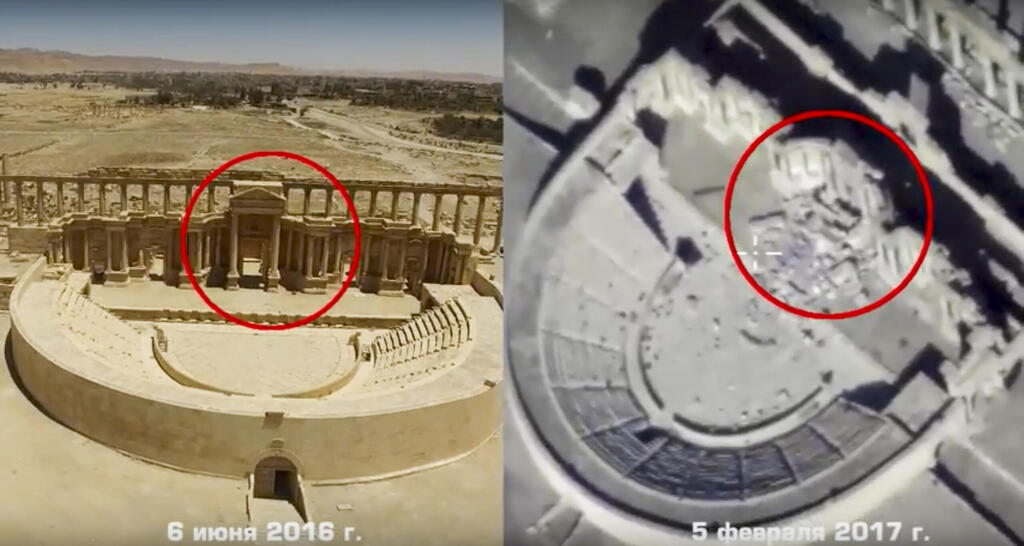
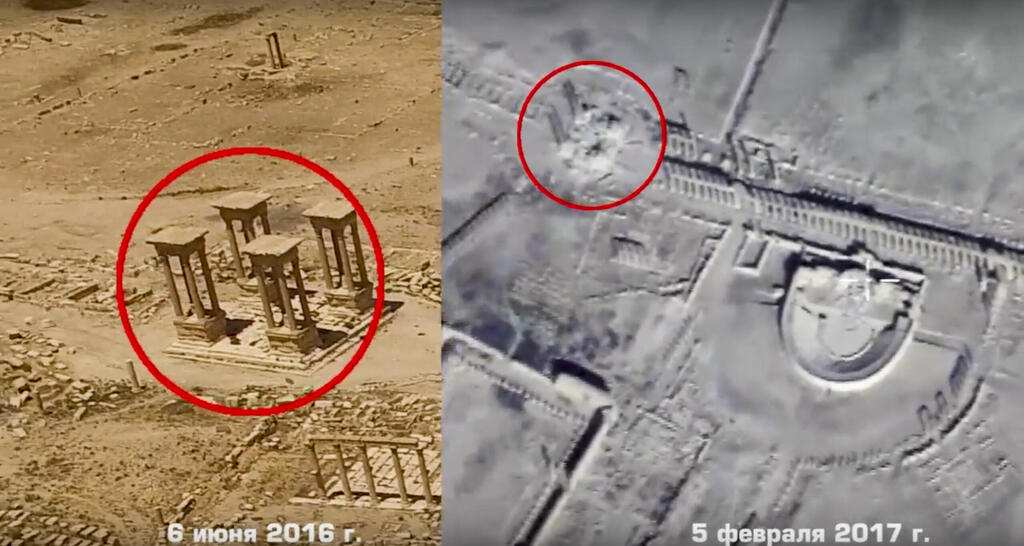
To date, only 10,000 people — roughly 10% of Palmyra’s pre-civil war population of 100,000 — have returned to the city. The report documents damage to 12 of Palmyra’s most important archaeological monuments, including Roman-era structures such as the second-century theater and tetrapylon (a monumental structure with four gateways), the third-century Diocletian’s Camp, the 13th-century Fakhr-al-Din al-Maani Castle, the first-century Valley of the Tombs, and the Palmyra Archaeological Museum.
The tetrapylon’s columns were completely demolished, reduced to rubble. The 2,200-year-old Temple of Baal Shamin, dedicated to the Canaanite sky god Baal Shamin, was obliterated, leaving no trace of its grandeur. The Roman theater suffered severe damage from bombings, and there is evidence of illegal excavations carried out by looters.
The Palmyra Archaeological Museum was also heavily damaged, with statues vandalized by intruders and airstrikes leaving the building structurally compromised. Although the museum is no longer operational, guards from the Directorate of Antiquities and local volunteers are working to protect it without any support from the new administration.
Challenges for preservation and recovery
The report underscores that the preservation of Palmyra’s heritage is inextricably linked to the return of its population. “The city faces monumental challenges due to the destruction caused by violent conflict, which has led to the mass displacement of its residents,” the report states. Rebuilding infrastructure and creating livable conditions are critical priorities to encourage the return of the local population.
(Photo: Russian Defense Ministry Press Service, AP)
“Without adequate housing, essential services, and economic opportunities, the return of residents will remain limited. This, in turn, hampers the ability of professionals and local workers to dedicate their efforts to the preservation of Palmyra’s heritage,” explained Sabrine.
Get the Ynetnews app on your smartphone: Google Play: https://bit.ly/4eJ37pE | Apple App Store: https://bit.ly/3ZL7iNv
The authors of the report hope to inspire both local and international communities to recognize the urgent threats facing Palmyra — a city referenced in Jewish texts, including its connection to King Solomon — and the pressing need to restore its historic sites.
“The findings highlight the critical need to implement restoration and reconstruction strategies for both the archaeological site and the modern city. This is essential not only to preserve one of the world’s most important heritage sites but also to facilitate the return of its people,” concluded Sabrine.
The sands of time are running out for Palmyra, and without immediate action, the remnants of this ancient city may be lost forever.