

Most Israelis who fly to Thailand are looking for white beaches, seaside massages and sunset cocktails. But for Ofek Edri, 25, a content creator from Afula, and his partner Neta Marko, 23, Thailand became the place where they decided to say yes to things that looked like bad ideas.
“We’re not a normal couple,” Ofek tells ynet. “We do everything together, whether it’s something we like or something we connect to less. Even if one of us is less into a certain experience, we still try it together. At the end of the day, we’re together all the time, and each of us also does things for the other. That’s our way of making it work.”

Ofek entered the world of social media five years ago. “At first we uploaded funny videos and pranks,” he says. “Slowly, the audience grew and we reached 70,000 followers on TikTok. I saw bloggers around the world traveling, filming and documenting their lives, and I told myself there was no way I was missing out on that. You only live once, so we decided to fly abroad for the first time, to Thailand.”
Tasting life
The first stop on their trip was Pattaya, a popular tourist city also known for its problematic reputation, including sex tourism, bars and nightlife. But Ofek insists there is another side to the city. “It’s definitely not the first place people think of when they talk about a young couple,” he laughs. “But again, we’re not a regular couple.”
According to him, the city has different faces. “There’s Soi 6, where you have the bars, the dancing and everything people imagine when they hear ‘Pattaya.’ And there’s Walking Street, which is much more touristy, with clubs, shows, attractions and a lot of people from all over the world. Whoever goes to those areas will see that. Whoever doesn’t want to does not have to be there. Pattaya also has beaches, trips, attractions and many other things.”
One of their most memorable experiences in Pattaya was a close encounter with elephants. “The elephant trip was fascinating,” Ofek recalls. “You don’t look at them from afar. You touch them, walk next to them, and suddenly find yourself standing with them in the water. Seeing their size up close is a feeling that’s hard to explain.”
Another surprise for the “crazy couple” in Pattaya was how easy it was to rent jet skis. “In Israel, you can’t get on a jet ski without the proper marine license, and rightly so,” Ofek says, noting that he does not have one. “In Thailand, everything is much simpler. You sign a few clauses, get a short briefing and go out on the water.”
He says that simplicity is exactly why caution is required. “It’s an insane experience, but also dangerous if you don’t respect the rules and the sea.”
After the brief safety explanation, he opened the throttle. “You can’t explain that feeling,” he says. “You’re racing across the water, Pattaya’s coastline is behind you and the wind is in your face. That’s why people say about Thailand: ‘If you haven’t been there, you won’t understand.’”
Their second stop was Phuket. “We were looking for an open barber shop and couldn’t find one,” Ofek recalls. “Suddenly I saw someone with a plastic chair in the middle of a parking lot and said to myself: There is no way I’m not getting a haircut here.”
What looked like a perfect idea for a video quickly became a test of endurance. “He put a white towel on me, and the whole place was full of smells, sweat and hair from the previous haircut. Someone had been there before me and had sweated into the towel, and I just sat there feeling like my whole body was itching.”
Still, he never thought of getting up. “It was one of the worst and best things at the same time. On the one hand, I wanted to run away. On the other, I knew that was exactly why I came, to see how people really live.”
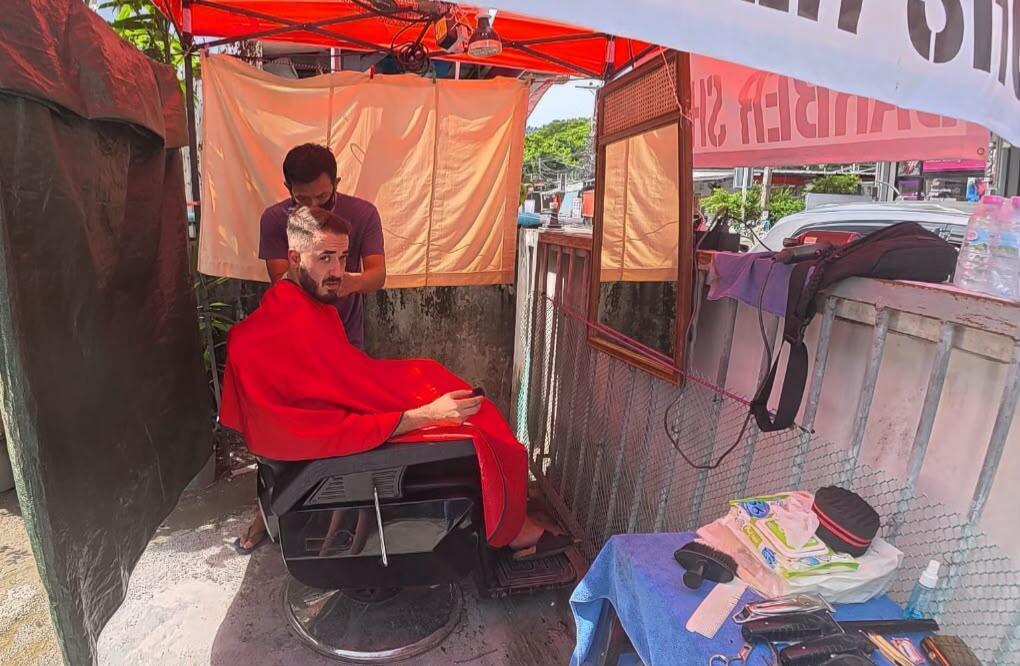
Ofek getting a haircut
(Photo: Neta Marko)
After the parking-lot haircut, it was time to eat. At Kamala Market, far from the bustle of Patong and Phuket Town, the two found a local night market and decided to take the culinary adventure one step further.
“Suddenly Neta says to me: ‘There’s crocodile here!’” Ofek laughs. “At first I thought she meant a statue or something.” She did not. “I went to the stall and saw they were really selling crocodile meat.”
Neta admits she was the one who pushed for the adventure. “In Israel, I always said I eat everything,” she laughs. “But in Thailand I suddenly understood that it’s less simple than I thought.”
Ofek says tasting crocodile meat was also a small battle between curiosity and the natural instinct to run away. “It’s a little more like schnitzel and a little less like steak,” he says, trying to describe the taste. “But honestly? It’s really good.”
From there, the road to scorpions, crickets and even durian, the iconic fruit known for its strong smell, was short. “Once you get into it, you want to try everything,” Neta says. “But the scorpion was the hardest for me to eat.”
‘When we lifted the blanket, we found a urine stain’
Thailand, however, soon showed them its less pleasant side. One of the hardest experiences of the trip began on an ordinary evening in Phuket.
“The hotel cost us 60 shekels per night for a couple,” Ofek says. “And that’s not an unusual price in Thailand. We had already slept in hotels at similar prices, and even lower, and got very good places.”
After a long day of filming, they returned to the room. “I put my head on the pillow and started editing the videos. Suddenly I saw a urine stain on the blanket.” At first, he thought it was an isolated stain. “But then I lifted the whole blanket and saw it was everywhere.”
Neta still shudders when she remembers the moment. “It was just wow.” The two immediately went down to the reception desk to complain. “I wanted a refund for the night that was ruined,” Ofek says. “But they didn’t agree. So we took our things and left.”
Leaving Phuket became the young couple’s first jarring lesson in price discrimination against tourists. “We understood from Grab and Bolt that a ride from Phuket to Krabi should cost between 1,500 and 2,000 baht,” Ofek says. “But the moment we went out into the street with our suitcases, reality looked different.”
A taxi driver approached him and asked where they needed to go. “I told him Krabi, and he immediately said 3,000 baht.” Ofek refused to pay that amount and tried to book a ride through an app. “Suddenly the first driver I chose sent a message saying he wanted more money. I ordered another driver, and he canceled too. Then another canceled. And another. I didn’t understand what was happening.”
Meanwhile, the same taxi driver remained nearby. “He looked at me and said: ‘I told you that you wouldn’t find that price.’” As if that were not enough, the price kept rising. “3,000 baht became 3,500, and then they were already asking me for 4,000 baht for the same ride.”
Ofek tried to get out of the situation. “I took the bags on my back and started walking in the heat, hoping that if I got farther away, I’d manage to order a taxi from somewhere else.”
It did not work. “In the end I understood I had no choice and paid an inflated price. I don’t know if there was coordination between the drivers, if that’s the system or if I just fell on a bad day.”
Traveling together for a month and a half, filming every moment and living almost 24 hours a day with each other is not easy. “Like every couple, we also fight,” Ofek says with a smile.
“We’re not a perfect couple, and what’s beautiful about our relationship is that we know how to rise above everything,” Neta adds. “Even when we’re most angry at each other, we keep going on our path and toward our goal. We keep filming.”
After the tourist areas and the chase for another experience that would film well for social media, the two arrived in Krabi and discovered a different Thailand, quieter, calmer and one that reminded them why they had boarded a plane for the first time in their lives.
“In Krabi, people smile at you, and it’s a real smile,” Neta says. “They’re really sweet here. Good people who want to help. In all the places we had been until then, we felt everyone only wanted money from us. More money and more money.”
Ofek felt the same. “In Phuket, tourism is so big and changes so quickly that every 10 seconds a new tourist arrives and the previous one won’t come back. Because of that, sometimes there is no real appreciation for tourists. All that matters is that you spend more money.”
In Krabi, he says, the feeling was completely different. “Here you feel that they want you to stay. They want you to come back. They don’t want to rip you off once and say goodbye. You feel it in the looks, in the behavior and in the way people talk to you.”
Neta sums it up in one sentence: “In Krabi, we felt more like guests and less like customers.”
After the filthy hotel, the overpriced taxi and the arguments along the way, the “crazy couple’s” favorite experience was waiting for them in the jungle.
“My best experience in Thailand so far was the monkeys,” Neta says without hesitation. It was a walking trail through Krabi’s tropical jungle, leading to viewpoints and secluded beaches.
“You go into nature and suddenly there are so many monkeys around you,” she recalls. “Whole groups of them. You walk along the route and they are just there with you the whole way.”
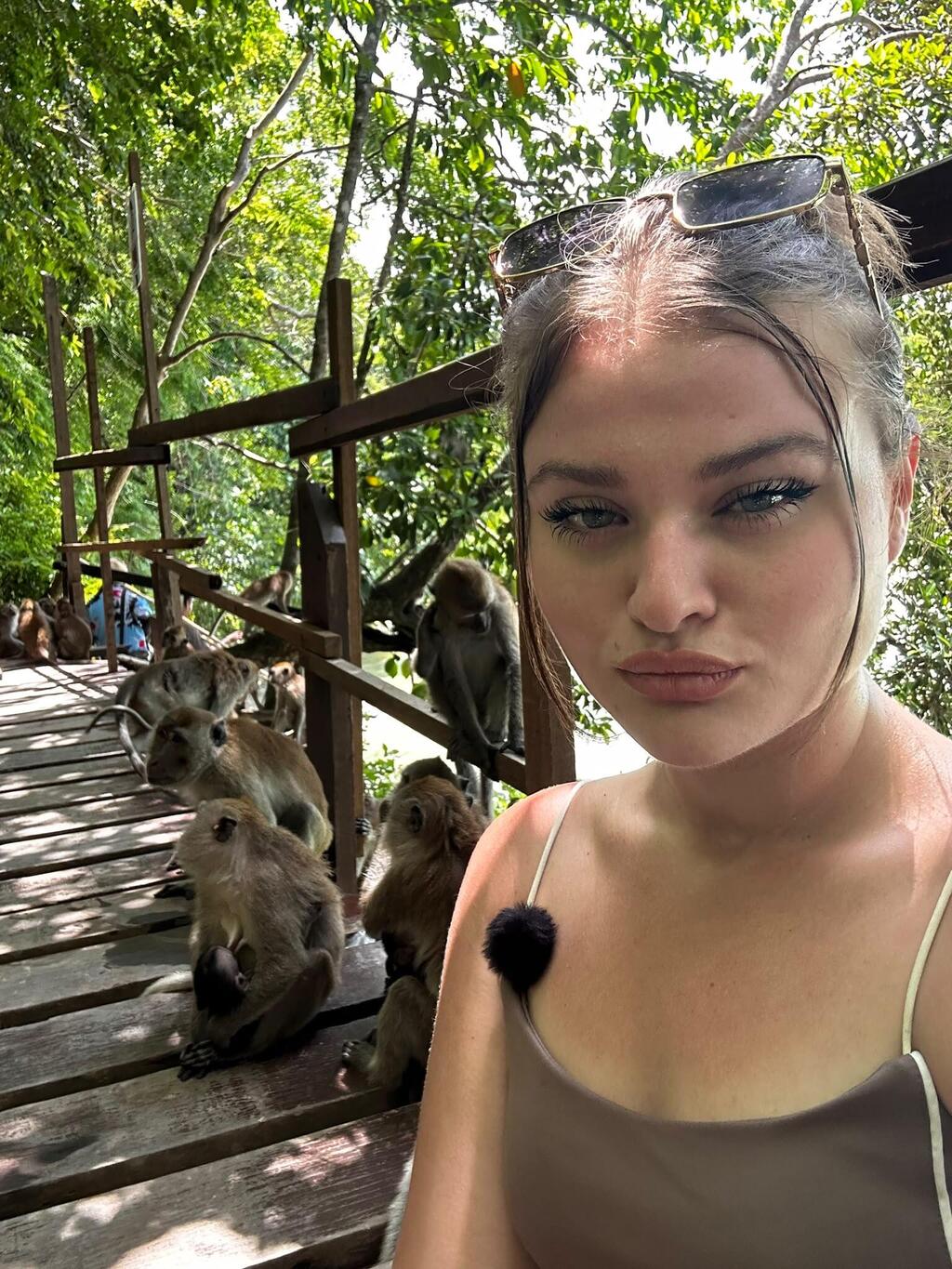
Selfie with monkeys in Krabi
(Photo: Neta Marko)
According to Neta, there are two routes. “One is relatively easy, with stairs and a moderate climb, and the other is much more challenging.”
Ofek says the choice of route was influenced by the tropical weather. “It started drizzling and it was very hot, so we decided to take the shorter route. It’s a real jungle,” he says. “There’s an organized trail that leads either to a hidden beach you can’t reach by car, or to a high viewpoint with an insane view for photos. You walk through the forest, and monkeys are all around you from every direction. It feels like another world.”
In the end, their first trip abroad changed something deeper in them. “This was the first destination we flew to,” Neta says. “Before that, we had never flown.”
Ofek adds honestly: “It was the first time I ever got on a plane. This trip developed me personally and made me understand things and mature. Everything I thought I understood, I discovered I didn’t understand at all.”