

Passengers at Ben Gurion Airport are facing another complication during the peak summer travel season after the Israel Airports Authority began enforcing a rule allowing checked baggage to enter the sorting system only three hours before departure, rather than four.
The change, enforced since August 3, is hitting Israeli airlines particularly hard. Unlike most foreign carriers, which generally open check-in counters only three hours before departure, Israeli airlines often operate common counters that serve multiple flights and have traditionally opened earlier during busy periods to help spread passenger loads.
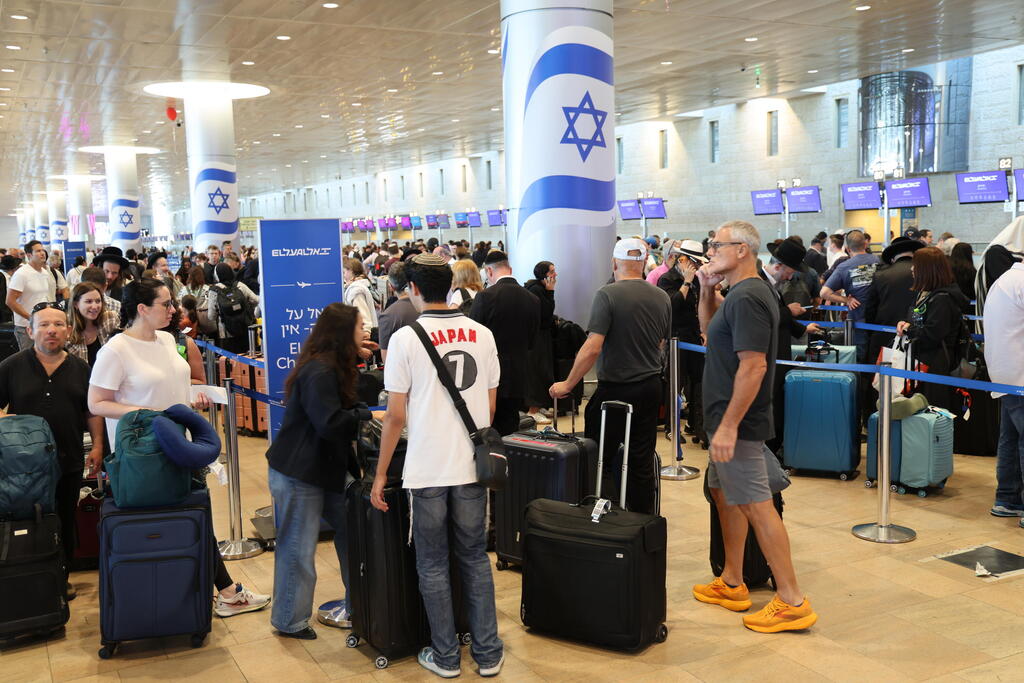
Ben Gurion Airport
(Photo: Yariv Katz)
The Airports Authority says baggage counters were never supposed to accept bags four hours before departure and that early opening violated existing procedures. In practice, however, the earlier system helped Israeli carriers move passengers through check-in more efficiently because their counters are not always divided strictly by individual flight.
Now, even if Israeli airlines open their counters four hours before departure, baggage sent into the system that early may not be handled because the relevant sorting areas are not yet operating.
During the first days of the new enforcement, dozens of suitcases reportedly became lost in the baggage system. Airlines initially tried assigning staff to handle bags arriving early, but that diverted manpower from other operations, prompting them to reduce check-in hours to three hours before departure, in line with most foreign carriers.
The result is less flexibility for passengers and airlines alike.
Travelers who arrive early to avoid congestion, leave extra time for security or spend more time in duty-free shops and airport lounges can no longer necessarily complete check-in when they arrive. The change also makes it harder for Israeli carriers to manage overlapping waves of departures during peak hours.
The Airports Authority says there is no reason for passengers to arrive more than three hours before their flight. It also insists that the three-hour rule has been in place since November 2025 and that airlines and ground-handling companies were formally notified then.
The authority rejected claims that the change was driven by a shortage of baggage-handling staff. It said the operational division responsible for baggage employed 1,811 workers in July 2026, compared with 1,753 in July 2025.
“Three hours for sending baggage is the accepted international standard,” the authority said. “Ground-handling companies and representatives of all airlines were already informed on November 18, 2025, that the sorting areas open three hours before departure and that bags sent four hours before will not be handled.”
It added that exceptions can still be arranged for special groups or unusual cases.
The baggage issue comes on top of already heavy congestion at Ben Gurion Airport, driven by peak summer demand, aviation disruptions in Europe and other operational pressures.
Israeli carriers accounted for more than 60% of the airport’s traffic in July, making the new baggage restrictions especially significant for a large share of departing passengers.
Parking pressure adds to the chaos
Congestion is not limited to the terminal.
Ben Gurion Airport’s short-term parking lots have repeatedly been closed because of high demand, with many travelers choosing the closer covered facilities rather than long-term lots that require shuttle rides.
Although the Airports Authority website states that vehicles left in short-term parking for more than 24 hours may be towed at the owner’s expense, enforcement is limited in practice. Some passengers simply pay the maximum daily parking rate, which can reach NIS 135 during peak periods and NIS 100 during regular periods, in exchange for the convenience of staying close to the terminal.
The Airports Authority has urged passengers and those accompanying them to use public transportation whenever possible because of the high demand.
For travelers already dealing with packed terminals and crowded parking facilities, the new baggage rule adds another layer of uncertainty: arriving early no longer necessarily means getting through the airport faster.