

Next time you fly and need something from a flight attendant, think twice before reaching out. It turns out one of the most troubling issues for cabin crews today is not drunk passengers or runway delays, but passengers who simply cannot keep their hands to themselves.
Reports and interviews in leading media outlets around the world are now highlighting the scale of the problem, with veteran crew members describing a reality in which their personal space is violated again and again. Their accounts reveal that many passengers feel completely free to tap flight attendants on the shoulder, pull at their uniforms and even pinch them — just to ask for a glass of water or have a tray cleared.
(Photo: Krakenimages.com / Shutterstock)
Three veteran flight attendants recently spotlighted the issue, sharing their experiences on an episode of the aviation podcast “Jumpseat Chronicles.” Michelle Montez, a flight attendant with 20 years of experience, said physical contact by passengers has become routine. “It’s almost a rare occurrence when it doesn’t happen,” she said.
Her colleague, flight attendant Darion Foy, agreed and described even more extreme situations. “You can talk to any flight attendant for any airline, and they will all agree that that’s something that we cannot stand and that we deal with so often, it’s insane,” he said. Foy also shared that during his career, there have been cases in which passengers went so far as to pinch him on the backside during a flight to get his attention.
Flight attendant Joshua Boyd made clear on the same podcast that crews would much rather passengers use the call button above their heads, even though it is one of the most hated sounds for flight attendants on a plane. “You do not have to touch me to get my attention,” Boyd said. “I just want to hear your sweet voice.”
The growing attention to the issue has also prompted deeper reporting by other media outlets. In an interview with The Washington Post, Sam Wilkins, a veteran flight attendant and first vice president of the Southwest Airlines flight attendants’ union, said the problem stems from a basic lack of understanding of boundaries. He noted that people would not normally tap a server in a restaurant to place an order, yet some passengers seem to believe those norms change once they board a plane.
As part of efforts to address the phenomenon and set clear boundaries in advance, many flight attendants around the world have begun adopting an active solution: wearing prominent pins or patches on their uniforms that state plainly in English: “No Touching.” The goal is to make clear to passengers seeking service, even before they speak or reach out, that a crew member’s personal space is not up for grabs.
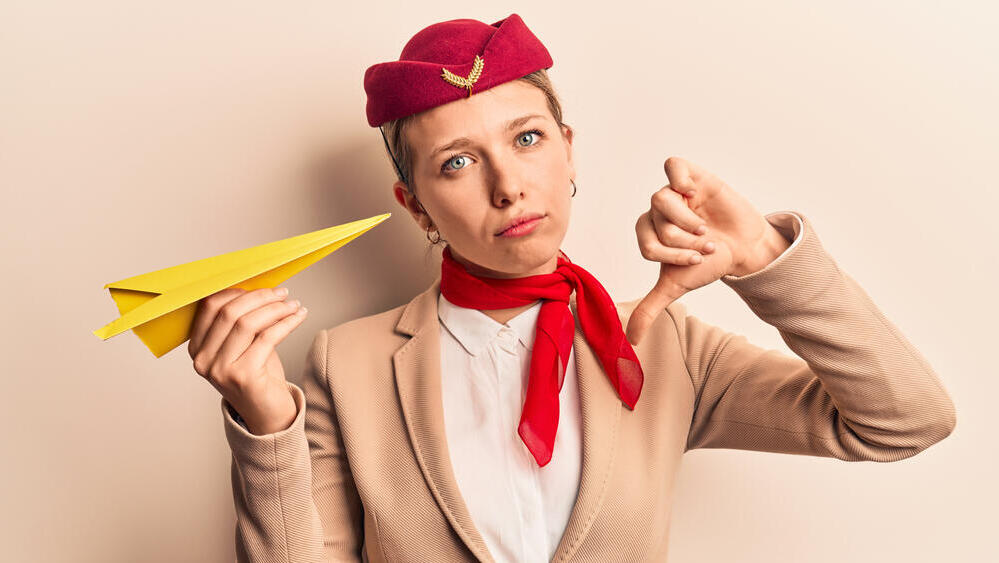
And that’s sometimes how it looks from the passengers’ side
The current complaints from flight attendants are also backed by hard data showing this is not a new problem. As early as 2018, a broad survey by the Association of Flight Attendants-CWA raised alarming figures, finding that about 18% of cabin crew members reported experiencing physical sexual harassment by passengers.
Aviation industry data show that incidents of violence on planes surged during the COVID-19 pandemic. Although the numbers have since declined somewhat, they remain far higher than before the pandemic. This new reality in the skies is exactly why flight attendants’ fight for their personal space has become so important today.
So what is the recommended course of action? Crew members say the rule is simple: use words. And if the noise of the plane is too loud or the flight attendant is a short distance away, it is better to press the call button above your head. Flight attendants say that although they hate the sound, they would rather passengers drive them crazy with it than reach out and touch them.