

It is one of the most addictive platforms in today’s digital world. It is not new, but for Israelis it has become almost essential — a way to ease tension and satisfy curiosity amid the challenging realities of the Middle East.
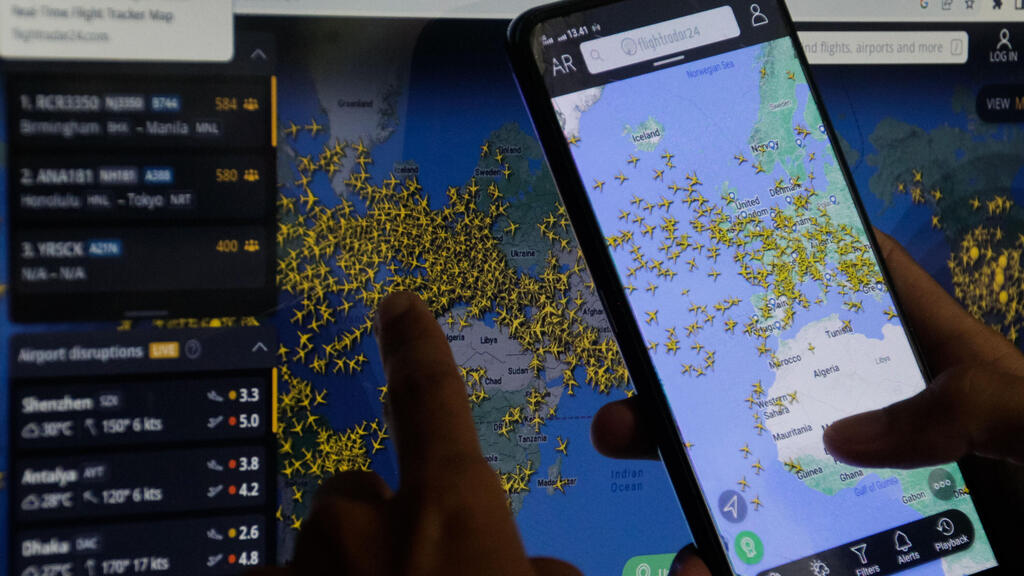
Flightradar24 is a global flight-tracking service that displays real-time air traffic on a map, via its website and mobile apps. It allows users to follow virtually any flight in the world — whether for open-source intelligence or for personal use. There is no real need to check the arrivals board at Ben-Gurion Airport to see when a friend is landing. You can simply track the aircraft itself.
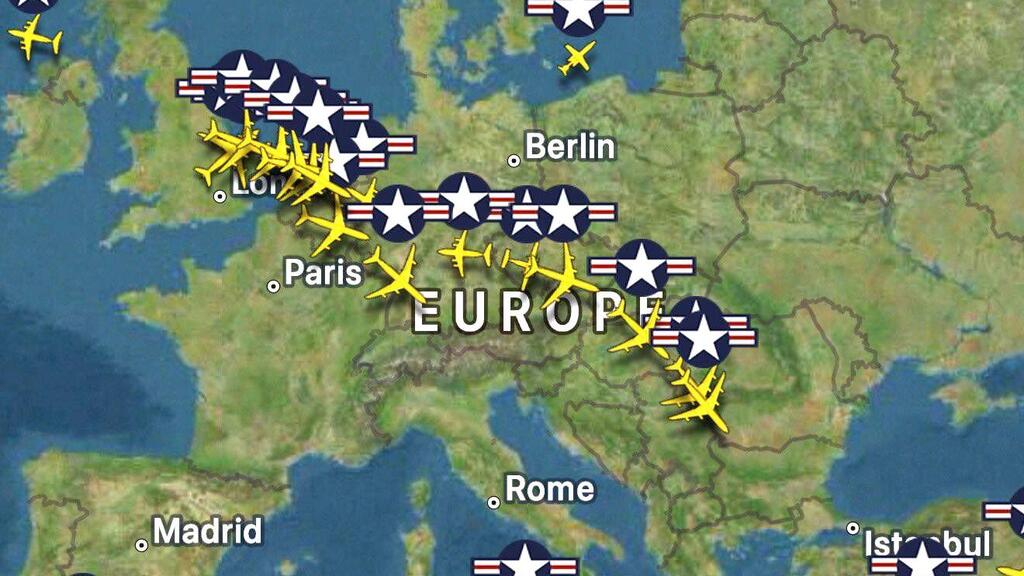
Flightradar24 pulls data on location, altitude, speed, heading and route, and connects it to airline and airport schedules. When then-U.S. House Speaker Nancy Pelosi flew to Taiwan in 2022 under threats from China, 2.92 million people tracked her plane, with about 708,000 watching simultaneously at the peak. When Queen Elizabeth II’s coffin was flown from London, more than 5 million users set a world record for tracking a single flight. So how does it work?
Two Swedish aviation enthusiasts who turned a hobby into a global obsession
The project began in 2006 as a small initiative by two aviation enthusiasts in Sweden, who set up a modest network of receivers across northern and central Europe. In 2009, the network opened to data contributions from around the world. Today, the company behind the site, Flightradar24 AB, is based in Stockholm and led by CEO Fredrik Lindahl.
Its global breakthrough came in 2010, when Iceland’s Eyjafjallajokull volcano paralyzed European air travel and news networks used the site to illustrate empty skies.
How does the site see aircraft?
To reduce blind spots and provide an accurate picture, the system combines several layers of data. At its core is ADS-B technology. Most aircraft continuously broadcast their position and altitude. Those signals are received by a vast network of more than 50,000 ground-based receivers worldwide.
Most of the receivers are operated by volunteers who host the equipment. The company even sends receiver kits to people in areas with limited coverage and provides them with free premium subscriptions.
To cover oceans and remote areas, the site also uses ADS-B data captured directly by satellites. Aircraft tracked this way appear in blue on the map. However, satellite data can be delayed by up to about 10 minutes, so it is generally displayed only when ground coverage is insufficient.
flightradar24
(Photo: Setyawan Utomo Hadi / shutterstock)
If an aircraft does not broadcast full ADS-B data, the system uses MLAT, calculating its position based on the time differences in which the signal reaches at least three separate receivers. In addition, the platform integrates other data sources, including operational aviation data, to complete the picture.
Why do planes disappear, and why is some information hidden?
Many people assume that if a flight does not appear on Flightradar24, it does not exist. That is incorrect. There are several reasons why flights may not appear or may suddenly vanish from the screen.
The first involves legal blocking and privacy. Private aircraft owners can request that their data be blocked through the U.S. Federal Aviation Administration’s Limiting Aircraft Data Displayed program. Another program, called PIA, allows owners to use a temporary anonymous address so the flight cannot be linked to its registration. The site’s privacy policy states that only in rare cases is information personally linked to a specific individual.
A second reason involves sensitive aircraft. High-profile planes, such as the U.S. president’s Air Force One, or certain military and government aircraft, may be intentionally blocked entirely. Another factor is GPS interference. Users sometimes see aircraft flying in perfect, illogical circles or jumping between locations. The company has previously said such anomalies can result from electronic warfare and regional GPS jamming that the system does not always filter out.
A beginner’s guide: Finding the action
Before diving into major dramas, most users open the app for a simple reason: A friend or family member is on a flight and they want to know when it will land.
The easiest way is to use the search bar and enter a flight number, which takes you directly to the aircraft on the map. If you do not have the flight number, you can search by route, for example from Tel Aviv to London. Once you click on the plane, you immediately see the most up-to-date estimated arrival time and know exactly when to leave for the airport.
After mastering the basics, those looking for real-time drama often search for code 7700 — the international emergency squawk code. Aircraft transmitting it appear in red on the map. Other notable codes are 7600, indicating loss of radio contact, and 7500, signaling an unlawful interference event such as a hijacking. These are internationally recognized transponder codes.
Another option is the “most tracked” feature, which shows where global attention is focused at any given moment — for example during a snowstorm at a major airport or when a plane is circling due to an engine problem preventing it from landing.
You can track El Al flights. Is that safe?
At this point, one of the first questions that arises is how it is possible to see in real time every aircraft operated by El Al Israel Airlines or other Israeli carriers. Does that not pose a security risk by exposing their precise routes?
The answer lies in a paradox of civil aviation: Transparency underpins safety. The ADS-B technology on which the site relies is an open, unencrypted international safety standard. The signals are broadcast openly and can be received by civilian equipment.
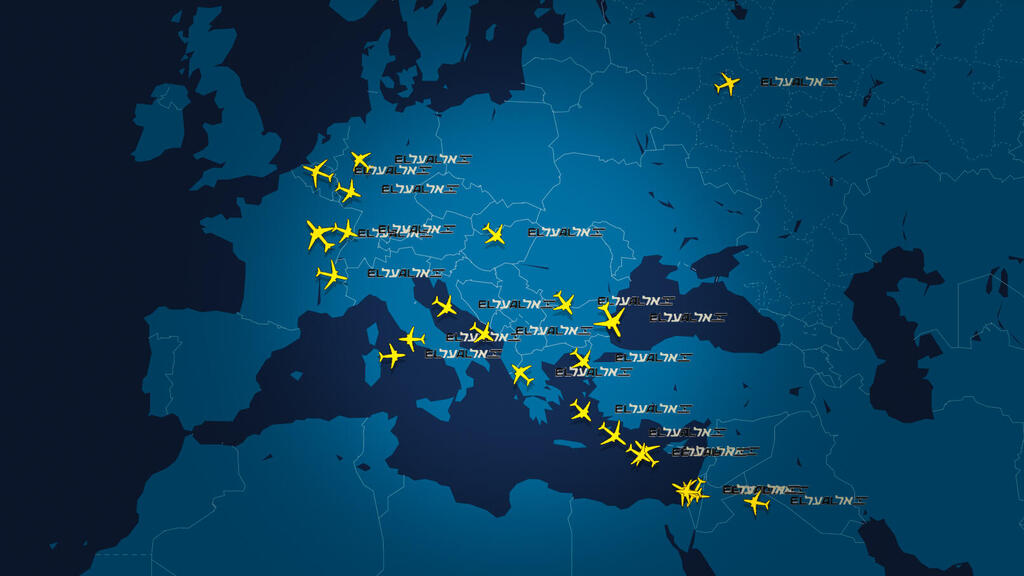
El Al aircraft over Europe in real time
(Photo: flightradar24)
In most major airspaces, regulations require aircraft to transmit using advanced transponders as part of the safety system. The goal is to create a shared air picture for air traffic controllers and aircraft themselves, not merely to prevent individual collisions. In civilian air corridors, aircraft cannot see without being seen.
Security systems address that transparency through other measures, including protective solutions and onboard defense systems that some countries and airlines reportedly install, alongside strict ground and air security procedures — all based on the understanding that an aircraft’s location is effectively public.
When the radar reveals the truth: Flights that made history
Beyond routine tracking, there have been cases in which Flightradar24 data became key evidence in major international dramas.
In May 2021, Ryanair Flight 4978 from Athens to Vilnius was instructed by Belarusian air traffic control to turn around and land in Minsk, citing a bomb threat. After landing, it emerged that the real aim was to arrest an opposition journalist on board. The map showed the aircraft was about 72 kilometers (45 miles) from Vilnius but about 183 kilometers (114 miles) from Minsk when it was diverted — a detail that immediately bolstered claims that the diversion was deliberate rather than an attempt to land at the nearest airport.

Queen Elizabeth II of Britain
(Photo: Phil Noble - WPA Pool/Getty Images)
In August 2023, another dramatic event occurred when the business jet of Yevgeny Prigozhin crashed in Russia, two months after he led a rebellion against President Vladimir Putin. Was it a malfunction or an assassination? According to the site’s data, within about 30 seconds the aircraft dropped more than 8,000 feet from cruising altitude following a series of unusual altitude fluctuations. The data did not explain the cause, but they reinforced assessments that something sudden and abnormal had occurred midair rather than a gradually developing technical failure.
The addiction — and the business
Alongside its free version, the site offers subscriptions for dedicated users. Paid tiers include real-time weather and lightning layers in some packages, a 3D flight view with aircraft models and terrain, and up to three years of flight history under the Business plan.
Beyond that, the company has become a commercial powerhouse. Through its business arm, it sells API services to airlines, developers and organizations, granting direct access to its secured data infrastructure.
So the next time you hear a strange noise in the sky, do not guess. Just open the radar.