

The bone fossil of a child from 1.5 million years ago was recently discovered in Israel in what appears to be a breakthrough in theories about migration of the human race from Africa to the rest of the world, which took place in the prehistoric era.
An Israeli research project discovered the remain in the Jordan Valley and it looks to be the first record of humans migrating from Africa to the area believed to be modern-day country of Georgia, 1.8 million years ago, followed by a second wave that arrived in Israel 1.5 million years ago.
The research, published on Wednesday by the Scientific Reports Journal, and led by researchers from Bar-Ilan University (Dr. Alon Barash), Ono Academic College (Professor Ela Bein), The University of Tulsa (Professor Miriam Belmaker), and Israel Antiques Authority (Dr. Omer Barzilai).
According to the researchers, DNA fossils reveal that human evolution began in Africa around six million years ago. About two million years ago, prehistoric man began migrating from north from Africa, and dispersing throughout Euro-Asia.
One of the most common destinations amongst the African migrants was the area of Tell Ubeidiya (Ovadiah) in the Jordan Valley, the site of a walled Biblical city on a mound near the Jordan River.
The prehistoric site is considered a keystone in archeological and evolutionary studies, and is believed to be one of the only places with remains of human activity from the African migration from as long as 1.5 million years ago.
It upholds the title of being the second most ancient site outside of Africa, following Damanisi in Georgia.
Since its initial excavations in the 1960s, the site has uncovered a surplus of rare animal bone remains, flint and stone tools.
Under innovative leadership, Ovadiah has expanded its archaeological digs to projects of replicating the historic environment of the site.

Through these digs, researchers show that the fossils of animal species in Ovadiah are similar to native-African wildlife. Likewise, many uncovered tools were identical to those found in African archaeological sites.
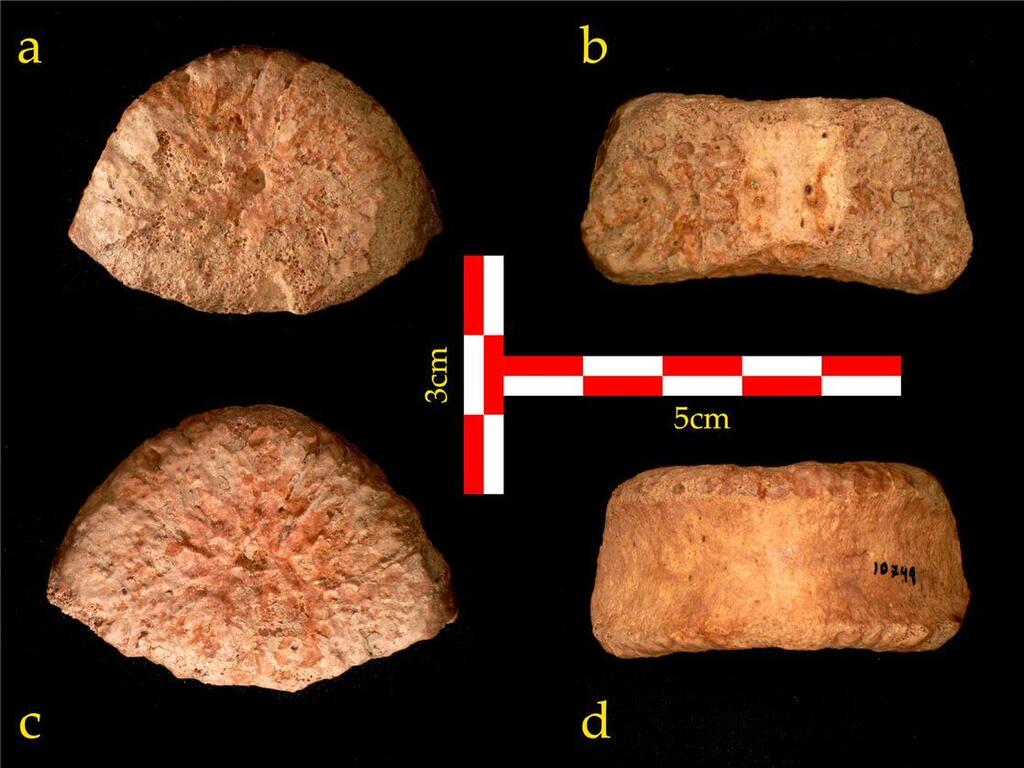
Amongst the discoveries, Professor Miriam Belmaker found a bone remain fitting to a human spine. The bone, dug up in 1966, was examined by Professor Ella Bein and Dr. Alon Barash, who identified it as a spine vertebrae from 1.5 million years ago.
"The bones indicate the existence of several species of humanoids outside Africa during the same period of time (in Georgia and Israel), confirming that migration from Africa occurred, apparently, in waves," said Dr. Barash. "There is an ongoing debate in the professional research on the issue of migration from Africa - whether it occurred as a one-time event, or whether there were a number of waves of immigration.
"Now, we have clear evidence of the presence of ancient humans at the site... These people were different from the people we find in Georgia, based on the difference between the size and shape of their vertebrae."